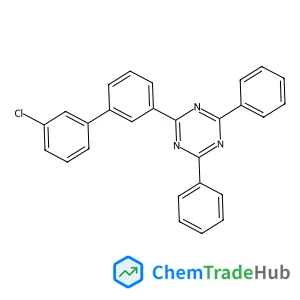
2-(3'-Chlorobiphenyl-3-yl)-4,6-diphenyl-1,3,5-triazine
CAS Number:
1443049-83-9
Molecular Formula:
C27H18ClN3
Krishna N. Tripathi, Devalina Ray, Ravi P. Singh
Functionalized polycyclic pyrrole-azole structures possessing fused six membered and seven membered rings were directly synthesized via ligand-enabled, Pd-catalyzed, site selective, intramolecular cross couplings of N-substituted pyrrole-azoles. C5-H activation in the presence of a reactive C2-H remains a challenge that needs to be addressed and this was targeted to be resolved through the present approach by specifically generating the cyclized products with 83–100% selectivity. The featured methodology provides a novel disconnection for the synthesis of pyrrole containing alkaloids and medicinal compounds.
Qiang Yan, Dehui Han, Yue Zhao
DOI: 10.1039/C3PY00804E
Antonella Ilenia Alfano, Angela Zampella, Ettore Novellino, Margherita Brindisi, Heiko Lange
DOI: 10.1039/D0RE00329H
Tile Gieshoff, Holger Frey
DOI: 10.1039/C3PY00707C
Tomohisa Miyazawa, Misao Hiza, Isao Nakamura, Tadahiro Fujitani
DOI: 10.1039/D1RE00232E
Arindam Sannigrahi, Shogo Takamuku, Patric Jannasch
DOI: 10.1039/C3PY00513E
Lewis R. Hart, Josephine L. Harries, Barnaby W. Greenland, Howard M. Colquhoun, Wayne Hayes
DOI: 10.1039/C3PY00081H
Bruce D. Adkins, Zach Mills, James Parks II, M. Brennan Pecha, Peter N. Ciesielski, Kristiina Iisa, Calvin Mukarakate, David J. Robichaud, Kristin Smith, Katherine Gaston, Michael B. Griffin, Joshua A. Schaidle
DOI: 10.1039/D1RE00007A
Pradeep Lamichhane, Ramhari Paneru, Linh N. Nguyen, Jun Sup Lim, Pradeep Bhartiya, Bishwa Chandra Adhikari, Sohail Mumtaz, Eun Ha Choi
DOI: 10.1039/D0RE00248H
Tao Xing, Xianzhu Yang, Liyi Fu, Lifeng Yan
DOI: 10.1039/C3PY00429E
When handling 2-Chloro-1,2-bis(4-methylphenyl)ethanone (CAS: 71193-32-3), it is ...
4-Ethoxy-3-(5-methyl-4-oxo-7-propyl-1,4-dihydroimidazo[5,1-f][1,2,4]triazin-2-yl...
Methyl 3-Oxo-4-Androsten-17-Carboxylate (CAS: 2681-55-2) should be stored in a c...
(R)-3-Amino-4-(3-hexylphenylamino)-4-oxobutylphosphonic acid is primarily used i...
2-Methyl-2-propanyl 3-amino-3-carbamoyl-1-azetidinecarboxylate (CAS: 1254120-14-...
There are alternative reagents that can be used in synthesis instead of (E)-4-(t...
[2-(3-Chlorophenyl)-1,3-thiazol-4-yl]methanol (CAS: 121202-20-8) is a crystallin...
The market and research trends for Methyl (2S)-[(4S)-2,2-dimethyl-1,3-dioxolan-4...
The market for 1-Bromo-2-isocyanatoethane (CAS: 42865-19-0) is driven by its use...
4-Nitro-D-phenylalanine hydrochloride (CAS: 147065-06-3) is primarily used in re...

Organic & Biomolecular Chemistry (OBC) publishes original and high impact research and reviews in organic chemistry. We welcome research that shows new or significantly improved protocols or methodologies in total synthesis, synthetic methodology or physical and theoretical organic chemistry as well as research that shows a significant advance in the organic chemistry or molecular design aspects of chemical biology, catalysis, supramolecular and macromolecular chemistry, theoretical chemistry, mechanism-oriented physical organic chemistry, medicinal chemistry or natural products. Articles published in the journal should report new work which makes a highly-significant impact in the field. Routine and incremental work is generally not suitable for publication in the journal. More details about key areas of our scope are below. In all cases authors should include in their article clear rationale for why their research has been carried out.