












Cu-Catalyzed asymmetric Friedel–Crafts propargylic alkylation of phenol derivatives
Literature Information
Publication Date
2017-11-06
DOI
10.1039/C7OB02133J
Impact Factor
3.876
Authors
Xiang-Ping Hu
View Original
Abstract
A copper-catalyzed asymmetric Friedel–Crafts propargylic alkylation of electron-rich phenol derivatives with a variety of propargylic esters has been described. With Cu(OTf)2 decorated with a chiral tridentate ketimine P,N,N-ligand as the catalyst, asymmetric Friedel–Crafts propargylic alkylation of 3,5-dialkoxyphenol derivatives proceeded smoothly in high yields and with good to excellent enantioselectivities. The present study suggested that the presence of an electron-rich substituent on the meta-position of phenol is essential for the promotion of Friedel–Crafts propargylic alkylation, and the substrate bearing two electron-rich groups on both the 3,5-positions of phenol tends to give a satisfactory performance.
Related Literature
Self-healing systems based on disulfide–thiol exchange reactions
Mark Pepels, Ivo Filot, Han Goossens
2013-03-13
Paper
DOI: 10.1039/C3PY00087G
Block selective grafting of poly(vinylphosphonic acid) from aromatic multiblock copolymers for nanostructured electrolyte membranes
Arindam Sannigrahi, Shogo Takamuku, Patric Jannasch
2013-05-29
Paper
DOI: 10.1039/C3PY00513E
Kinetic modelling of reactions for the synthesis of 2-methyl-5-ethyl pyridine
Leo Schmid, Peter Wasserscheid, Hannsjörg Freund
2021-05-04
Paper
DOI: 10.1039/D1RE00085C
Modeling biomass hydrothermal carbonization by the maximum information entropy criterion
Alberto Gallifuoco, Alessandro Antonio Papa, Luca Taglieri
2021-03-11
Paper
DOI: 10.1039/D1RE00002K
Numerical analysis of mixing chamber non-uniformities and feed conditions for optimal performance of urea SCR
Risha Raju, Jishnu Chandran R, A. Salih, Kuruvilla Joseph
2020-09-10
Paper
DOI: 10.1039/D0RE00269K
Efficient Ni-based catalysts for the hydrotreatment of lignin dimer model compounds to cycloalkanes/cycloalkanols
Minghao Zhou
2021-01-04
Paper
DOI: 10.1039/D0RE00379D
Improvement of n-butanol Guerbet condensation: a reaction integration of n-butanol Guerbet condensation and 1,1-dibutoxybutane hydrolysis
Xiaoxu Han, Shuaiqi Li, Hualiang An, Xinqiang Zhao, Yanji Wang
2021-07-04
Paper
DOI: 10.1039/D1RE00206F
Intrinsic self-healing of covalent polymers through bond reconnection towards strength restoration
Ming Qiu Zhang, Min Zhi Rong
2013-02-27
Minireview
DOI: 10.1039/C3PY00005B
Bifunctional carbon Ni/NiO nanofiber catalyst based on 5-sulfosalicylic acid for conversion of C5/C6 carbohydrates into ethyl levulinate
Haixin Guo, Yuya Abe, Xinhua Qi
2020-07-30
Paper
DOI: 10.1039/D0RE00153H
You might also like
Compound Q&A
What precautions should be taken when handling 2-Chloro-1,2-bis(4-methylphenyl)ethanone (CAS: 71193-32-3)?
When handling 2-Chloro-1,2-bis(4-methylphenyl)ethanone (CAS: 71193-32-3), it is ...
71193-32-32-Chloro-1,2-bis(4-m...
Compound Q&A
What industries use 4-Ethoxy-3-(5-methyl-4-oxo-7-propyl-1,4-dihydroimidazo[5,1-f][1,2,4]triazin-2-yl)benzenesulfonyl chloride (CAS: 224789-26-8)?
4-Ethoxy-3-(5-methyl-4-oxo-7-propyl-1,4-dihydroimidazo[5,1-f][1,2,4]triazin-2-yl...
224789-26-84-Ethoxy-3-(5-methyl...
Compound Q&A
How should Methyl 3-Oxo-4-Androsten-17-Carboxylate (CAS: 2681-55-2) be stored?
Methyl 3-Oxo-4-Androsten-17-Carboxylate (CAS: 2681-55-2) should be stored in a c...
2681-55-2Methyl 3-Oxo-4-Andro...
Compound Q&A
What are the main uses of (R)-3-Amino-4-(3-hexylphenylamino)-4-oxobutylphosphonic acid (CAS: 909725-61-7)?
(R)-3-Amino-4-(3-hexylphenylamino)-4-oxobutylphosphonic acid is primarily used i...
909725-61-7(R)-3-Amino-4-(3-hex...
Compound Q&A
What regulatory guidelines apply to 2-Methyl-2-propanyl 3-amino-3-carbamoyl-1-azetidinecarboxylate (CAS: 1254120-14-3)?
2-Methyl-2-propanyl 3-amino-3-carbamoyl-1-azetidinecarboxylate (CAS: 1254120-14-...
1254120-14-32-Methyl-2-propanyl ...
Compound Q&A
Are there alternatives to (E)-4-(tert-Butoxy)-4-oxobut-2-enoic acid (CAS: 135355-96-3) in synthesis?
There are alternative reagents that can be used in synthesis instead of (E)-4-(t...
135355-96-3(E)-4-(tert-Butoxy)-...
Compound Q&A
What are the physical and chemical properties of [2-(3-Chlorophenyl)-1,3-thiazol-4-yl]methanol (CAS: 121202-20-8)?
[2-(3-Chlorophenyl)-1,3-thiazol-4-yl]methanol (CAS: 121202-20-8) is a crystallin...
121202-20-8[2-(3-Chlorophenyl)-...
Compound Q&A
What is the market or research trend for Methyl (2S)-[(4S)-2,2-dimethyl-1,3-dioxolan-4-yl]{[(4-methylphenyl)sulfonyl]oxy}acetate (CAS: 166249-17-8)?
The market and research trends for Methyl (2S)-[(4S)-2,2-dimethyl-1,3-dioxolan-4...
166249-17-8Methyl (2S)-[(4S)-2,...
Compound Q&A
What is the market or research trend for 1-Bromo-2-isocyanatoethane (CAS: 42865-19-0)?
The market for 1-Bromo-2-isocyanatoethane (CAS: 42865-19-0) is driven by its use...
42865-19-01-Bromo-2-isocyanato...
Compound Q&A
What are the main uses of 4-Nitro-D-phenylalanine hydrochloride (CAS: 147065-06-3)?
4-Nitro-D-phenylalanine hydrochloride (CAS: 147065-06-3) is primarily used in re...
147065-06-34-Nitro-D-phenylalan...
Source Journal
Organic & Biomolecular Chemistry

CiteScore:
3.4
Self-citation Rate:
10.3%
Articles per Year:
1041
Organic & Biomolecular Chemistry (OBC) publishes original and high impact research and reviews in organic chemistry. We welcome research that shows new or significantly improved protocols or methodologies in total synthesis, synthetic methodology or physical and theoretical organic chemistry as well as research that shows a significant advance in the organic chemistry or molecular design aspects of chemical biology, catalysis, supramolecular and macromolecular chemistry, theoretical chemistry, mechanism-oriented physical organic chemistry, medicinal chemistry or natural products. Articles published in the journal should report new work which makes a highly-significant impact in the field. Routine and incremental work is generally not suitable for publication in the journal. More details about key areas of our scope are below. In all cases authors should include in their article clear rationale for why their research has been carried out.
Recommended Compounds
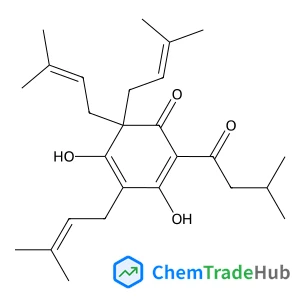
3,5-Dihydroxy-4-(3-methylbutanoyl)-2,6,6-tris(3-methyl-2-buten-1-yl)-2,4-cyclohexadien-1-one
CAS Number:
468-28-0
Molecular Formula:
C26H38O4
Recommended Suppliers





Disclaimer
This page provides academic journal information for reference and research purposes only. We are not affiliated with any journal publishers and do not handle publication submissions. For publication-related inquiries, please contact the respective journal publishers directly.
If you notice any inaccuracies in the information displayed, please contact us at support@chemtradehub.com. We will promptly review and address your concerns.