












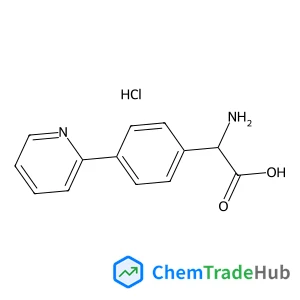
2-Amino-2-(4-(pyridin-2-YL)phenyl)acetic acid hydrochloride
CAS Number:
1135818-89-1
Molecular Formula:
C13H13ClN2O2
Mahdi Shirazi, Annemie Bogaerts, Erik C. Neyts
In this study, we investigated the diffusion of H-atoms to the subsurface and their further diffusion into the bulk of a Ni(111) crystal by means of density functional theory calculations in the context of thermal and plasma-assisted catalysis. The H-atoms at the surface can originate from the dissociative adsorption of H2 or CH4 molecules, determining the surface H-coverage. When a threshold H-coverage is passed, corresponding to 1.00 ML for the crystalline Ni(111) surface, the surface-bound H-atoms start to diffuse to the subsurface. A similar threshold coverage is observed for the interstitial H-coverage. Once the interstitial sites are filled up with a coverage above 1.00 ML of H, dissolution of interstitial H-atoms to the layer below the interstitial sites will be initiated. Hence, by applying a high pressure or inducing a reactive plasma and high temperature, increasing the H-flux to the surface, a large amount of hydrogen can diffuse in a crystalline metal like Ni and can be absorbed. The formation of metal hydride may modify the entire reaction kinetics of the system. Equivalently, the H-atoms in the bulk can easily go back to the surface and release a large amount of heat. In a plasma process, H-atoms are formed in the plasma, and therefore the energy barrier for dissociative adsorption is dismissed, thus allowing achievement of the threshold coverage without applying a high pressure as in a thermal process. As a result, depending on the crystal plane and type of metal, a large number of H-atoms can be dissolved (absorbed) in the metal catalyst, explaining the high efficiency of plasma-assisted catalytic reactions. Here, the mechanism of H-dissolution is established as a chemical identifier for the investigation of the reaction kinetics of a chemical process.
DOI: 10.1039/B100238O
Junnan He, Nan Zheng, Ming Li, YuBin Zheng, Wangze Song
DOI: 10.1039/D1PY00650A
M. Gabriela Lagorio, Enrique San Román, André Zeug, Jörg Zimmermann, Beate Röder
DOI: 10.1039/B100077M
DOI: 10.1039/B010029N
Marc Guerre, Gérald Lopez, Bruno Améduri, Mona Semsarilar, Vincent Ladmiral
DOI: 10.1039/D1PY00221J
Prathyusha Chimala, M. Mario Perera, Aissatou Wade, Tucker McKenzie, Joshua Allor, Neil Ayres
DOI: 10.1039/D1PY00560J
DOI: 10.1039/A906046D
Zoltán Paál, Tamás Koltai, (the late) Károly Matusek, Jean-Marie Manoli, Claude Potvin, Martin Muhler, Ute Wild, Pál Tétényi
DOI: 10.1039/B009047F
Francesca Benevelli, Waclaw Kolodziejski, Krzysztof Wozniak, Jacek Klinowski
DOI: 10.1039/B100894N
Gerhard Gritzner
DOI: 10.1039/B100487P
(3.beta.)-3-Hydroxy-N,N-dimethyl-chol-5-en-24-amide (CAS: 79066-03-8) is primari...
5-(Aminomethyl)-2-methoxyphenol (CAS: 89702-89-6) is classified under GHS as a s...
Thieno[2,3-c]pyridin-7(6H)-one (CAS: 28981-13-7) is a heterocyclic organic compo...
1-[(6-Methoxy-3-pyridinyl)methyl]-4-piperidinamine dihydrochloride is generally ...
[(2E)-3-Phenyl-2-propen-1-yl]phosphonic acid (CAS: 146404-58-2) is regulated und...
6-Bromo-7-methoxyquinoline (CAS: 1620515-86-7) falls under the scope of the Glob...
This compound is primarily used in the pharmaceutical industry for the developme...
1-Ethyl-7-[2-methyl-6-(4H-1,2,4-triazol-3-yl)-3-pyridinyl]-3,5-dihydropyrazino[2...
Alternative reagents such as 2-[(dimethylamino)methyl]phenylboronic acid or rela...
3-(Piperidin-4-yloxy)pyridine (CAS: 310881-48-2) is an organic compound with the...

Physical Chemistry Chemical Physics (PCCP) is an international journal co-owned by 19 physical chemistry and physics societies from around the world. This journal publishes original, cutting-edge research in physical chemistry, chemical physics and biophysical chemistry. To be suitable for publication in PCCP, articles must include significant innovation and/or insight into physical chemistry; this is the most important criterion that reviewers and Editors will judge against when evaluating submissions. The journal has a broad scope and welcomes contributions spanning experiment, theory, computation and data science. Topical coverage includes spectroscopy, dynamics, kinetics, statistical mechanics, thermodynamics, electrochemistry, catalysis, surface science, quantum mechanics, quantum computing and machine learning. Interdisciplinary research areas such as polymers and soft matter, materials, nanoscience, energy, surfaces/interfaces, and biophysical chemistry are welcomed if they demonstrate significant innovation and/or insight into physical chemistry. Joined experimental/theoretical studies are particularly appreciated when complementary and based on up-to-date approaches.
![N-[(6-Bromo-3-pyridinyl)methyl]ethanamine structure](https://static.chemtradehub.com/structs/120/120740-05-8-ca55.webp "N-[(6-Bromo-3-pyridinyl)methyl]ethanamine structure")
![4-[(4-Bromophenyl)sulfonyl]thiomorpholine structure](https://static.chemtradehub.com/structs/223/223555-81-5-2d67.webp "4-[(4-Bromophenyl)sulfonyl]thiomorpholine structure")




