












Magnetite hollow microspheres with a broad absorption bandwidth of 11.9 GHz: toward promising lightweight electromagnetic microwave absorption
Literature Information
Publication Date
2017-07-10
DOI
10.1039/C7CP03292G
Impact Factor
3.676
Authors
Alexander Sivkov, Alexander Ivashutenko, Viktor Zhuravlev, Qing Guo, Liping Li, Guangshe Li, GuoDong Wei, Wei Han
View Original
Abstract
High-performance magnetite-based hollow spheres with the advantages of low density and low loading content are promising as an ideal lightweight electromagnetic (EM) wave absorption candidate. However, the effective preparation methods for these hollow spheres are still limited, and as a result, materials design and practical applications based on their size-dependent EM microwave attenuation properties are poorly accessible. In this study, high quality magnetite hollow spheres were successfully prepared by a simple, fast, one-step, and scalable plasma dynamic method with sole use of inexpensive precursors (oxygen and mild steel). The experimental results reveal that the as-prepared products are hollowed multiple-component magnetite spheres and have a very wide size distribution with a diameter of several tens of nanometers to hundreds of micrometers, which can be further separated into three fractions with different particle size distributions (0–30 μm, 30–100 μm, and >100 μm) by a simple magnetic separation method. The EM wave absorption results demonstrate that the hollow microspheres can exhibit excellent absorption ability with an effective absorption bandwidth (reflection loss ≤−10 dB) of 11.9 GHz from 3.7 to 15.6 GHz for an only 2 mm thick test absorber (50 wt% filler) and a maximum RL value of −36 dB at ∼8.2 GHz. Moreover, the positions of these resonant absorption peaks strongly depend on the sphere sizes and can be regulated at the L + C band, X band, and Ku band. Strikingly, differing from the nearly negligible microwave absorption for the ground powders, the dominating absorption mechanism for the hollow microspheres could be ascribed to the enhanced magnetic loss and multiple scattering due to the novel hollow magnetic structures, which are beneficial for the attenuation ability and improvements to their permeability and impedance matching.
Related Literature
Role of hysteresis in the molecular picture of friction
D. J. Diestler, G. T. Gao, X. C. Zeng
2001-02-09
Paper
DOI: 10.1039/B007772K
Dielectric studies of freezing behavior in porous materials: Water and methanol in activated carbon fibres
K. E. Gubbins, R. Radhakrishnan
2001-03-13
Paper
DOI: 10.1039/B009792F
Synthesis and self-aggregated nanostructures of hydrogen-bonding polydimethylsiloxane
Senbin Chen, Yanggui Wu, Huiying Wang, Bengao Zhu, Bijing Xiong, Wolfgang H. Binder, Jintao Zhu
2021-06-25
Paper
DOI: 10.1039/D1PY00513H
Sulfur uptake and exchange, HDS activity and structure of sulfided, Al2O3 supported MoOx, PdMoOx and PtMoOx catalysts
Zoltán Paál, Tamás Koltai, (the late) Károly Matusek, Jean-Marie Manoli, Claude Potvin, Martin Muhler, Ute Wild, Pál Tétényi
2001-03-19
Paper
DOI: 10.1039/B009047F
Photooxidation of alkylphenothiazines in SiMCM-48, AlMCM-48 and VMCM-48 mesoporous molecular sieves
2001-01-24
Paper
DOI: 10.1039/B008247N
Electron magnetic resonance study of stable radicals in irradiated D-fructose single crystals
Gauthier Vanhaelewyn, Philippe Lahorte, Frank De Proft, Wim Mondelaers, Paul Geerlings, Freddy Callens
2001-04-03
Paper
DOI: 10.1039/B008248L
You might also like
Compound Q&A
What are the main uses of (3.beta.)-3-Hydroxy-N,N-dimethyl-chol-5-en-24-amide (CAS: 79066-03-8)?
(3.beta.)-3-Hydroxy-N,N-dimethyl-chol-5-en-24-amide (CAS: 79066-03-8) is primari...
79066-03-8(3.beta.)-3-Hydroxy-...
Compound Q&A
What regulatory guidelines apply to 5-(aminomethyl)-2-methoxyphenol (CAS: 89702-89-6)?
5-(Aminomethyl)-2-methoxyphenol (CAS: 89702-89-6) is classified under GHS as a s...
89702-89-65-(aminomethyl)-2-me...
Compound Q&A
What is Thieno[2,3-c]pyridin-7(6H)-one (CAS: 28981-13-7)?
Thieno[2,3-c]pyridin-7(6H)-one (CAS: 28981-13-7) is a heterocyclic organic compo...
28981-13-7Thieno[2,3-c]pyridin...
Compound Q&A
Is 1-[(6-Methoxy-3-pyridinyl)methyl]-4-piperidinamine dihydrochloride (CAS: 1185311-28-7) safe?
1-[(6-Methoxy-3-pyridinyl)methyl]-4-piperidinamine dihydrochloride is generally ...
1185311-28-71-[(6-Methoxy-3-pyri...
Compound Q&A
What regulatory guidelines apply to [(2E)-3-Phenyl-2-propen-1-yl]phosphonic acid (CAS: 146404-58-2)?
[(2E)-3-Phenyl-2-propen-1-yl]phosphonic acid (CAS: 146404-58-2) is regulated und...
146404-58-2[(2E)-3-Phenyl-2-pro...
Compound Q&A
What regulatory guidelines apply to 6-Bromo-7-methoxyquinoline (CAS: 1620515-86-7)?
6-Bromo-7-methoxyquinoline (CAS: 1620515-86-7) falls under the scope of the Glob...
1620515-86-76-Bromo-7-methoxyqui...
Compound Q&A
What industries use (2R)-1-(1-Benzofuran-2-yl)-N-propyl-2-pentanamine (CAS: 260550-89-8)?
This compound is primarily used in the pharmaceutical industry for the developme...
260550-89-8(2R)-1-(1-Benzofuran...
Compound Q&A
What are the main uses of 1-Ethyl-7-[2-methyl-6-(4H-1,2,4-triazol-3-yl)-3-pyridinyl]-3,5-dihydropyrazino[2,3-b]pyrazin-2(1H)-one (CAS: 1228013-15-7)?
1-Ethyl-7-[2-methyl-6-(4H-1,2,4-triazol-3-yl)-3-pyridinyl]-3,5-dihydropyrazino[2...
1228013-15-71-Ethyl-7-[2-methyl-...
Compound Q&A
Are there alternatives to {5-(Acryloylamino)-2-[(dimethylamino)methyl]phenyl}boronic acid (CAS: 1217500-78-1) in synthesis?
Alternative reagents such as 2-[(dimethylamino)methyl]phenylboronic acid or rela...
1217500-78-1{5-(Acryloylamino)-2...
Compound Q&A
What is 3-(Piperidin-4-yloxy)pyridine (CAS: 310881-48-2)?
3-(Piperidin-4-yloxy)pyridine (CAS: 310881-48-2) is an organic compound with the...
310881-48-23-(Piperidin-4-yloxy...
Source Journal
Physical Chemistry Chemical Physics

CiteScore:
5.5
Self-citation Rate:
10.3%
Articles per Year:
3036
Physical Chemistry Chemical Physics (PCCP) is an international journal co-owned by 19 physical chemistry and physics societies from around the world. This journal publishes original, cutting-edge research in physical chemistry, chemical physics and biophysical chemistry. To be suitable for publication in PCCP, articles must include significant innovation and/or insight into physical chemistry; this is the most important criterion that reviewers and Editors will judge against when evaluating submissions. The journal has a broad scope and welcomes contributions spanning experiment, theory, computation and data science. Topical coverage includes spectroscopy, dynamics, kinetics, statistical mechanics, thermodynamics, electrochemistry, catalysis, surface science, quantum mechanics, quantum computing and machine learning. Interdisciplinary research areas such as polymers and soft matter, materials, nanoscience, energy, surfaces/interfaces, and biophysical chemistry are welcomed if they demonstrate significant innovation and/or insight into physical chemistry. Joined experimental/theoretical studies are particularly appreciated when complementary and based on up-to-date approaches.
Recommended Compounds
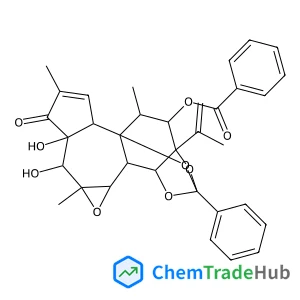

(4aS,10aS)-7-Isopropyl-1,4a-dimethyl-5,8-dioxo-3,4,4a,5,8,9,10,10a-octahydro-2-phenanthrenecarboxylic acid
CAS Number:
142950-86-5
Molecular Formula:
C20H24O4
Recommended Suppliers






Disclaimer
This page provides academic journal information for reference and research purposes only. We are not affiliated with any journal publishers and do not handle publication submissions. For publication-related inquiries, please contact the respective journal publishers directly.
If you notice any inaccuracies in the information displayed, please contact us at support@chemtradehub.com. We will promptly review and address your concerns.