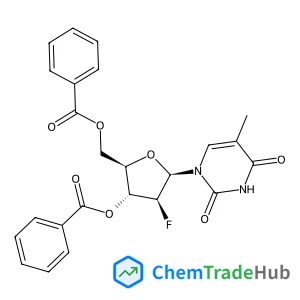
1-(3',5'-Di-O-benzoyl-2'-deoxy-2'-fluoro-b-D-arabinofuranosyl)thymine
CAS Number:
97614-47-6
Molecular Formula:
C24H21FN2O7
P. López-Tarifa, Nicoletta Liguori, Naudin van den Heuvel, Roberta Croce, Lucas Visscher
The light harvesting complex II (LHCII), is a pigment–protein complex responsible for most of the light harvesting in plants. LHCII harvests sunlight and transfers excitation energy to the reaction centre of the photo-system, where the water oxidation process takes place. The energetics of LHCII can be modulated by means of conformational changes allowing a switch from a harvesting to a quenched state. In this state, the excitation energy is no longer transferred but converted into thermal energy to prevent photooxidation. Based on molecular dynamics simulations at the microsecond time scale, we have recently proposed that the switch between different fluorescent states can be probed by correlating shifts in the chromophore–chromophore Coulomb interactions to particular protein movements. However, these findings are based upon calculations in the ideal point dipole approximation (IDA) where the Coulomb couplings are simplified as first order dipole–dipole interactions, also assuming that the chromophore transition dipole moments lay in particular directions of space with constant moduli (FIX-IDA). In this work, we challenge this approximation using the time-dependent density functional theory (TDDFT) combined with the frozen density embedding (FDE) approach. Our aim is to establish up to which limit FIX-IDA can be applied and which chromophore types are better described under this approximation. For that purpose, we use the classical trajectories of solubilised light harvesting complex II (LHCII) we have recently reported [Liguori et al., Sci. Rep., 2015, 5, 15661] and selected three pairs of chromophores containing chlorophyll and carotenoids (Chl and Car): Chla611–Chla612, Chlb606–Chlb607 and Chla612–Lut620. Using the FDE in the Tamm–Dancoff approximation (FDEc-TDA), we show that IDA is accurate enough for predicting Chl–Chl Coulomb couplings. However, the FIX-IDA largely overestimates Chl–Car interactions mainly because the transition dipole for the Cars is not trivially oriented on the polyene chain.

Polycyclic Aromatic Compounds

Bioorganic & Medicinal Chemistry Letters

Biocatalysis and Biotransformation

Critical Reviews in Solid State and Materials Sciences

NDT & E International

Journal of Asian Natural Products Research

Acta Metallurgica Sinica-English Letters

Journal of the Indian Institute of Science

Bioorganic & Medicinal Chemistry

Cellulose
DOI: 10.1039/A905655F
Marc Guerre, Gérald Lopez, Bruno Améduri, Mona Semsarilar, Vincent Ladmiral
DOI: 10.1039/D1PY00221J
Prathyusha Chimala, M. Mario Perera, Aissatou Wade, Tucker McKenzie, Joshua Allor, Neil Ayres
DOI: 10.1039/D1PY00560J
Gerhard Gritzner
DOI: 10.1039/B100487P
Michael L. Klein
DOI: 10.1039/B009490K
Francesca Benevelli, Waclaw Kolodziejski, Krzysztof Wozniak, Jacek Klinowski
DOI: 10.1039/B100894N
DOI: 10.1039/B010029N
M. Masino, A. Girlando, L. Farina, A. Brillante
DOI: 10.1039/B100243K
K. E. Gubbins, R. Radhakrishnan
DOI: 10.1039/B009792F
(3.beta.)-3-Hydroxy-N,N-dimethyl-chol-5-en-24-amide (CAS: 79066-03-8) is primari...
5-(Aminomethyl)-2-methoxyphenol (CAS: 89702-89-6) is classified under GHS as a s...
Thieno[2,3-c]pyridin-7(6H)-one (CAS: 28981-13-7) is a heterocyclic organic compo...
1-[(6-Methoxy-3-pyridinyl)methyl]-4-piperidinamine dihydrochloride is generally ...
[(2E)-3-Phenyl-2-propen-1-yl]phosphonic acid (CAS: 146404-58-2) is regulated und...
6-Bromo-7-methoxyquinoline (CAS: 1620515-86-7) falls under the scope of the Glob...
This compound is primarily used in the pharmaceutical industry for the developme...
1-Ethyl-7-[2-methyl-6-(4H-1,2,4-triazol-3-yl)-3-pyridinyl]-3,5-dihydropyrazino[2...
Alternative reagents such as 2-[(dimethylamino)methyl]phenylboronic acid or rela...
3-(Piperidin-4-yloxy)pyridine (CAS: 310881-48-2) is an organic compound with the...

Physical Chemistry Chemical Physics (PCCP) is an international journal co-owned by 19 physical chemistry and physics societies from around the world. This journal publishes original, cutting-edge research in physical chemistry, chemical physics and biophysical chemistry. To be suitable for publication in PCCP, articles must include significant innovation and/or insight into physical chemistry; this is the most important criterion that reviewers and Editors will judge against when evaluating submissions. The journal has a broad scope and welcomes contributions spanning experiment, theory, computation and data science. Topical coverage includes spectroscopy, dynamics, kinetics, statistical mechanics, thermodynamics, electrochemistry, catalysis, surface science, quantum mechanics, quantum computing and machine learning. Interdisciplinary research areas such as polymers and soft matter, materials, nanoscience, energy, surfaces/interfaces, and biophysical chemistry are welcomed if they demonstrate significant innovation and/or insight into physical chemistry. Joined experimental/theoretical studies are particularly appreciated when complementary and based on up-to-date approaches.
![Ethanone, 1-[4-chloro-2-(methylthio)-5-pyrimidinyl]- structure](https://static.chemtradehub.com/structs/661/66116-82-3-863e.webp "Ethanone, 1-[4-chloro-2-(methylthio)-5-pyrimidinyl]- structure")
amine structure](https://static.chemtradehub.com/structs/629/62924-61-2-0728.webp "[(2-chlorophenyl)methyl](ethyl)amine structure")