












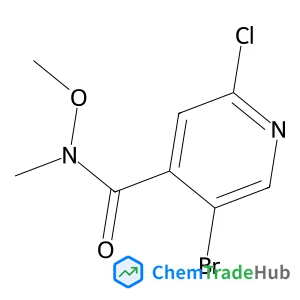
5-Bromo-2-chloro-N-methoxy-N-methylisonicotinamide
CAS Number:
1256790-08-5
Molecular Formula:
C8H8BrClN2O2
Prakriti Adhikary, Dipankar Mandal
We have prepared a flexible polymer composite film containing poly(vinylidene fluoride-co-hexafluoropropylene) (P(VDF–HFP)) and Zn2+ for the fabrication of a multifunctional piezoelectric based nanogenerator (MFNG), where a traditional electrical poling treatment was avoided. The desirable amount of Zn2+ yields more than 99% of electro-active phases in the P(VDF–HFP) matrix that co-operates to enhance the dielectric properties of the composite film via hydrogen bonding interactions. In situ thermal Fourier transform infrared (FT-IR) spectroscopy affirms the improved thermal stability of the electro-active β-phase and the β → γ phase transition temperature in the Zn2+ doped composite film. It also shows UV absorption and intense blue light emission confirmed by a CIE 1931 chart that gives it applicability as a flexible optical sensor. The MFNG behaves as an efficient mechanical energy harvester that delivers an open-circuit voltage ∼6 V and an output power of 2.4 μW and successfully enables the charging of a capacitor by simple repetitive finger touch and release motions (a pressure amplitude of ∼14 kPa). The UV light sensing ability of the MFNG is confirmed under the continuous application and removal of applied stress, which is very promising for designing versatile self-powered optoelectronic smart sensors. Our approach is very simple and cost effective for the construction of a new class of flexible multifunctional energy harvesters that have wonderful applications in the areas of piezo-photonics, wireless detection and flexible self-powered opto-electronics.
Daniel R. Tackley, Geoffrey Dent, W. Ewen Smith
DOI: 10.1039/B007763L
DOI: 10.1039/A905035C
Uwe Langer, Christof Hoelger, Gerd Buntkowsky, Hans-Martin Vieth, Hans-Heinrich Limbach
DOI: 10.1039/B007564G
DOI: 10.1039/A906046D
DOI: 10.1039/B100238O
DOI: 10.1039/B008247N
Marc Guerre, Gérald Lopez, Bruno Améduri, Mona Semsarilar, Vincent Ladmiral
DOI: 10.1039/D1PY00221J
Gerhard Gritzner
DOI: 10.1039/B100487P
Li-wu Lin, Yuan Kou, Ming Zou, Zhen Yan
DOI: 10.1039/B100690H
(3.beta.)-3-Hydroxy-N,N-dimethyl-chol-5-en-24-amide (CAS: 79066-03-8) is primari...
5-(Aminomethyl)-2-methoxyphenol (CAS: 89702-89-6) is classified under GHS as a s...
Thieno[2,3-c]pyridin-7(6H)-one (CAS: 28981-13-7) is a heterocyclic organic compo...
1-[(6-Methoxy-3-pyridinyl)methyl]-4-piperidinamine dihydrochloride is generally ...
[(2E)-3-Phenyl-2-propen-1-yl]phosphonic acid (CAS: 146404-58-2) is regulated und...
6-Bromo-7-methoxyquinoline (CAS: 1620515-86-7) falls under the scope of the Glob...
This compound is primarily used in the pharmaceutical industry for the developme...
1-Ethyl-7-[2-methyl-6-(4H-1,2,4-triazol-3-yl)-3-pyridinyl]-3,5-dihydropyrazino[2...
Alternative reagents such as 2-[(dimethylamino)methyl]phenylboronic acid or rela...
3-(Piperidin-4-yloxy)pyridine (CAS: 310881-48-2) is an organic compound with the...

Physical Chemistry Chemical Physics (PCCP) is an international journal co-owned by 19 physical chemistry and physics societies from around the world. This journal publishes original, cutting-edge research in physical chemistry, chemical physics and biophysical chemistry. To be suitable for publication in PCCP, articles must include significant innovation and/or insight into physical chemistry; this is the most important criterion that reviewers and Editors will judge against when evaluating submissions. The journal has a broad scope and welcomes contributions spanning experiment, theory, computation and data science. Topical coverage includes spectroscopy, dynamics, kinetics, statistical mechanics, thermodynamics, electrochemistry, catalysis, surface science, quantum mechanics, quantum computing and machine learning. Interdisciplinary research areas such as polymers and soft matter, materials, nanoscience, energy, surfaces/interfaces, and biophysical chemistry are welcomed if they demonstrate significant innovation and/or insight into physical chemistry. Joined experimental/theoretical studies are particularly appreciated when complementary and based on up-to-date approaches.
![4,4-Difluoro-2-methyl-1-{[(2-methyl-2-propanyl)oxy]carbonyl}-L-proline structure](https://static.chemtradehub.com/structs/119/1194032-23-9-f426.webp "4,4-Difluoro-2-methyl-1-{[(2-methyl-2-propanyl)oxy]carbonyl}-L-proline structure")
![N-[4-(Cyanoethynyl)phenyl]-16-oxo-4,7,10,13-tetraoxa-17-azahenicos-1-yn-21-amide structure](https://static.chemtradehub.com/structs/218/2183440-36-8-68cb.webp "N-[4-(Cyanoethynyl)phenyl]-16-oxo-4,7,10,13-tetraoxa-17-azahenicos-1-yn-21-amide structure")
![Bis(N,N''-dimethylpiperazine)tetra[copper(I) iodide] structure](https://static.chemtradehub.com/structs/140/1401708-91-5-2b86.webp "Bis(N,N''-dimethylpiperazine)tetra[copper(I) iodide] structure")




