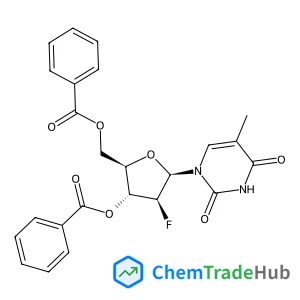
1-(3',5'-Di-O-benzoyl-2'-deoxy-2'-fluoro-b-D-arabinofuranosyl)thymine
CAS Number:
97614-47-6
Molecular Formula:
C24H21FN2O7
Dariusz Grzegorz Piekarski, Rudy Delaunay, Arkadiusz Mika, Sylvain Maclot, Lamri Adoui, Bernd A. Huber, Patrick Rousseau, Alicja Domaracka
We present a combined experimental and theoretical study of the fragmentation of multiply-charged γ-aminobutyric acid molecules (GABAz+, z = 2, 3) in the gas phase. The combination of ab initio molecular dynamics simulations with multiple-coincidence mass spectrometry techniques allows us to observe and identify doubly-charged fragments in coincidence with another charged moiety. The present results indicate that double and triple electron capture lead to the formation of doubly-charged reactive nitrogen and oxygen species (RNS and ROS) with different probabilities due to the different charge localisation and fragmentation behaviour of GABA2+ and GABA3+. The MD simulations unravel the fast (femtosecond) formation of large doubly charged species, observed on the experimental microsecond timescale. The excess of positive charge is stabilised by the presence of cyclic X-member (X = 3–5) ring structures. 5-Member cyclic molecules can sequentially evaporate neutral moieties, such as H2, H2O and CO2, leading to smaller doubly charged fragments as those observed in the experiments.
Junnan He, Nan Zheng, Ming Li, YuBin Zheng, Wangze Song
DOI: 10.1039/D1PY00650A
Tomasz Goworek, Czesław Rybka, Jan Wawryszczuk
DOI: 10.1039/B008826I
Gauthier Vanhaelewyn, Philippe Lahorte, Frank De Proft, Wim Mondelaers, Paul Geerlings, Freddy Callens
DOI: 10.1039/B008248L
Lorenzo Franco, Luigi Pasimeni, Glauco Ponterini, Marco Ruzzi, Ulderico Segre
DOI: 10.1039/B009427G
Dana Nachtigallová, Petr Nachtigall, Joachim Sauer
DOI: 10.1039/B100712M
Fabien Porcheron, Bernard Rousseau, Martin Schoen, Alain H. Fuchs
DOI: 10.1039/B008828P
M. Masino, A. Girlando, L. Farina, A. Brillante
DOI: 10.1039/B100243K
Sigrid D. Peyerimhoff
DOI: 10.1039/B009604K
(3.beta.)-3-Hydroxy-N,N-dimethyl-chol-5-en-24-amide (CAS: 79066-03-8) is primari...
5-(Aminomethyl)-2-methoxyphenol (CAS: 89702-89-6) is classified under GHS as a s...
Thieno[2,3-c]pyridin-7(6H)-one (CAS: 28981-13-7) is a heterocyclic organic compo...
1-[(6-Methoxy-3-pyridinyl)methyl]-4-piperidinamine dihydrochloride is generally ...
[(2E)-3-Phenyl-2-propen-1-yl]phosphonic acid (CAS: 146404-58-2) is regulated und...
6-Bromo-7-methoxyquinoline (CAS: 1620515-86-7) falls under the scope of the Glob...
This compound is primarily used in the pharmaceutical industry for the developme...
1-Ethyl-7-[2-methyl-6-(4H-1,2,4-triazol-3-yl)-3-pyridinyl]-3,5-dihydropyrazino[2...
Alternative reagents such as 2-[(dimethylamino)methyl]phenylboronic acid or rela...
3-(Piperidin-4-yloxy)pyridine (CAS: 310881-48-2) is an organic compound with the...

Physical Chemistry Chemical Physics (PCCP) is an international journal co-owned by 19 physical chemistry and physics societies from around the world. This journal publishes original, cutting-edge research in physical chemistry, chemical physics and biophysical chemistry. To be suitable for publication in PCCP, articles must include significant innovation and/or insight into physical chemistry; this is the most important criterion that reviewers and Editors will judge against when evaluating submissions. The journal has a broad scope and welcomes contributions spanning experiment, theory, computation and data science. Topical coverage includes spectroscopy, dynamics, kinetics, statistical mechanics, thermodynamics, electrochemistry, catalysis, surface science, quantum mechanics, quantum computing and machine learning. Interdisciplinary research areas such as polymers and soft matter, materials, nanoscience, energy, surfaces/interfaces, and biophysical chemistry are welcomed if they demonstrate significant innovation and/or insight into physical chemistry. Joined experimental/theoretical studies are particularly appreciated when complementary and based on up-to-date approaches.
![N-[4-(Cyanoethynyl)phenyl]-16-oxo-4,7,10,13-tetraoxa-17-azahenicos-1-yn-21-amide structure](https://static.chemtradehub.com/structs/218/2183440-36-8-68cb.webp "N-[4-(Cyanoethynyl)phenyl]-16-oxo-4,7,10,13-tetraoxa-17-azahenicos-1-yn-21-amide structure")