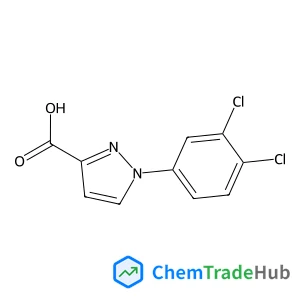
1-(3,4-Dichlorophenyl)-1H-pyrazole-3-carboxylic acid
CAS Number:
1152949-12-6
Molecular Formula:
C10H6Cl2N2O2
Afnan Alghannam, Christopher L. Muhich
Titanium oxide is often decorated with metal nano-particles and either serves as a catalyst support or enables photocatalytic activity. The activity of these systems degrades over time due to catalytic particle agglomeration and growth by Ostwald ripening where adatoms dissociate from metal particles, diffuse across the surface and add to other metal particles. In this work, we use density functional theory calculations to study the diffusion mechanisms of select group VIII and 1B late-transition metal adatoms commonly used in catalysis and photocatalysis (Au, Ag, Cu, Pt, Rh, Ni, Co and Fe) on the anatase TiO2(101) surface. All metal adatoms preferentially occupy the bridge site between two 2-fold-coordinated oxygen anions (O2c). Surface migration was investigated by calculating the minimum energy pathway from one bridge site to another along three pathways: two in the [010] direction along a row of surface O2c anions and one in the [10] direction between two rows of surface O2c anions. For all adatoms, migration along the [010] direction is favored over migration along the [10] direction due to closer packing of the atoms in the [010] direction and therefore stronger adatom–surface interactions. As the adatom hops along the [010] direction, it preferentially moves through a metastable OTiO structure in which the adatom partially embeds itself within the surface, with the exception of Au, which remains above the surface. The adatoms migrate with relative activation energies of: Au (0.24 eV) < Ag (0.48 eV) < Rh (0.60 eV) < Co (0.78 eV) < Pt (0.84 eV) < Ni (0.86 eV) < Cu (1.23 eV) < Fe (1.79 eV) along the favored pathway. This preference arises from the strength of adatom–surface bonding and the electronegativity difference between the metal adatom and the TiO2 surface. We found a linear correlation between the binding energy/electronegativity and the activation energy for hopping where stronger binding energies and more oxidized adatoms have higher activation energies for adatom migration. The linear correlation developed in this work enables rapid estimations of the hopping rates of other transition metal adatoms across the TiO2 surface.
Minxian Wu, Gijs Vanhoutte, Neil R. Brooks, Koen Binnemans, Jan Fransaer
DOI: 10.1039/C4CP06076H
Panpan Jing, Lining Pan, Jinlu Du, Jianbo Wang, Qingfang Liu
DOI: 10.1039/C5CP01228G
Arpan Bhattacharya, Surajit Chatterjee, Roopali Prajapati, Tushar Kanti Mukherjee
DOI: 10.1039/C5CP00543D
Chih-Hao Chang, Ming-Kuan Hsu, Szu-Wei Wu, Mei-Hsin Chen, Hung-Hsuan Lin, Chia-Shou Li, Tun-Wen Pi, Hsin-Hua Chang, Nien-Po Chen
DOI: 10.1039/C5CP01692D
Haihan Chen, Michael J. Ezell, Kristine D. Arquero, Mychel E. Varner, Matthew L. Dawson, R. Benny Gerber, Barbara J. Finlayson-Pitts
DOI: 10.1039/C5CP00838G
A. D. Godbeer, J. S. Al-Khalili, P. D. Stevenson
DOI: 10.1039/C5CP00472A
Bo Cai, Shengli Zhang, Ziyu Hu, Yonghong Hu, Yousheng Zou, Haibo Zeng
DOI: 10.1039/C5CP00563A
Chao-Feng Wu, Tian-Ran Wei, Jing-Feng Li
DOI: 10.1039/C4CP06021K
Ralph Koitz
DOI: 10.1039/C5CP01384D
Elena F. Belogolova, Tamara I. Vakul'skaya, Valery F. Sidorkin
DOI: 10.1039/C4CP06046F
Waste containing N-Methoxy-N-methyl-1,3-thiazole-5-carboxamide (CAS: 898825-89-3...
N-(4-Biphenylyl)dibenzo[b,d]furan-4-amine should be stored in a tightly sealed c...
The market for 3-Acetamido-5-amino-2,4,6-triiodobenzoic acid (CAS: 1713-07-1) is...
Benzyl 2-O-acetyl-3,4,6-tri-O-benzyl-beta-D-galactopyranoside (CAS: 61820-03-9) ...
2-Ethylpiperazine dihydrochloride (CAS: 438050-52-3) is regulated under the Glob...
1,1'-[1,3-Phenylenebis(methylene)]bis(3-methyl-1H-pyrrole-2,5-dione) (CAS: 11946...
Several alternatives can be used in the synthesis of 5-Fluoro-2-(1-pyrrolidinyl)...
Proper personal protective equipment (PPE) must be worn when handling this compo...
When handling 6-Bromoimidazo[1,2-a]pyridin-8-amine, it is important to wear appr...
Alternatives to (2S,4R)-4-(4-Nitrobenzyl)pyrrolidine-2-carboxylic acid hydrochlo...

Physical Chemistry Chemical Physics (PCCP) is an international journal co-owned by 19 physical chemistry and physics societies from around the world. This journal publishes original, cutting-edge research in physical chemistry, chemical physics and biophysical chemistry. To be suitable for publication in PCCP, articles must include significant innovation and/or insight into physical chemistry; this is the most important criterion that reviewers and Editors will judge against when evaluating submissions. The journal has a broad scope and welcomes contributions spanning experiment, theory, computation and data science. Topical coverage includes spectroscopy, dynamics, kinetics, statistical mechanics, thermodynamics, electrochemistry, catalysis, surface science, quantum mechanics, quantum computing and machine learning. Interdisciplinary research areas such as polymers and soft matter, materials, nanoscience, energy, surfaces/interfaces, and biophysical chemistry are welcomed if they demonstrate significant innovation and/or insight into physical chemistry. Joined experimental/theoretical studies are particularly appreciated when complementary and based on up-to-date approaches.

![[(5-Methyl-1,3,4-thiadiazol-2-yl)sulfanyl]acetic acid structure](https://static.chemtradehub.com/structs/509/50918-26-8-4ce8.webp "[(5-Methyl-1,3,4-thiadiazol-2-yl)sulfanyl]acetic acid structure")