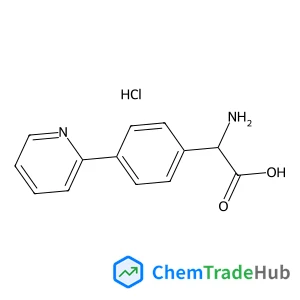
2-Amino-2-(4-(pyridin-2-YL)phenyl)acetic acid hydrochloride
CAS Number:
1135818-89-1
Molecular Formula:
C13H13ClN2O2
Yican Wu, Jinxing Li, Yinlun Yuan, Meiqiu Dong, Bao Zha, Xinrui Miao, Yi Hu, Wenli Deng
We design a bifunctional molecule (5-bromo-2-hexadecyloxy-benzoic acid, 5-BHBA) with a bromine atom and a carboxyl group and its two-dimensional self-assembly is experimentally and theoretically investigated by using scanning tunneling microscopy (STM) and density functional theory (DFT) calculations. The supramolecular self-organization of 5-BHBA in two different solvents (1-octanoic acid and n-hexadecane) at the liquid–solid interface at different solution concentrations is obviously different due to the cooperative and competitive intermolecular halogen and hydrogen bonds. Three kinds of nanoarchitectures composed of dimers, trimers and tetramers are formed at the 1-octanoic acid/graphite interface based on –COOH⋯HOOC–, triangular CO⋯Br⋯H–C, –Br⋯O(H), Br⋯Br, and O⋯H interactions. Furthermore, by using n-hexadecane as the solvent, two kinds of self-assembled linear patterns can be observed due to the coadsorption, in which the dimers are formed by intermolecular –COOH⋯HOOC– hydrogen bonds. The molecule–solvent and solvent–solvent van der Waals force and intermolecular hydrogen bonds dominate the formation of coadsorbed patterns. We propose that the cooperative and competitive halogen and hydrogen bonds are related to the polarity of the solvent and the type of molecule–solvent interaction. The intermolecular binding energy of different dimers and their stability are supported by theoretical calculations. The result provides a new and innovative insight to induce the 2D self-assembled nanostructures by halogen and hydrogen bonds at the liquid–solid interface.
Fabien Porcheron, Bernard Rousseau, Martin Schoen, Alain H. Fuchs
DOI: 10.1039/B008828P
H. Vrielinck, K. Sabbe, F. Callens, P. Matthys
DOI: 10.1039/B008244I
Prathyusha Chimala, M. Mario Perera, Aissatou Wade, Tucker McKenzie, Joshua Allor, Neil Ayres
DOI: 10.1039/D1PY00560J
Ian C. Hamilton, George J. Kakabadse, Sue Le Vent
DOI: 10.1039/B009408K
Li-wu Lin, Yuan Kou, Ming Zou, Zhen Yan
DOI: 10.1039/B100690H
Mauricia Schettino, Rosana M. Romano, Alexander Yu. Makarov, Andrey V. Zibarev
DOI: 10.1039/B009433L
Tomasz Goworek, Czesław Rybka, Jan Wawryszczuk
DOI: 10.1039/B008826I
Senbin Chen, Yanggui Wu, Huiying Wang, Bengao Zhu, Bijing Xiong, Wolfgang H. Binder, Jintao Zhu
DOI: 10.1039/D1PY00513H
(3.beta.)-3-Hydroxy-N,N-dimethyl-chol-5-en-24-amide (CAS: 79066-03-8) is primari...
5-(Aminomethyl)-2-methoxyphenol (CAS: 89702-89-6) is classified under GHS as a s...
Thieno[2,3-c]pyridin-7(6H)-one (CAS: 28981-13-7) is a heterocyclic organic compo...
1-[(6-Methoxy-3-pyridinyl)methyl]-4-piperidinamine dihydrochloride is generally ...
[(2E)-3-Phenyl-2-propen-1-yl]phosphonic acid (CAS: 146404-58-2) is regulated und...
6-Bromo-7-methoxyquinoline (CAS: 1620515-86-7) falls under the scope of the Glob...
This compound is primarily used in the pharmaceutical industry for the developme...
1-Ethyl-7-[2-methyl-6-(4H-1,2,4-triazol-3-yl)-3-pyridinyl]-3,5-dihydropyrazino[2...
Alternative reagents such as 2-[(dimethylamino)methyl]phenylboronic acid or rela...
3-(Piperidin-4-yloxy)pyridine (CAS: 310881-48-2) is an organic compound with the...

Physical Chemistry Chemical Physics (PCCP) is an international journal co-owned by 19 physical chemistry and physics societies from around the world. This journal publishes original, cutting-edge research in physical chemistry, chemical physics and biophysical chemistry. To be suitable for publication in PCCP, articles must include significant innovation and/or insight into physical chemistry; this is the most important criterion that reviewers and Editors will judge against when evaluating submissions. The journal has a broad scope and welcomes contributions spanning experiment, theory, computation and data science. Topical coverage includes spectroscopy, dynamics, kinetics, statistical mechanics, thermodynamics, electrochemistry, catalysis, surface science, quantum mechanics, quantum computing and machine learning. Interdisciplinary research areas such as polymers and soft matter, materials, nanoscience, energy, surfaces/interfaces, and biophysical chemistry are welcomed if they demonstrate significant innovation and/or insight into physical chemistry. Joined experimental/theoretical studies are particularly appreciated when complementary and based on up-to-date approaches.
![Ethanone, 1-[4-chloro-2-(methylthio)-5-pyrimidinyl]- structure](https://static.chemtradehub.com/structs/661/66116-82-3-863e.webp "Ethanone, 1-[4-chloro-2-(methylthio)-5-pyrimidinyl]- structure")