












Connectivity pattern modifies excited state relaxation dynamics of fluorophore–photoswitch molecular dyads
Literature Information
Publication Date
2016-12-21
DOI
10.1039/C6CP07112K
Impact Factor
3.676
Authors
F. Schweighöfer, J. Moreno, S. Chiantia, A. Herrmann, S. Hecht, J. Wachtveitl
View Original
Abstract
In order to modulate the emission of BODIPY fluorophores, they were connected to a diarylethene (DAE) photoswitch via phenylene–ethynylene linkers of different lengths and orientations. The latter allowed for modulation of the electronic coupling in the prepared four BODIPY–DAE dyads, which were compared also to appropriate BODIPY and DAE model compounds by steady state as well as time-resolved spectroscopies. In their open isomers, all dyads show comparable luminescence behavior indicative of an unperturbed BODIPY fluorophore. In strong contrast, in the closed isomers the BODIPY emission is efficiently quenched but the deactivation mechanism depends on the nature of the linker. The most promising dyad was rendered water-soluble by means of micellar encapsulation and aqueous suspensions were investigated by fluorescence spectroscopy and microscopy. Our results (i) illustrate that the electronic communication between the BODIPY and DAE units can indeed be fine-tuned by the nature of the linker to achieve fluorescence modulation while maintaining photoswitchability and (ii) highlight potential applications to image and control biological processes with high spatio-temporal resolution.
Recommended Journals
Related Literature
Intermolecular electron transfer in merocyanine aggregates studied by optical and transient EPR methods
Lorenzo Franco, Luigi Pasimeni, Glauco Ponterini, Marco Ruzzi, Ulderico Segre
2001-04-03
Paper
DOI: 10.1039/B009427G
Complexation behaviour of p-tert-butylcalix[4]arene and p-tert-butylcalix[6]arene towards acetone
Francesca Benevelli, Waclaw Kolodziejski, Krzysztof Wozniak, Jacek Klinowski
2001-04-05
Paper
DOI: 10.1039/B100894N
The concepts of non-Gibbsian and non-Lewisian properties in chemical thermodynamics
João Carlos R. Reis, Michael J. Blandamer, Michael I. Davis, Gérard Douhéret
2001-03-16
Paper
DOI: 10.1039/B009512P
Facile synthesis of GalNAc monomers and block polycations for hepatocyte gene delivery
Matthew R. Bockman, Rishad J. Dalal, Ramya Kumar, Theresa M. Reineke
2021-06-29
Paper
DOI: 10.1039/D1PY00250C
Interaction of tetrameric silver with ammonia in AgCs-rho zeolite
Jaroslaw Sadlo, Marek Danilczuk, Jacek Michalik
2001-02-09
Paper
DOI: 10.1039/B008246P
Post-resonance Raman and theoretical studies on 1,3,2,4-benzodithiadiazines, formally anti-aromatic compounds
Mauricia Schettino, Rosana M. Romano, Alexander Yu. Makarov, Andrey V. Zibarev
2001-03-14
Paper
DOI: 10.1039/B009433L
Solution self-assembly of fluorinated polymers, an overview
Marc Guerre, Gérald Lopez, Bruno Améduri, Mona Semsarilar, Vincent Ladmiral
2021-05-25
Review Article
DOI: 10.1039/D1PY00221J
Network formation in polyethyleneglycol solutions. An intradiffusion study
Paper
DOI: 10.1039/A905035C
You might also like
Compound Q&A
What are the main uses of (3.beta.)-3-Hydroxy-N,N-dimethyl-chol-5-en-24-amide (CAS: 79066-03-8)?
(3.beta.)-3-Hydroxy-N,N-dimethyl-chol-5-en-24-amide (CAS: 79066-03-8) is primari...
79066-03-8(3.beta.)-3-Hydroxy-...
Compound Q&A
What regulatory guidelines apply to 5-(aminomethyl)-2-methoxyphenol (CAS: 89702-89-6)?
5-(Aminomethyl)-2-methoxyphenol (CAS: 89702-89-6) is classified under GHS as a s...
89702-89-65-(aminomethyl)-2-me...
Compound Q&A
What is Thieno[2,3-c]pyridin-7(6H)-one (CAS: 28981-13-7)?
Thieno[2,3-c]pyridin-7(6H)-one (CAS: 28981-13-7) is a heterocyclic organic compo...
28981-13-7Thieno[2,3-c]pyridin...
Compound Q&A
Is 1-[(6-Methoxy-3-pyridinyl)methyl]-4-piperidinamine dihydrochloride (CAS: 1185311-28-7) safe?
1-[(6-Methoxy-3-pyridinyl)methyl]-4-piperidinamine dihydrochloride is generally ...
1185311-28-71-[(6-Methoxy-3-pyri...
Compound Q&A
What regulatory guidelines apply to [(2E)-3-Phenyl-2-propen-1-yl]phosphonic acid (CAS: 146404-58-2)?
[(2E)-3-Phenyl-2-propen-1-yl]phosphonic acid (CAS: 146404-58-2) is regulated und...
146404-58-2[(2E)-3-Phenyl-2-pro...
Compound Q&A
What regulatory guidelines apply to 6-Bromo-7-methoxyquinoline (CAS: 1620515-86-7)?
6-Bromo-7-methoxyquinoline (CAS: 1620515-86-7) falls under the scope of the Glob...
1620515-86-76-Bromo-7-methoxyqui...
Compound Q&A
What industries use (2R)-1-(1-Benzofuran-2-yl)-N-propyl-2-pentanamine (CAS: 260550-89-8)?
This compound is primarily used in the pharmaceutical industry for the developme...
260550-89-8(2R)-1-(1-Benzofuran...
Compound Q&A
What are the main uses of 1-Ethyl-7-[2-methyl-6-(4H-1,2,4-triazol-3-yl)-3-pyridinyl]-3,5-dihydropyrazino[2,3-b]pyrazin-2(1H)-one (CAS: 1228013-15-7)?
1-Ethyl-7-[2-methyl-6-(4H-1,2,4-triazol-3-yl)-3-pyridinyl]-3,5-dihydropyrazino[2...
1228013-15-71-Ethyl-7-[2-methyl-...
Compound Q&A
Are there alternatives to {5-(Acryloylamino)-2-[(dimethylamino)methyl]phenyl}boronic acid (CAS: 1217500-78-1) in synthesis?
Alternative reagents such as 2-[(dimethylamino)methyl]phenylboronic acid or rela...
1217500-78-1{5-(Acryloylamino)-2...
Compound Q&A
What is 3-(Piperidin-4-yloxy)pyridine (CAS: 310881-48-2)?
3-(Piperidin-4-yloxy)pyridine (CAS: 310881-48-2) is an organic compound with the...
310881-48-23-(Piperidin-4-yloxy...
Source Journal
Physical Chemistry Chemical Physics

CiteScore:
5.5
Self-citation Rate:
10.3%
Articles per Year:
3036
Physical Chemistry Chemical Physics (PCCP) is an international journal co-owned by 19 physical chemistry and physics societies from around the world. This journal publishes original, cutting-edge research in physical chemistry, chemical physics and biophysical chemistry. To be suitable for publication in PCCP, articles must include significant innovation and/or insight into physical chemistry; this is the most important criterion that reviewers and Editors will judge against when evaluating submissions. The journal has a broad scope and welcomes contributions spanning experiment, theory, computation and data science. Topical coverage includes spectroscopy, dynamics, kinetics, statistical mechanics, thermodynamics, electrochemistry, catalysis, surface science, quantum mechanics, quantum computing and machine learning. Interdisciplinary research areas such as polymers and soft matter, materials, nanoscience, energy, surfaces/interfaces, and biophysical chemistry are welcomed if they demonstrate significant innovation and/or insight into physical chemistry. Joined experimental/theoretical studies are particularly appreciated when complementary and based on up-to-date approaches.
Recommended Compounds
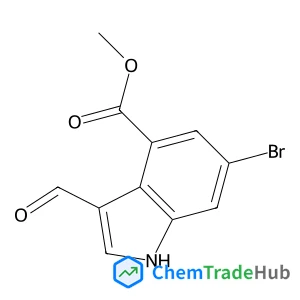
methyl 6-bromo-3-formyl-1H-indole-4-carboxylate
CAS Number:
1353636-63-1
Molecular Formula:
C11H8BrNO3
Recommended Suppliers






Disclaimer
This page provides academic journal information for reference and research purposes only. We are not affiliated with any journal publishers and do not handle publication submissions. For publication-related inquiries, please contact the respective journal publishers directly.
If you notice any inaccuracies in the information displayed, please contact us at support@chemtradehub.com. We will promptly review and address your concerns.