












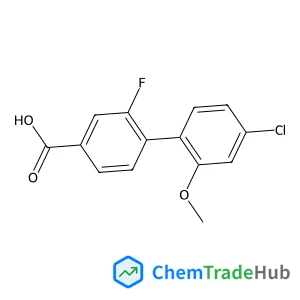
4-(4-Chloro-2-methoxyphenyl)-3-fluorobenzoic acid
CAS Number:
1261970-23-3
Molecular Formula:
C14H10ClFO3
Kai Feng, Beibei Tang, Peiyi Wu
Ex situ characterizations based on TGA and XRD techniques revealed that MeOH vapor had little influence on the Nafion microstructures. To reveal the underlying mechanism, in this study, we designed new FTIR-based equipment to track in situ the microstructural changes of a bulk Nafion membrane in MeOH-saturated air. First, an interesting MeOH-breathing phenomenon was found in the ionic domains of Nafion. It demonstrated that there existed a dynamic equilibrium between the sorption and desorption processes of MeOH vapor in Nafion. Second, the FTIR results also detected the high stability of the hydrophobic regions of Nafion in MeOH vapor. The super-acid –CF2–SO3H always retained a small quantity of bonded H2O (H+(H2O)n) inside the Nafion membrane. MeOH vapor was absorbed first into the hydrophilic regions, however, the interactions between –CF2–SO3H and MeOH vapor were much weaker than those between –CF2–SO3H and H+(H2O)n. Therefore, a protective layer composed of residual water formed in the lumen of the hydrophilic ionic domains of Nafion, which protected its hydrophobic regions from the MeOH attack. Hereby, the self-protection ability of Nafion in MeOH vapor was detected for the first time. This work gave a new insight into the complex interplay between Nafion and MeOH vapor.
DOI: 10.1039/C4CP04711G
Frank Morgner, Alexandre Lecointre, Loïc J. Charbonnière, Hans-Gerd Löhmannsröben
DOI: 10.1039/C4CP04206A
Taeeun Yim, Soo Jung Choi, Jeong-Han Park, Woosuk Cho, Yong Nam Jo, Tae-Hyun Kim, Young-Jun Kim
DOI: 10.1039/C4CP04723K
Yuqing Wang, Yi Feng, Yangming Chen, Fei Mo, Gang Qian, Dongbo Yu, Yang Wang, Xuebin Zhang
DOI: 10.1039/C4CP04251D
Gaurav Jha, Anoop N., Abdur Rahaman, Moloy Sarkar
DOI: 10.1039/C4CP05350H
Bo Wang, Shane A. Seabrook, Praveen Nedumpully-Govindan, Pengyu Chen, Hong Yin, Lynne Waddington, V. Chandana Epa, Jason K. Kirby, Feng Ding
DOI: 10.1039/C4CP04996A
L. Wang, I.-S. Tamgho, L. A. Crandall, J. J. Rack, C. J. Ziegler
DOI: 10.1039/C4CP04737K
Ivy Kanungo, Nishter Nishad Fathima, Raghava Rao Jonnalagadda, Balachandran Unni Nair
DOI: 10.1039/C4CP04363D
DOI: 10.1039/C4CP05186F
Rodrigo B. Kato, Frederico T. Silva, Gisele L. Pappa, Jadson C. Belchior
DOI: 10.1039/C4CP03779K
(5-Sulfamoyl-3-pyridinyl)boronic acid is primarily used in chemical synthesis, p...
Benzyl 2-methyl-2-(methylsulfonyl)-4-pentenoate is typically synthesized via est...
When handling 8-Fluoroquinolin-6-ol (CAS: 209353-22-0), it is important to use p...
1,3-Dibromo-5-(2-methyl-2-propanyl)benzene (CAS: 129316-09-2) is a crystalline c...
Ethyl 7-chloro-4-oxo-1-(1,3-thiazol-2-yl)-1,4-dihydro-1,8-naphthyridine-3-carbox...
When handling Delta-7-Avenasterol (CAS: 23290-26-8), it is important to wear app...
Proper handling involves the use of personal protective equipment such as gloves...
When handling 2-Methyl-2-proanyl 4-[(2-aminophenyl)amino]-1-piperidinecarboxylat...
N-Methyl-4-chlorobenzylamine hydrochloride (CAS: 65542-24-7) is a organic compou...
[2-(Dodecyloxy)ethoxy]acetic acid (CAS: 27306-90-7) is generally considered safe...

Physical Chemistry Chemical Physics (PCCP) is an international journal co-owned by 19 physical chemistry and physics societies from around the world. This journal publishes original, cutting-edge research in physical chemistry, chemical physics and biophysical chemistry. To be suitable for publication in PCCP, articles must include significant innovation and/or insight into physical chemistry; this is the most important criterion that reviewers and Editors will judge against when evaluating submissions. The journal has a broad scope and welcomes contributions spanning experiment, theory, computation and data science. Topical coverage includes spectroscopy, dynamics, kinetics, statistical mechanics, thermodynamics, electrochemistry, catalysis, surface science, quantum mechanics, quantum computing and machine learning. Interdisciplinary research areas such as polymers and soft matter, materials, nanoscience, energy, surfaces/interfaces, and biophysical chemistry are welcomed if they demonstrate significant innovation and/or insight into physical chemistry. Joined experimental/theoretical studies are particularly appreciated when complementary and based on up-to-date approaches.
![N-[2,6-Di(9-anthryl)-4-oxido-8,9,10,11,12,13,14,15-octahydrodinaphtho[2,1-d:1',2'-f][1,3,2]dioxaphosphepin-4-yl]-1,1,1-trifluoromethanesulfonamide structure](https://static.chemtradehub.com/structs/122/1227374-64-2-cdb5.webp "N-[2,6-Di(9-anthryl)-4-oxido-8,9,10,11,12,13,14,15-octahydrodinaphtho[2,1-d:1',2'-f][1,3,2]dioxaphosphepin-4-yl]-1,1,1-trifluoromethanesulfonamide structure")
![4-Fluoro-2-(4-{[(3S,4R)-4-(2-hydroxy-2-propanyl)-3-pyrrolidinyl]amino}-6,7-dimethoxy-2-quinazolinyl)phenol hydrochloride (1:1) structure](https://static.chemtradehub.com/structs/143/1431697-96-9-619c.webp "4-Fluoro-2-(4-{[(3S,4R)-4-(2-hydroxy-2-propanyl)-3-pyrrolidinyl]amino}-6,7-dimethoxy-2-quinazolinyl)phenol hydrochloride (1:1) structure")




