












Dipole correlation effects on the local field and the effective dielectric constant in composite dielectrics containing high-k inclusions
Literature Information
Publication Date
2016-06-15
DOI
10.1039/C6CP03149H
Impact Factor
3.676
Authors
Hartmut Löwen, Lei Zhu
View Original
Abstract
Mixing dielectric polymers with high permittivity (high-k) inclusions can affect their electrical properties. In actuation applications of dielectric elastomers, the polarized inclusions generate additional volume polarization-related electrostriction. In energy storage applications, it is possible to store more energy in dielectric composites because of additional polarization of the inclusions and interfaces. However, mixing an electroactive polymer with high-k inclusions also brings several disadvantages. The expulsion of the field from the interior of high-k fillers and the presence of two poles on the filler surface along the applied field direction result in higher local fields EL near the inclusion poles. The resulting field enhancement lowers the breakdown field (Eb) threshold for the material and therefore compromises the actuation and energy storage capabilities of dielectric composites. To mitigate this issue, the dependence of EL on the morphology of inclusion distribution, the field localization effect in chained configurations, and the role of the dipole–dipole correlation effects in the enhancement of the dipolar field of inclusions are analyzed. We show that the dipolar correlation effects are strong in large inclusion composites and their contribution to the inclusion dipole moment μ and to the local fields EL can reach 30–50%. A new method for deriving the composite permittivity from the field EL distribution, based on a caged probe technique, is also presented.
Related Literature
Elastic strain effects on catalysis of a PdCuSi metallic glass thin film
Yiyi Yang, Tuhina Adit Maark, Andrew Peterson, Sharvan Kumar
2014-12-02
Paper
DOI: 10.1039/C4CP04924A
Photoisomerisation of azobenzene crystals in aqueous dispersions examined by higher order derivative spectra
2014-12-02
Paper
DOI: 10.1039/C4CP05186F
Heterogeneous oxidation of nitrite anion by gas-phase ozone in an aqueous droplet levitated by laser tweezers (optical trap): is there any evidence for enhanced surface reaction?
Andrew D. Ward, Martin D. King
2014-12-11
Paper
DOI: 10.1039/C4CP05062B
The properties of Irn (n = 2–10) clusters and their nucleation on γ-Al2O3 and MgO surfaces: from ab initio studies
Yongchang Chen, Miao Huo, Qiang Li, Zhaolin Sun, Lijuan Song
2014-12-02
Paper
DOI: 10.1039/C4CP04881D
Cyclic voltammetry using silver as cathode material: a simple method for determining electro and chemical features and solubility values of CO2 in ionic liquids
Irene Reche, Iluminada Gallardo, Gonzalo Guirado
2014-11-27
Communication
DOI: 10.1039/C4CP05409A
Effects of repulsive interaction on the electric double layer of an imidazolium-based ionic liquid by molecular dynamics simulation
Wenyang Jin, Xiaohong Liu, Yining Han, Shu Li, Tianying Yan
2014-11-25
Paper
DOI: 10.1039/C4CP04853A
A functionalised nickel cyclam catalyst for CO2 reduction: electrocatalysis, semiconductor surface immobilisation and light-driven electron transfer
Gaia Neri, James J. Walsh, Calum Wilson, Anna Reynal, Jason Y. C. Lim, Xiaoe Li, Andrew J. P. White, Nicholas J. Long, James R. Durrant, Alexander J. Cowan
2014-11-26
Communication
DOI: 10.1039/C4CP04871G
Theoretical evaluation of the surface electrochemistry of perovskites with promising photon absorption properties for solar water splitting
Joseph H. Montoya, Monica Garcia-Mota
2014-11-27
Paper
DOI: 10.1039/C4CP05259E
Thermostability and reversibility of silver nanoparticle–protein binding
Bo Wang, Shane A. Seabrook, Praveen Nedumpully-Govindan, Pengyu Chen, Hong Yin, Lynne Waddington, V. Chandana Epa, Jason K. Kirby, Feng Ding
2014-11-21
Paper
DOI: 10.1039/C4CP04996A
You might also like
Compound Q&A
What are the main uses of (5-Sulfamoyl-3-pyridinyl)boronic acid (CAS: 951233-61-7)?
(5-Sulfamoyl-3-pyridinyl)boronic acid is primarily used in chemical synthesis, p...
951233-61-7(5-Sulfamoyl-3-pyrid...
Compound Q&A
How is Benzyl 2-methyl-2-(methylsulfonyl)-4-pentenoate (CAS: 1942858-50-5) typically synthesized?
Benzyl 2-methyl-2-(methylsulfonyl)-4-pentenoate is typically synthesized via est...
1942858-50-5Benzyl 2-methyl-2-(m...
Compound Q&A
What precautions should be taken when handling 8-Fluoroquinolin-6-ol (CAS: 209353-22-0)?
When handling 8-Fluoroquinolin-6-ol (CAS: 209353-22-0), it is important to use p...
209353-22-08-Fluoroquinolin-6-o...
Compound Q&A
What are the physical and chemical properties of 1,3-Dibromo-5-(2-methyl-2-propanyl)benzene (CAS: 129316-09-2)?
1,3-Dibromo-5-(2-methyl-2-propanyl)benzene (CAS: 129316-09-2) is a crystalline c...
129316-09-21,3-Dibromo-5-(2-met...
Compound Q&A
What industries use Ethyl 7-chloro-4-oxo-1-(1,3-thiazol-2-yl)-1,4-dihydro-1,8-naphthyridine-3-carboxylate (CAS: 174726-87-5)?
Ethyl 7-chloro-4-oxo-1-(1,3-thiazol-2-yl)-1,4-dihydro-1,8-naphthyridine-3-carbox...
174726-87-5Ethyl 7-chloro-4-oxo...
Compound Q&A
What precautions should be taken when handling Delta-7-Avenasterol (CAS: 23290-26-8)?
When handling Delta-7-Avenasterol (CAS: 23290-26-8), it is important to wear app...
23290-26-8Delta-7-Avenasterol
Compound Q&A
What precautions should be taken when handling N-({(5R)-3-[3-Fluoro-4-(4-morpholinyl)phenyl]-2-oxo-1,3-oxazolidin-5-yl}methyl)acetamide (CAS: 872992-20-6)?
Proper handling involves the use of personal protective equipment such as gloves...
872992-20-6N-({(5R)-3-[3-Fluoro...
Compound Q&A
What precautions should be taken when handling 2-Methyl-2-proanyl 4-[(2-aminophenyl)amino]-1-piperidinecarboxylate (CAS: 79099-00-6)?
When handling 2-Methyl-2-proanyl 4-[(2-aminophenyl)amino]-1-piperidinecarboxylat...
79099-00-62-Methyl-2-propanyl ...
Compound Q&A
What is N-Methyl-4-chlorobenzylamine hydrochloride (CAS: 65542-24-7)?
N-Methyl-4-chlorobenzylamine hydrochloride (CAS: 65542-24-7) is a organic compou...
65542-24-7N-Methyl-4-chloroben...
Compound Q&A
Is [2-(Dodecyloxy)ethoxy]acetic acid (CAS: 27306-90-7) safe?
[2-(Dodecyloxy)ethoxy]acetic acid (CAS: 27306-90-7) is generally considered safe...
27306-90-7[2-(Dodecyloxy)ethox...
Source Journal
Physical Chemistry Chemical Physics

CiteScore:
5.5
Self-citation Rate:
10.3%
Articles per Year:
3036
Physical Chemistry Chemical Physics (PCCP) is an international journal co-owned by 19 physical chemistry and physics societies from around the world. This journal publishes original, cutting-edge research in physical chemistry, chemical physics and biophysical chemistry. To be suitable for publication in PCCP, articles must include significant innovation and/or insight into physical chemistry; this is the most important criterion that reviewers and Editors will judge against when evaluating submissions. The journal has a broad scope and welcomes contributions spanning experiment, theory, computation and data science. Topical coverage includes spectroscopy, dynamics, kinetics, statistical mechanics, thermodynamics, electrochemistry, catalysis, surface science, quantum mechanics, quantum computing and machine learning. Interdisciplinary research areas such as polymers and soft matter, materials, nanoscience, energy, surfaces/interfaces, and biophysical chemistry are welcomed if they demonstrate significant innovation and/or insight into physical chemistry. Joined experimental/theoretical studies are particularly appreciated when complementary and based on up-to-date approaches.
Recommended Compounds
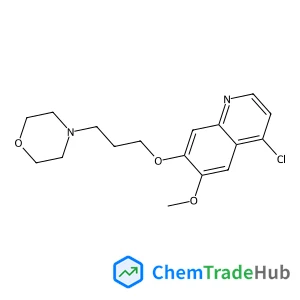
4-(3-((4-Chloro-6-methoxyquinolin-7-yl)oxy)propyl)morpholine
CAS Number:
205448-32-4
Molecular Formula:
C17H21ClN2O3
Recommended Suppliers





Disclaimer
This page provides academic journal information for reference and research purposes only. We are not affiliated with any journal publishers and do not handle publication submissions. For publication-related inquiries, please contact the respective journal publishers directly.
If you notice any inaccuracies in the information displayed, please contact us at support@chemtradehub.com. We will promptly review and address your concerns.