













Complexes of carborane acids linked by strong hydrogen bonds: acidity scales
Literature Information
Publication Date
2016-05-20
DOI
10.1039/C6CP02867E
Impact Factor
3.676
Authors
View Original
Abstract
Carborane acids, currently known as the strongest acis, are analyzed and compared with other species classified as superacids as well as with selected mineral acids and carbocations. Calculations (B3LYP/6-311++G(d,p) level) on these moieties as well as on their conjugate bases were performed to evaluate corresponding proton affinities. In addition, the complexes of these species with the CHB11F11− anion and the complexes of the conjugate bases with the trimethylammonium cation were analyzed. The scales, based on spectroscopic results, DFT energies and on the topological QTAIM (Quantum Theory of Atoms in Molecules) parameters, are introduced and discussed to order the acidity of the species analyzed here. The properties of the bond critical points corresponding to the intermolecular contacts are discussed. The majority of the results show that HCHB11F11 carborane acid is the strongest in agreement with the previous experimental studies of Reed and coworkers. Very often the abovementioned acidity scales show that carborane acids are able to protonate hydrocarbons.
Related Literature
An efficient particulate photocatalyst for overall water splitting based on scandium and magnesium co-doped strontium titanate
Riku Okamoto, Akira Kimura, Yuhi Nakayasu, Akira Yamakata, Ryota Tomizawa, Taizo Masuda, Koichiro Nakatani
2023-11-29
Paper
DOI: 10.1039/D3SE01408H
Investigating theoretical and experimental cross sections for elastic electron scattering from isoflurane
Bratislav P. Marinković, Jaime Rosado, Francisco Blanco, Gustavo García, Jelena B. Maljković
2023-12-07
Paper
DOI: 10.1039/D3CP05052A
H2 formation from the E2–E4 states of nitrogenase
Hao Jiang, Ulf Ryde
2023-12-08
Paper
DOI: 10.1039/D3CP05181A
Unraveling the effect of particle size of active metals in Ni/MgO on methane activation and carbon growth mechanism
Shengzhuo Chen, Juntian Niu, Xianrong Zheng, Haiyu Liu, Yan Jin, Jingyu Ran
2023-12-15
Paper
DOI: 10.1039/D3CP05435G
Correction: Extracting accurate information from triplet–triplet annihilation upconversion data with a mass-conserving kinetic model
Abhishek Kalpattu, Tristan Dilbeck, Kenneth Hanson
2023-12-14
Correction
DOI: 10.1039/D3CP90241B
Solvent effects on the intramolecular charge transfer excited state of 3CzClIPN: a broadband transient absorption study
Meixin Cheng
2023-12-04
Paper
DOI: 10.1039/D3CP04975B
Low-cost transition metal–nitrogen–carbon electrocatalysts for the oxygen reduction reaction: operating conditions from aqueous electrolytes to fuel cells
Li-Ting Cui, Wen-Feng Lin, Shi-Gang Sun
2023-12-05
Perspective
DOI: 10.1039/D3SE01275A
Charge doping and electric field tunable ferromagnetism and Curie temperature of the MnS2 monolayer
Jing Xie, Dongni Wu, Yangfang Liao, Xiaolong Cao, Shiyou Zhou
2023-11-14
Paper
DOI: 10.1039/D3CP04382G
Delayed photodissociation of the tin cluster Sn22−
Alexander Jankowski, Paul Fischer, Klavs Hansen, Lutz Schweikhard
2023-12-15
Paper
DOI: 10.1039/D3CP04476A
Solar-driven electrochemical NH3 splitting into H2 and N2 on BiVO4-based photoanodes
Miwako Teranishi, Shin-ichi Naya, Hiroaki Tada
2023-12-13
Paper
DOI: 10.1039/D3SE01513K
You might also like
Compound Q&A
How should waste containing N-Methoxy-N-methyl-1,3-thiazole-5-carboxamide (CAS: 898825-89-3) be handled?
Waste containing N-Methoxy-N-methyl-1,3-thiazole-5-carboxamide (CAS: 898825-89-3...
898825-89-3N-Methoxy-N-methyl-1...
Compound Q&A
How should N-(4-Biphenylyl)dibenzo[b,d]furan-4-amine (CAS: 1318338-47-4) be stored?
N-(4-Biphenylyl)dibenzo[b,d]furan-4-amine should be stored in a tightly sealed c...
1318338-47-4N-(4-Biphenylyl)dibe...
Compound Q&A
What is the market or research trend for 3-Acetamido-5-amino-2,4,6-triiodobenzoic acid (CAS: 1713-07-1)?
The market for 3-Acetamido-5-amino-2,4,6-triiodobenzoic acid (CAS: 1713-07-1) is...
1713-07-13-Acetamido-5-amino-...
Compound Q&A
How should Benzyl 2-O-acetyl-3,4,6-tri-O-benzyl-beta-D-galactopyranoside (CAS: 61820-03-9) be stored?
Benzyl 2-O-acetyl-3,4,6-tri-O-benzyl-beta-D-galactopyranoside (CAS: 61820-03-9) ...
61820-03-9Benzyl 2-O-acetyl-3,...
Compound Q&A
What regulatory guidelines apply to 2-Ethylpiperazine dihydrochloride (CAS: 438050-52-3)?
2-Ethylpiperazine dihydrochloride (CAS: 438050-52-3) is regulated under the Glob...
438050-52-32-Ethylpiperazine di...
Compound Q&A
What regulatory guidelines apply to 1,1'-[1,3-Phenylenebis(methylene)]bis(3-methyl-1H-pyrrole-2,5-dione) (CAS: 119462-56-5)?
1,1'-[1,3-Phenylenebis(methylene)]bis(3-methyl-1H-pyrrole-2,5-dione) (CAS: 11946...
119462-56-51,1'-[1,3-Phenyleneb...
Compound Q&A
Are there alternatives to 5-Fluoro-2-(1-pyrrolidinyl)pyridine (CAS: 1287217-79-1) in synthesis?
Several alternatives can be used in the synthesis of 5-Fluoro-2-(1-pyrrolidinyl)...
1287217-79-15-Fluoro-2-(1-pyrrol...
Compound Q&A
What precautions should be taken when handling 1-((2R,3R,4R,5R)-5-((bis(4-methoxyphenyl)(phenyl)methoxy)methyl)-4-hydroxy-3-methoxytetrahydrofuran-2-yl)-5-methylpyrimidine-2,4(1H,3H)-dione (CAS: 153631-19-7)?
Proper personal protective equipment (PPE) must be worn when handling this compo...
153631-19-71-((2R,3R,4R,5R)-5-(...
Compound Q&A
What precautions should be taken when handling 6-Bromoimidazo[1,2-a]pyridin-8-amine (CAS: 676371-00-9)?
When handling 6-Bromoimidazo[1,2-a]pyridin-8-amine, it is important to wear appr...
676371-00-96-Bromoimidazo[1,2-a...
Compound Q&A
Are there alternatives to (2S,4R)-4-(4-Nitrobenzyl)pyrrolidine-2-carboxylic acid hydrochloride (CAS: 1049740-22-8) in synthesis?
Alternatives to (2S,4R)-4-(4-Nitrobenzyl)pyrrolidine-2-carboxylic acid hydrochlo...
1049740-22-8(2S,4R)-4-(4-Nitrobe...
Source Journal
Physical Chemistry Chemical Physics

CiteScore:
5.5
Self-citation Rate:
10.3%
Articles per Year:
3036
Physical Chemistry Chemical Physics (PCCP) is an international journal co-owned by 19 physical chemistry and physics societies from around the world. This journal publishes original, cutting-edge research in physical chemistry, chemical physics and biophysical chemistry. To be suitable for publication in PCCP, articles must include significant innovation and/or insight into physical chemistry; this is the most important criterion that reviewers and Editors will judge against when evaluating submissions. The journal has a broad scope and welcomes contributions spanning experiment, theory, computation and data science. Topical coverage includes spectroscopy, dynamics, kinetics, statistical mechanics, thermodynamics, electrochemistry, catalysis, surface science, quantum mechanics, quantum computing and machine learning. Interdisciplinary research areas such as polymers and soft matter, materials, nanoscience, energy, surfaces/interfaces, and biophysical chemistry are welcomed if they demonstrate significant innovation and/or insight into physical chemistry. Joined experimental/theoretical studies are particularly appreciated when complementary and based on up-to-date approaches.
Recommended Compounds
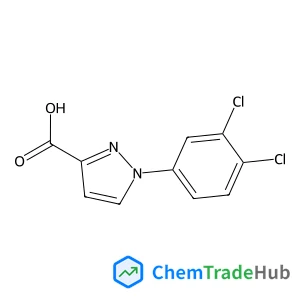
1-(3,4-Dichlorophenyl)-1H-pyrazole-3-carboxylic acid
CAS Number:
1152949-12-6
Molecular Formula:
C10H6Cl2N2O2
Recommended Suppliers






Disclaimer
This page provides academic journal information for reference and research purposes only. We are not affiliated with any journal publishers and do not handle publication submissions. For publication-related inquiries, please contact the respective journal publishers directly.
If you notice any inaccuracies in the information displayed, please contact us at support@chemtradehub.com. We will promptly review and address your concerns.