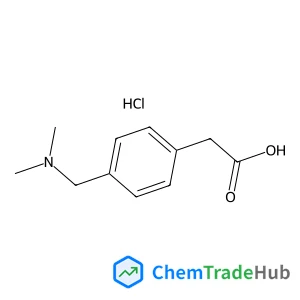
4-(Dimethylaminomethyl)phenylacetic acid hydrochloride
CAS Number:
99985-52-1
Molecular Formula:
C11H16ClNO2
Zeeshan Haider, Jin You Zheng, Young Soo Kang
Unique octagonal shaped BiOCl nanosheets (NS) dominantly exposed with high energy {001} crystal facets have been fabricated via a simple hydrothermal route without using organic surfactants. The dynamics of photogenerated charge carriers have been studied by time-resolved photoluminescence spectroscopy. The fitting parameters of the decay kinetics were used to calculate both the intensity weighted average lifetime (〈τ〉int.), as well as the amplitude weighted average lifetime (〈τ〉amp.) of the photogenerated charge carriers. The 〈τ〉int. and 〈τ〉amp. values for {001} BiOCl NS, i.e., 17.23 ns and 1.94 ns, respectively, were observed to be significantly higher than the corresponding values obtained for pristine BiOCl such as 2.52 ns and 1.07 ns, respectively. Significant quenching of the PL emission intensity of {001} BiOCl NS reflected the enhanced separation of the photogenerated charge carriers. Reduced thickness and in situ iodine doping was favorable to minimize the recombination tendency. The photocatalytic activity was monitored via the photodegradation of RhB under visible light illumination (λ > 400 nm). {001} BiOCl NS exhibited superior performance when compared to pristine BiOCl in terms of the rapid degradation kinetics and higher photonic efficiency. The photocatalytic efficiency of {001} BiOCl NS was 2.8 times higher than pristine BiOCl. Iodine doping induced extended the optical absorption in the visible region and improved the separation of the photogenerated charge carriers, which played an important role to enhance the photocatalytic activity. The photodegradation mechanism was systematically studied using various radical quenchers and it was revealed that photogenerated holes (h+) and superoxide radicals (˙O2−) actively participated whereas hydroxyl (OH˙) radicals had a negligible contribution in the photodegradation of RhB. {001} BiOCl NS has shown a higher photocurrent density and lower charge transfer resistance analyzed through photoelectrochemical and electrochemical impedance measurements. This study highlights the fabrication of unique octagonal BiOCl NS with improved separation of charge carriers across high energy crystal facts to design a highly efficient photocatalyst.
Matthew E. Potter, Mark E. Light, Daniel J. M. Irving, Alice E. Oakley, Stephanie Chapman, Philip Chater, Geoff Cutts, Andrew Watts, Michael Wharmby, Bart D. Vandegehuchte, Moritz W. Schreiber, Robert Raja
DOI: 10.1039/D0CP00670J
DOI: 10.1039/C9CP03473K
Salla I. Virtanen, Anne M. Kiirikki, Kornelia M. Mikula, Hideo Iwaï, O. H. Samuli Ollila
DOI: 10.1039/D0CP03473H
Puja Adhikari, Neng Li, Matthew Shin, Reidun Twarock, Wai-Yim Ching
DOI: 10.1039/D0CP03145C
Mingyu Zhao, Xianqi Dai, Yanan Tang
DOI: 10.1039/D0CP03406A
Weijie Hua, Guangjun Tian, Yi Luo
DOI: 10.1039/D0CP02970J
Hoi Kil Choi, Hana Jung, Jeong-Un Jin, Young-Kwan Kim, Nam-Ho You, Bon-Cheol Ku, Yonjig Kim, Jaesang Yu
DOI: 10.1039/D0CP03498C
Dávid Fertig, Mónika Valiskó, Dezsö Boda
DOI: 10.1039/D0CP03237A
Ying Xu, Xiaoyu Xuan, Zhuhua Zhang, Wanlin Guo
DOI: 10.1039/D0CP03112G
Christian Gutt
DOI: 10.1039/D0CP03551C
Waste containing N-Methoxy-N-methyl-1,3-thiazole-5-carboxamide (CAS: 898825-89-3...
N-(4-Biphenylyl)dibenzo[b,d]furan-4-amine should be stored in a tightly sealed c...
The market for 3-Acetamido-5-amino-2,4,6-triiodobenzoic acid (CAS: 1713-07-1) is...
Benzyl 2-O-acetyl-3,4,6-tri-O-benzyl-beta-D-galactopyranoside (CAS: 61820-03-9) ...
2-Ethylpiperazine dihydrochloride (CAS: 438050-52-3) is regulated under the Glob...
1,1'-[1,3-Phenylenebis(methylene)]bis(3-methyl-1H-pyrrole-2,5-dione) (CAS: 11946...
Several alternatives can be used in the synthesis of 5-Fluoro-2-(1-pyrrolidinyl)...
Proper personal protective equipment (PPE) must be worn when handling this compo...
When handling 6-Bromoimidazo[1,2-a]pyridin-8-amine, it is important to wear appr...
Alternatives to (2S,4R)-4-(4-Nitrobenzyl)pyrrolidine-2-carboxylic acid hydrochlo...

Physical Chemistry Chemical Physics (PCCP) is an international journal co-owned by 19 physical chemistry and physics societies from around the world. This journal publishes original, cutting-edge research in physical chemistry, chemical physics and biophysical chemistry. To be suitable for publication in PCCP, articles must include significant innovation and/or insight into physical chemistry; this is the most important criterion that reviewers and Editors will judge against when evaluating submissions. The journal has a broad scope and welcomes contributions spanning experiment, theory, computation and data science. Topical coverage includes spectroscopy, dynamics, kinetics, statistical mechanics, thermodynamics, electrochemistry, catalysis, surface science, quantum mechanics, quantum computing and machine learning. Interdisciplinary research areas such as polymers and soft matter, materials, nanoscience, energy, surfaces/interfaces, and biophysical chemistry are welcomed if they demonstrate significant innovation and/or insight into physical chemistry. Joined experimental/theoretical studies are particularly appreciated when complementary and based on up-to-date approaches.
![2-(7,7-Difluorobicyclo[4.1.0]hept-1-yl)ethanamine structure](https://static.chemtradehub.com/structs/209/2098065-08-6-ff24.webp "2-(7,7-Difluorobicyclo[4.1.0]hept-1-yl)ethanamine structure")