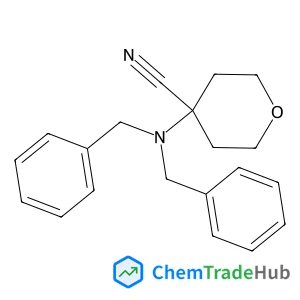
4-(Dibenzylamino)tetrahydro-2H-pyran-4-carbonitrile
CAS Number:
1630906-81-8
Molecular Formula:
C20H22N2O
Hui Yao
Bio-based poly(dibutyl itaconate-ter-isoprene-ter-4-vinylpyridine) (PDBIIVP) elastomers with different 4-vinylpyridine (4-VP) contents were synthesized by redox emulsion polymerization for the purpose of designing and preparing green graphene oxide (GO)/PDBIIVP nanocomposites with strong interfacial interaction. The ionic bonding interfaces in the nanocomposites were the result of electrostatic attraction between the in situ protonated pyridine groups of PDBIIVP and the electronegative GO sheets with hydrochloric acid during latex co-coagulation and were confirmed by X-ray photoelectron spectroscopy. The inclusion of a small amount of 4-VP (less than 7 wt%) improved the dispersion of GO, the interfacial interaction between PDBIIVP and GO, and the performance of the GO/PDBIIVP nanocomposite markedly. The reinforcement effects of GO on the mechanical and gas barrier properties of PDBIIVP increased continuously with increasing 4-VP content. Additionally, GO/PDBIIVP nanocomposites with a fixed 4-VP content and different GO loadings were prepared and characterized. As the GO loading increased, the performance of the nanocomposites improved greatly. For the GO/PDBIIVP with 7.0 wt% of 4-VP and 4 phr of GO, the tensile strength increased by 700%, the volume loss of abrasion decreased by 53%, and the gas permeability decreased by 63% compared with those of the neat PDBIIVP. The remarkable improvements are attributed to the strong ionic bonding interfaces between the pyridine-included bio-based elastomer and GO. We believe that this work of new polymer construction with the functional group targeting the interfacial interaction with GO should be an important strategy for developing GO-based polymer nanocomposites with high performance.
Rachael H. Dolan, James E. Anderson, Timothy J. Wallington
DOI: 10.1039/D1SE00979F
Bowen Luo, Zhixiang Huang, Riyang Shu, Yu Cheng, Zhipeng Tian, Chao Wang, Ying Chen
DOI: 10.1039/D1SE01403J
Zheng-Han Guo, Jie-Ying Lin, Pei-Ru Chen, Kai-Qin Ou, Xiang-Ya Xu, Jin-Kun Li, Sai Huang, Xin-Xin Sang, Jing-Cheng Liu, Jun-Ling Song
DOI: 10.1039/D1SE01313K
Youssef Berro, Damaris Kehrli, Jean-François Brilhac, Marianne Balat-Pichelin
DOI: 10.1039/D1SE01549D
Heeyeon An
DOI: 10.1039/D1SE01784E
Zhongbiao Li, Jinpeng Wang, Jiangpeng Zhu, Yanjun Sun, Zhihao Wang, Yujun Zhao, Qiuju Zheng
DOI: 10.1039/D1SE01291F
Takafumi Iwai, Akinobu Nakada, Masanobu Higashi, Hajime Suzuki, Osamu Tomita
DOI: 10.1039/D1SE01272J
Hwapyung Jung, Arindam Adhikari, Rajkumar Patel
DOI: 10.1039/D1SE01716K
When handling 2-Methyl-2-propanyl 5-amino-2-thiophenecarboxylate (CAS: 1498311-5...
5-Bromo-1,2-dichloro-3-fluorobenzene (CAS: 1000572-93-9) is a crystalline solid ...
(2R)-2-Amino-2-(4-bromophenyl)ethanol (CAS: 354153-64-3) should be stored in a c...
Methyl 4-(aminomethyl)tetrahydro-2H-pyran-4-carboxylate hydrochloride (CAS: 3627...
1,4-Dimethyl-1H-pyrazole-5-sulfonyl chloride is primarily used as an intermediat...
Dinaphtho[1,2-b:2',1'-d]furan is generally safe when handled with appropriate pe...
The market for 7-Methyl-7,9-dihydro-1H-purine-2,6,8(3H)-trione (CAS: 612-37-3) i...
2-(4-Chlorophenyl)malonaldehyde (CAS: 205676-17-1) is a colorless or light yello...
2-Methylchrysene (CAS: 3351-32-4) is typically synthesized via the reaction of c...
N-(6-aminopyrimidin-4-yl)acetamide (CAS: 89533-23-3) is generally considered saf...

Polymer Chemistry welcomes submissions in all areas of polymer science that have a strong focus on macromolecular chemistry. Manuscripts may cover a broad range of fields, yet no direct application focus is required.

![3-[7-Amino-3-(3-pyridinyl)pyrazolo[1,5-a]pyrimidin-6-yl]phenol structure](https://static.chemtradehub.com/structs/861/861249-77-6-025b.webp "3-[7-Amino-3-(3-pyridinyl)pyrazolo[1,5-a]pyrimidin-6-yl]phenol structure")