


Polymerization of isobutylene catalyzed by EtAlCl2/bis(2-chloroethyl) ether complex in steel vessels
Literature Information
Publication Date
2015-06-05
DOI
10.1039/C5PY00624D
Impact Factor
5.582
Authors
Sanjib Banerjee, Jack Emert, Peter Wright, Thomas Skourlis, Rich Severt, Rudolf Faust
View Original
Abstract
When synthesis of highly reactive polyisobutylene (HR PIB) via cationic polymerization of isobutylene (IB) using ethylaluminum dichloride·bis(2-chloroethyl) ether (EADC·CEE) complex were carried out in metal reactors made of 316 stainless steel (SS), PIB olefin with up to 20% lower exo-olefin content were obtained compared to that obtained in glass reactors (up to 90%). In an effort to investigate this reduction in exo-olefin selectivity in SS reactors, we have studied the polymerization of IB using EADC·CEE complex in SS (minimum of 10.5% chromium content by mass), carbon steel (CS) (0% chromium content by mass), monel alloy 400 (M400) (0% chromium content by mass) and glass reactors. The latter was examined in the presence and absence of SS balls. Mechanistic studies using ATR-FTIR and 1H NMR spectroscopy suggest that this decrease in exo-olefin selectivity is due to a side reaction of EADC with Cr2O3 involving the loss of the ethyl group from EADC and decomplexation of the EADC·CEE complex which hinders the selective abstraction of the β-proton from the growing chain end. In the absence of chromium (CS and M400 reactors), the exo-olefin content is virtually identical to that obtained in glass reactors. Therefore, CS and M400 reactors are suitable to produce HR PIB with high exo-olefin content.
Recommended Journals

CrystEngComm

Current Pharmaceutical Biotechnology

Angewandte Chemie International Edition

Molecular Diversity

Nature Reviews Drug Discovery

Mini-Reviews in Medicinal Chemistry

Faraday Discussions

Physical Chemistry Chemical Physics

Environmental Toxicology and Pharmacology

Journal of Enzyme inhibition and Medicinal Chemistry
Related Literature
Phase separation induced shell thickness variations in electrospun hollow Bioglass 45S5 fiber mats for drug delivery applications
D. Durgalakshmi, S. Balakumar
2015-05-06
Paper
DOI: 10.1039/C5CP01738F
Electric field control of proton-transfer molecular switching: molecular dynamics study on salicylidene aniline
Joanna Sadlej, Andrzej L. Sobolewski
2015-05-06
Communication
DOI: 10.1039/C5CP00686D
Reinforced photocatalytic reduction of CO2 to CO by a ternary metal oxide NiCo2O4
Zhaoyu Wang, Min Jiang, Jiani Qin, Han Zhou, Zhengxin Ding
2015-05-08
Paper
DOI: 10.1039/C5CP01997D
Spin decontamination of broken-symmetry density functional theory calculations: deeper insight and new formulations
Nicolas Ferré, Nathalie Guihéry, Jean-Paul Malrieu
2015-01-28
Paper
DOI: 10.1039/C4CP05531D
Electronic couplings for molecular charge transfer: benchmarking CDFT, FODFT and FODFTB against high-level ab initio calculations. II
Adam Kubas, Fruzsina Gajdos, Harald Oberhofer, Jochen Blumberger
2014-12-22
Paper
DOI: 10.1039/C4CP04749D
Structure and segregation of dopant–defect complexes at grain boundaries in nanocrystalline doped ceria
Pratik P. Dholabhai, Jeffery A. Aguiar, Longjia Wu, Terry G. Holesinger, Toshihiro Aoki, Ricardo H. R. Castro, Blas P. Uberuaga
2015-05-11
Paper
DOI: 10.1039/C5CP02200B
Ab initio study of the O4H+ novel species: spectroscopic fingerprints to aid its observation
F. George D. Xavier, Rámon Hernández-Lamoneda
2015-05-12
Paper
DOI: 10.1039/C5CP01822F
Pit assisted oxygen chemisorption on GaN surfaces
Mandeep Kaur, Sandeep Singh
2015-05-06
Paper
DOI: 10.1039/C5CP00540J
Gold atomic clusters extracting the valence electrons to shield the carbon monoxide passivation on near-monolayer core–shell nanocatalysts in methanol oxidation reactions
Hong Dao Li, Guo-Wei Lee, Po-Chun Huang, Po-Wei Yang, Yu-Ting Liu, Yen-Fa Liao, Horng-Tay Jeng, Deng-Sung Lin, Tsang-Lang Lin
2015-05-07
Paper
DOI: 10.1039/C5CP01103E
You might also like
Compound Q&A
What are the main uses of (5-Sulfamoyl-3-pyridinyl)boronic acid (CAS: 951233-61-7)?
(5-Sulfamoyl-3-pyridinyl)boronic acid is primarily used in chemical synthesis, p...
951233-61-7(5-Sulfamoyl-3-pyrid...
Compound Q&A
How is Benzyl 2-methyl-2-(methylsulfonyl)-4-pentenoate (CAS: 1942858-50-5) typically synthesized?
Benzyl 2-methyl-2-(methylsulfonyl)-4-pentenoate is typically synthesized via est...
1942858-50-5Benzyl 2-methyl-2-(m...
Compound Q&A
What precautions should be taken when handling 8-Fluoroquinolin-6-ol (CAS: 209353-22-0)?
When handling 8-Fluoroquinolin-6-ol (CAS: 209353-22-0), it is important to use p...
209353-22-08-Fluoroquinolin-6-o...
Compound Q&A
What are the physical and chemical properties of 1,3-Dibromo-5-(2-methyl-2-propanyl)benzene (CAS: 129316-09-2)?
1,3-Dibromo-5-(2-methyl-2-propanyl)benzene (CAS: 129316-09-2) is a crystalline c...
129316-09-21,3-Dibromo-5-(2-met...
Compound Q&A
What industries use Ethyl 7-chloro-4-oxo-1-(1,3-thiazol-2-yl)-1,4-dihydro-1,8-naphthyridine-3-carboxylate (CAS: 174726-87-5)?
Ethyl 7-chloro-4-oxo-1-(1,3-thiazol-2-yl)-1,4-dihydro-1,8-naphthyridine-3-carbox...
174726-87-5Ethyl 7-chloro-4-oxo...
Compound Q&A
What precautions should be taken when handling Delta-7-Avenasterol (CAS: 23290-26-8)?
When handling Delta-7-Avenasterol (CAS: 23290-26-8), it is important to wear app...
23290-26-8Delta-7-Avenasterol
Compound Q&A
What precautions should be taken when handling N-({(5R)-3-[3-Fluoro-4-(4-morpholinyl)phenyl]-2-oxo-1,3-oxazolidin-5-yl}methyl)acetamide (CAS: 872992-20-6)?
Proper handling involves the use of personal protective equipment such as gloves...
872992-20-6N-({(5R)-3-[3-Fluoro...
Compound Q&A
What precautions should be taken when handling 2-Methyl-2-proanyl 4-[(2-aminophenyl)amino]-1-piperidinecarboxylate (CAS: 79099-00-6)?
When handling 2-Methyl-2-proanyl 4-[(2-aminophenyl)amino]-1-piperidinecarboxylat...
79099-00-62-Methyl-2-propanyl ...
Compound Q&A
What is N-Methyl-4-chlorobenzylamine hydrochloride (CAS: 65542-24-7)?
N-Methyl-4-chlorobenzylamine hydrochloride (CAS: 65542-24-7) is a organic compou...
65542-24-7N-Methyl-4-chloroben...
Compound Q&A
Is [2-(Dodecyloxy)ethoxy]acetic acid (CAS: 27306-90-7) safe?
[2-(Dodecyloxy)ethoxy]acetic acid (CAS: 27306-90-7) is generally considered safe...
27306-90-7[2-(Dodecyloxy)ethox...
Source Journal
Polymer Chemistry

CiteScore:
8.6
Self-citation Rate:
7.3%
Articles per Year:
457
Polymer Chemistry welcomes submissions in all areas of polymer science that have a strong focus on macromolecular chemistry. Manuscripts may cover a broad range of fields, yet no direct application focus is required.
Recommended Compounds
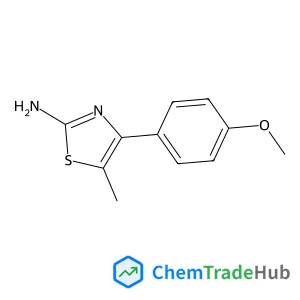
4-(4-Methoxyphenyl)-5-methyl-1,3-thiazol-2-amine
CAS Number:
105512-88-7
Molecular Formula:
C11H12N2OS
Recommended Suppliers





Disclaimer
This page provides academic journal information for reference and research purposes only. We are not affiliated with any journal publishers and do not handle publication submissions. For publication-related inquiries, please contact the respective journal publishers directly.
If you notice any inaccuracies in the information displayed, please contact us at support@chemtradehub.com. We will promptly review and address your concerns.