












Evaluating chemical ligation techniques for the synthesis of block copolypeptides, polypeptoids and block copolypept(o)ides: a comparative study
Literature Information
Publication Date
2015-05-01
DOI
10.1039/C5PY00461F
Impact Factor
5.582
Authors
Kristina Klinker, Regina Holm, Philipp Heller, Matthias Barz
View Original
Abstract
In this work, we describe the synthesis of block copolypeptides, polypeptoids and block copolypept(o)ides by chemical ligation techniques. Polysarcosine (PSar), poly(N-ε-trifluoroacetyl-L-lysine) (PLys(TFA)) and poly(γ-benzyl-L-glutamate) (PGlu(OBzl)) homopolymers of different polarities and end group functionalities but with similar average degrees of polymerization (Xn = 50 and 100) could be obtained by ring opening polymerization (ROP) of α-amino acid N-carboxyanhydrides (NCA) and postpolymerization modification reactions. In the next step, these polymers were applied to copper(I)-catalyzed azide–alkyne coupling (CuAAC), strain-promoted azide–alkyne coupling (SPAAC) and native chemical ligation (NCL). Our results suggest that all the employed ligation techniques can be used for the synthesis of block copolypeptides, polypeptoids and block copolypept(o)ides. SPAAC displayed, for most conditions, the highest ligation efficiencies (up to 86%) and, from a practical point of view, is the most feasible method. NCL, however, performed very well for short hydrophilic polymers (up to 88%) and is favourable for the ligation of peptides from solid phase peptide synthesis (SPPS) to polysarcosine. As a proof of principle, we report a protocol for an efficient NCL coupling of polysarcosine to the T-cell receptor core peptide (TCR CP), which is known to inhibit IL-2 production in antigen-stimulated T cells and, therefore, to suppress inflammation. In a comparative study, the ligation method, which directly relates to the chemical nature of the ligation site, neither influenced cytotoxicity nor complement activation. To conclude, chemical ligation techniques represent a complementary synthetic approach to the well-established sequential ring opening polymerization of NCAs.
Related Literature
Towards being genuinely smart: ‘isothermally-responsive’ polymers as versatile, programmable scaffolds for biologically-adaptable materials
Daniel J. Phillips
2014-12-05
Review Article
DOI: 10.1039/C4PY01539H
Well-defined two dimensional covalent organic polymers: rational design, controlled syntheses, and potential applications
Zhonghua Xiang, Dapeng Cao, Liming Dai
2015-01-23
Review Article
DOI: 10.1039/C4PY01383B
‘One-pot’ sequential deprotection/functionalisation of linear-dendritic hybrid polymers using a xanthate mediated thiol/Michael addition
Sam E. R. Auty, Oliver C. J. Andrén, Faye Y. Hern, Michael Malkoch, Steven P. Rannard
2014-10-07
Paper
DOI: 10.1039/C4PY01253D
Paclitaxel-loaded cholesterol-conjugated polyoxyethylene sorbitol oleate polymeric micelles for glioblastoma therapy across the blood–brain barrier
Shasha Li, Taojian Tu, Xingxing Qi, Yerong Xiong, Shuang Du, Yan Shen, Jiasheng Tu, Chunmeng Sun
2015-02-13
Paper
DOI: 10.1039/C4PY01422G
Facile synthesis of well-controlled poly(glycidyl methacrylate) and its block copolymers via SARA ATRP at room temperature
Francisco Catalão, Joana R. Góis, A. S. M. Trino, Arménio C. Serra, Jorge F. J. Coelho
2014-12-23
Paper
DOI: 10.1039/C4PY01616E
Synthesis of well-defined α,ω-telechelic multiblock copolymers in aqueous medium: in situ generation of α,ω-diols
Alexandre Simula, Vasiliki Nikolaou, Athina Anastasaki, Fehaid Alsubaie, Gabit Nurumbetov
2015-01-16
Paper
DOI: 10.1039/C4PY01802H
Red fluorescent cross-linked glycopolymer nanoparticles based on aggregation induced emission dyes for cell imaging
Ke Wang, Xiqi Zhang, Bin Yang, Zhen Li, Qingsong Zhang, Zengfang Huang, Yen Wei
2014-11-27
Paper
DOI: 10.1039/C4PY01452A
Surface-initiated Cu(0) mediated controlled radical polymerization (SI-CuCRP) using a copper plate
Tao Zhang, Yunhao Du, Felix Müller, Ihsan Amin, Rainer Jordan
2015-02-17
Paper
DOI: 10.1039/C5PY00093A
You might also like
Compound Q&A
What are the main uses of (5-Sulfamoyl-3-pyridinyl)boronic acid (CAS: 951233-61-7)?
(5-Sulfamoyl-3-pyridinyl)boronic acid is primarily used in chemical synthesis, p...
951233-61-7(5-Sulfamoyl-3-pyrid...
Compound Q&A
How is Benzyl 2-methyl-2-(methylsulfonyl)-4-pentenoate (CAS: 1942858-50-5) typically synthesized?
Benzyl 2-methyl-2-(methylsulfonyl)-4-pentenoate is typically synthesized via est...
1942858-50-5Benzyl 2-methyl-2-(m...
Compound Q&A
What precautions should be taken when handling 8-Fluoroquinolin-6-ol (CAS: 209353-22-0)?
When handling 8-Fluoroquinolin-6-ol (CAS: 209353-22-0), it is important to use p...
209353-22-08-Fluoroquinolin-6-o...
Compound Q&A
What are the physical and chemical properties of 1,3-Dibromo-5-(2-methyl-2-propanyl)benzene (CAS: 129316-09-2)?
1,3-Dibromo-5-(2-methyl-2-propanyl)benzene (CAS: 129316-09-2) is a crystalline c...
129316-09-21,3-Dibromo-5-(2-met...
Compound Q&A
What industries use Ethyl 7-chloro-4-oxo-1-(1,3-thiazol-2-yl)-1,4-dihydro-1,8-naphthyridine-3-carboxylate (CAS: 174726-87-5)?
Ethyl 7-chloro-4-oxo-1-(1,3-thiazol-2-yl)-1,4-dihydro-1,8-naphthyridine-3-carbox...
174726-87-5Ethyl 7-chloro-4-oxo...
Compound Q&A
What precautions should be taken when handling Delta-7-Avenasterol (CAS: 23290-26-8)?
When handling Delta-7-Avenasterol (CAS: 23290-26-8), it is important to wear app...
23290-26-8Delta-7-Avenasterol
Compound Q&A
What precautions should be taken when handling N-({(5R)-3-[3-Fluoro-4-(4-morpholinyl)phenyl]-2-oxo-1,3-oxazolidin-5-yl}methyl)acetamide (CAS: 872992-20-6)?
Proper handling involves the use of personal protective equipment such as gloves...
872992-20-6N-({(5R)-3-[3-Fluoro...
Compound Q&A
What precautions should be taken when handling 2-Methyl-2-proanyl 4-[(2-aminophenyl)amino]-1-piperidinecarboxylate (CAS: 79099-00-6)?
When handling 2-Methyl-2-proanyl 4-[(2-aminophenyl)amino]-1-piperidinecarboxylat...
79099-00-62-Methyl-2-propanyl ...
Compound Q&A
What is N-Methyl-4-chlorobenzylamine hydrochloride (CAS: 65542-24-7)?
N-Methyl-4-chlorobenzylamine hydrochloride (CAS: 65542-24-7) is a organic compou...
65542-24-7N-Methyl-4-chloroben...
Compound Q&A
Is [2-(Dodecyloxy)ethoxy]acetic acid (CAS: 27306-90-7) safe?
[2-(Dodecyloxy)ethoxy]acetic acid (CAS: 27306-90-7) is generally considered safe...
27306-90-7[2-(Dodecyloxy)ethox...
Source Journal
Polymer Chemistry

CiteScore:
8.6
Self-citation Rate:
7.3%
Articles per Year:
457
Polymer Chemistry welcomes submissions in all areas of polymer science that have a strong focus on macromolecular chemistry. Manuscripts may cover a broad range of fields, yet no direct application focus is required.
Recommended Compounds
![4,10-Dihydroxy-3H-pyrano[3,4,5-kl]xanthen-3-one structure](https://static.chemtradehub.com/structs/125/1259330-61-4-de48.webp "4,10-Dihydroxy-3H-pyrano[3,4,5-kl]xanthen-3-one structure")
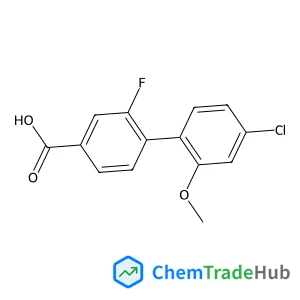
4-(4-Chloro-2-methoxyphenyl)-3-fluorobenzoic acid
CAS Number:
1261970-23-3
Molecular Formula:
C14H10ClFO3
![5-Chloropyrrolo[2,1-f][1,2,4]triazin-4(3H)-one structure](https://static.chemtradehub.com/structs/888/888720-60-3-4f7c.webp "5-Chloropyrrolo[2,1-f][1,2,4]triazin-4(3H)-one structure")
Recommended Suppliers




Disclaimer
This page provides academic journal information for reference and research purposes only. We are not affiliated with any journal publishers and do not handle publication submissions. For publication-related inquiries, please contact the respective journal publishers directly.
If you notice any inaccuracies in the information displayed, please contact us at support@chemtradehub.com. We will promptly review and address your concerns.