












![1-Oxa-8-azaspiro[4.5]decan-3-ol structure](https://static.chemtradehub.com/structs/757/757239-76-2-a0ec.webp "1-Oxa-8-azaspiro[4.5]decan-3-ol structure")
Evolution of magnetization due to asymmetric dimerization: theoretical considerations and application to aberrant oligomers formed by apoSOD12SH
Literature Information
Publication Date
2015-07-09
DOI
10.1039/C5CP03044G
Impact Factor
3.676
Authors
Ashok Sekhar, Alex D. Bain, Jessica A. O. Rumfeldt, Elizabeth M. Meiering
View Original
Abstract
A set of coupled differential equations is presented describing the evolution of magnetization due to an exchange reaction whereby a pair of identical monomers form an asymmetric dimer. In their most general form the equations describe a three-site exchange process that reduces to two-site exchange under certain limiting conditions that are discussed. An application to the study of sparsely populated, transiently formed sets of aberrant dimers, symmetric and asymmetric, of superoxide dismutase is presented. Fits of concentration dependent CPMG relaxation dispersion profiles provide measures of the dimer dissociation constants and both on- and off-rates. Dissociation constants on the order of 70 mM are extracted from fits of the data, with dimeric populations of ∼2% and lifetimes of ∼6 and ∼2 ms for the symmetric and asymmetric complexes, respectively. This work emphasizes the important role that NMR relaxation experiments can play in characterizing very weak molecular complexes that remain invisible to most biophysical approaches.
Related Literature
Photocatalytic printing of inorganic nanopatterns via poly(styrene-block-carbosilane) copolymer thin films on titania substrates
Juan Peng, Alejandra Garcia Marcos, Seong-Jun Jeong, Holger Frey, Dong Ha Kim
2009-01-06
Communication
DOI: 10.1039/B816398G
(H2NC4H8NCH2CH2NH2)2Zn2Sn2Se7: a hybrid ternary semiconductor stabilized by amine molecules acting simultaneously as ligands and counterions
Aggelos Philippidis, Thomas Bakas, Pantelis N. Trikalitis
2009-02-03
Communication
DOI: 10.1039/B821859E
Expansion of the sortase-mediated labeling method for site-specific N-terminal labeling of cell surfaceproteins on living cells
Teruyasu Yamamoto
2009-01-07
Communication
DOI: 10.1039/B818792D
Evidence of strong hydrogen bonding by 8-aminoguanine
Aaron E. Engelhart, Thomas Hellman Morton, Nicholas V. Hud
2008-12-01
Communication
DOI: 10.1039/B818409G
Biomaterials from sugars: ring-opening polymerization of a carbohydrate lactone
Andrew J. P. White, Molly M. Stevens, Charlotte K. Williams
2008-12-18
Communication
DOI: 10.1039/B817658B
Reversible photoisomerisability and particle size changes of mill-dispersed azobenzene crystals in water
2009-01-27
Communication
DOI: 10.1039/B820022J
You might also like
Compound Q&A
What precautions should be taken when handling 2-Methyl-2-propanyl 5-amino-2-thiophenecarboxylate (CAS: 1498311-57-1)?
When handling 2-Methyl-2-propanyl 5-amino-2-thiophenecarboxylate (CAS: 1498311-5...
1498311-57-12-Methyl-2-propanyl ...
Compound Q&A
What are the physical and chemical properties of 5-Bromo-1,2-dichloro-3-fluorobenzene (CAS: 1000572-93-9)?
5-Bromo-1,2-dichloro-3-fluorobenzene (CAS: 1000572-93-9) is a crystalline solid ...
1000572-93-95-Bromo-1,2-dichloro...
Compound Q&A
How should (2R)-2-Amino-2-(4-bromophenyl)ethanol (CAS: 354153-64-3) be stored?
(2R)-2-Amino-2-(4-bromophenyl)ethanol (CAS: 354153-64-3) should be stored in a c...
354153-64-3(2R)-2-Amino-2-(4-br...
Compound Q&A
What regulatory guidelines apply to Methyl 4-(aminomethyl)tetrahydro-2H-pyran-4-carboxylate hydrochloride (CAS: 362707-24-2)?
Methyl 4-(aminomethyl)tetrahydro-2H-pyran-4-carboxylate hydrochloride (CAS: 3627...
362707-24-2Methyl 4-(aminomethy...
Compound Q&A
What are the main uses of 1,4-dimethyl-1H-pyrazole-5-sulfonyl chloride (CAS: 1174834-52-6)?
1,4-Dimethyl-1H-pyrazole-5-sulfonyl chloride is primarily used as an intermediat...
1174834-52-61,4-dimethyl-1H-pyra...
Compound Q&A
Is Dinaphtho[1,2-b:2',1'-d]furan (CAS: 239-69-0) safe?
Dinaphtho[1,2-b:2',1'-d]furan is generally safe when handled with appropriate pe...
239-69-0Dinaphtho[1,2-b:2',1...
Compound Q&A
What is the market or research trend for 7-Methyl-7,9-dihydro-1H-purine-2,6,8(3H)-trione (CAS: 612-37-3)?
The market for 7-Methyl-7,9-dihydro-1H-purine-2,6,8(3H)-trione (CAS: 612-37-3) i...
612-37-37-Methyl-7,9-dihydro...
Compound Q&A
What are the physical and chemical properties of 2-(4-Chlorophenyl)malonaldehyde (CAS: 205676-17-1)?
2-(4-Chlorophenyl)malonaldehyde (CAS: 205676-17-1) is a colorless or light yello...
205676-17-12-(4-Chlorophenyl)ma...
Compound Q&A
How is 2-Methylchrysene (CAS: 3351-32-4) typically synthesized?
2-Methylchrysene (CAS: 3351-32-4) is typically synthesized via the reaction of c...
3351-32-42-Methylchrysene
Compound Q&A
Is N-(6-aminopyrimidin-4-yl)acetamide (CAS: 89533-23-3) safe?
N-(6-aminopyrimidin-4-yl)acetamide (CAS: 89533-23-3) is generally considered saf...
89533-23-3N-(6-aminopyrimidin-...
Source Journal
Physical Chemistry Chemical Physics

CiteScore:
5.5
Self-citation Rate:
10.3%
Articles per Year:
3036
Physical Chemistry Chemical Physics (PCCP) is an international journal co-owned by 19 physical chemistry and physics societies from around the world. This journal publishes original, cutting-edge research in physical chemistry, chemical physics and biophysical chemistry. To be suitable for publication in PCCP, articles must include significant innovation and/or insight into physical chemistry; this is the most important criterion that reviewers and Editors will judge against when evaluating submissions. The journal has a broad scope and welcomes contributions spanning experiment, theory, computation and data science. Topical coverage includes spectroscopy, dynamics, kinetics, statistical mechanics, thermodynamics, electrochemistry, catalysis, surface science, quantum mechanics, quantum computing and machine learning. Interdisciplinary research areas such as polymers and soft matter, materials, nanoscience, energy, surfaces/interfaces, and biophysical chemistry are welcomed if they demonstrate significant innovation and/or insight into physical chemistry. Joined experimental/theoretical studies are particularly appreciated when complementary and based on up-to-date approaches.
Recommended Compounds

![3-[7-Amino-3-(3-pyridinyl)pyrazolo[1,5-a]pyrimidin-6-yl]phenol structure](https://static.chemtradehub.com/structs/861/861249-77-6-025b.webp "3-[7-Amino-3-(3-pyridinyl)pyrazolo[1,5-a]pyrimidin-6-yl]phenol structure")
3-[7-Amino-3-(3-pyridinyl)pyrazolo[1,5-a]pyrimidin-6-yl]phenol
CAS Number:
861249-77-6
Molecular Formula:
C17H13N5O
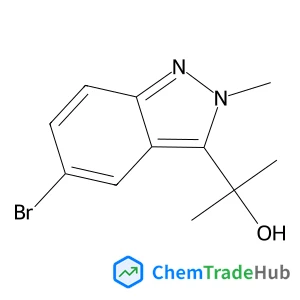
2-(5-Bromo-2-methyl-2H-indazol-3-yl)-2-propanol
CAS Number:
1823787-20-7
Molecular Formula:
C11H13BrN2O
Recommended Suppliers






Disclaimer
This page provides academic journal information for reference and research purposes only. We are not affiliated with any journal publishers and do not handle publication submissions. For publication-related inquiries, please contact the respective journal publishers directly.
If you notice any inaccuracies in the information displayed, please contact us at support@chemtradehub.com. We will promptly review and address your concerns.