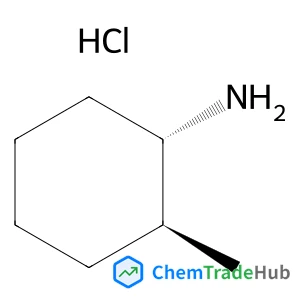
(1R,2R)-2-Methylcyclohexanamine hydrochloride (1:1)
CAS Number:
39558-31-1
Molecular Formula:
C7H16ClN
Torsten Berndt, Ralf Kaethner, Jens Voigtländer, Frank Stratmann, Mark Pfeifle, Patrick Reichle, Mikko Sipilä, Markku Kulmala, Matthias Olzmann
Stabilized Criegee Intermediates (sCIs) have been identified as oxidants of atmospheric trace gases such as SO2, NO2, carboxylic acids or carbonyls. The atmospheric sCI concentrations, and accordingly their importance for trace gas oxidation, are controlled by the rate of the most important loss processes, very likely the unimolecular reactions and the reaction with water vapour (monomer and dimer) ubiquitously present at high concentrations in the troposphere. In this study, the rate coefficients of the unimolecular reaction of the simplest sCI, formaldehyde oxide, CH2OO, and its bimolecular reaction with the water monomer have been experimentally determined at T = (297 ± 1) K and at atmospheric pressure by using a free-jet flow system. CH2OO was produced by the reaction of ozone with C2H4, and CH2OO concentrations were probed indirectly by detecting H2SO4 after titration with SO2. Time-resolved experiments yield a rate coefficient of the unimolecular reaction of k(uni) = (0.19 ± 0.07) s−1, a value that is supported by quantum-chemical and statistical rate theory calculations as well as by additional measurements performed under CH2OO steady-state conditions. A rate coefficient of k(CH2OO+H2O) = (3.2 ± 1.2) × 10−16 cm3 molecule−1 s−1 has been determined for sufficiently low H2O concentrations (<1015 molecule cm−3) that allow separation from the CH2OO reaction with the water dimer. In order to evaluate the accuracy of the experimental approach, the rate coefficients of the reactions with acetaldehyde and acetone were reinvestigated. The obtained rate coefficients k(CH2OO+acetald) = (1.7 ± 0.5) × 10−12 and k(CH2OO+acetone) = (3.4 ± 0.9) × 10−13 cm3 molecule−1 s−1 are in good agreement with literature data.
DOI: 10.1039/C4CP05186F
Tobias Schwabe, Maarten T. P. Beerepoot, Jacob Kongsted
DOI: 10.1039/C4CP04524F
Yongchang Chen, Miao Huo, Qiang Li, Zhaolin Sun, Lijuan Song
DOI: 10.1039/C4CP04881D
Sheng Han, Jianzhong Jiang, Yanshan Huang, Yanping Tang, Jing Cao, Dongqing Wu
DOI: 10.1039/C4CP04887C
Bo Wang, Shane A. Seabrook, Praveen Nedumpully-Govindan, Pengyu Chen, Hong Yin, Lynne Waddington, V. Chandana Epa, Jason K. Kirby, Feng Ding
DOI: 10.1039/C4CP04996A
Taewon Lee, Deok-Yong Cho, Hyung-Soon Kwon, Han-Ill Yoo
DOI: 10.1039/C4CP04576A
Andrew D. Ward, Martin D. King
DOI: 10.1039/C4CP05062B
Alireza Ostadhossein, Ekin D. Cubuk, Georgios A. Tritsaris, Efthimios Kaxiras, Sulin Zhang, Adri C. T. van Duin
DOI: 10.1039/C4CP05198J
Wenyang Jin, Xiaohong Liu, Yining Han, Shu Li, Tianying Yan
DOI: 10.1039/C4CP04853A
Amin Ordikhani Seyedlar, Siegfried Stapf, Carlos Mattea
DOI: 10.1039/C4CP04178J
(5-Sulfamoyl-3-pyridinyl)boronic acid is primarily used in chemical synthesis, p...
Benzyl 2-methyl-2-(methylsulfonyl)-4-pentenoate is typically synthesized via est...
When handling 8-Fluoroquinolin-6-ol (CAS: 209353-22-0), it is important to use p...
1,3-Dibromo-5-(2-methyl-2-propanyl)benzene (CAS: 129316-09-2) is a crystalline c...
Ethyl 7-chloro-4-oxo-1-(1,3-thiazol-2-yl)-1,4-dihydro-1,8-naphthyridine-3-carbox...
When handling Delta-7-Avenasterol (CAS: 23290-26-8), it is important to wear app...
Proper handling involves the use of personal protective equipment such as gloves...
When handling 2-Methyl-2-proanyl 4-[(2-aminophenyl)amino]-1-piperidinecarboxylat...
N-Methyl-4-chlorobenzylamine hydrochloride (CAS: 65542-24-7) is a organic compou...
[2-(Dodecyloxy)ethoxy]acetic acid (CAS: 27306-90-7) is generally considered safe...

Physical Chemistry Chemical Physics (PCCP) is an international journal co-owned by 19 physical chemistry and physics societies from around the world. This journal publishes original, cutting-edge research in physical chemistry, chemical physics and biophysical chemistry. To be suitable for publication in PCCP, articles must include significant innovation and/or insight into physical chemistry; this is the most important criterion that reviewers and Editors will judge against when evaluating submissions. The journal has a broad scope and welcomes contributions spanning experiment, theory, computation and data science. Topical coverage includes spectroscopy, dynamics, kinetics, statistical mechanics, thermodynamics, electrochemistry, catalysis, surface science, quantum mechanics, quantum computing and machine learning. Interdisciplinary research areas such as polymers and soft matter, materials, nanoscience, energy, surfaces/interfaces, and biophysical chemistry are welcomed if they demonstrate significant innovation and/or insight into physical chemistry. Joined experimental/theoretical studies are particularly appreciated when complementary and based on up-to-date approaches.
![4-Fluoro-2-(4-{[(3S,4R)-4-(2-hydroxy-2-propanyl)-3-pyrrolidinyl]amino}-6,7-dimethoxy-2-quinazolinyl)phenol hydrochloride (1:1) structure](https://static.chemtradehub.com/structs/143/1431697-96-9-619c.webp "4-Fluoro-2-(4-{[(3S,4R)-4-(2-hydroxy-2-propanyl)-3-pyrrolidinyl]amino}-6,7-dimethoxy-2-quinazolinyl)phenol hydrochloride (1:1) structure")