













Luminescence studies on SnO2 and SnO2:Eu nanocrystals grown by laser assisted flow deposition
Literature Information
Publication Date
2015-04-21
DOI
10.1039/C4CP06114D
Impact Factor
3.676
Authors
N. F. Santos, J. Rodrigues, T. Holz, N. Ben Sedrine, A. Sena, A. J. Neves, F. M. Costa, T. Monteiro
View Original
Abstract
Transparent conductive tin oxide materials have been a research topic extensively studied in recent years due to the great interest for many applications. However, in most of them, the pure form is rarely used, being usually modified by the incorporation of dopants. Selecting the most appropriate technique to develop nanocrystals of doped tin oxide and understanding the influence of dopant on the optical properties are the challenges that need to be addressed when envisaging devices. To fulfill this objective, the recently developed laser assisted flow deposition (LAFD) method is explored to grow SnO2 and SnO2:Eu nanocrystals. The morphology of these nanocrystals was investigated by scanning electron microscopy and well defined prismatic nanocrystals with sizes of ∼60 nm were identified. The crystalline quality assessed by X-ray diffraction measurements and Raman spectroscopy indicates that the produced nanocrystals are monophasic and crystallize in the tetragonal rutile structure. Steady state luminescence studies provide the information on the optical active centres in the SnO2 and SnO2:Eu nanocrystals. For the undoped samples only broad emission bands were observed by pumping the samples in the ultraviolet region. The broad emission was found to be an overlap of green and red optical centres as identified by temperature and excitation intensity dependent luminescence. The latter was found to exhibit an excitonic-related behaviour and the green emission was found to be of utmost importance to discuss the intraionic luminescence in the doped samples. For the SnO2:Eu nanocrystals the luminescence is dominated by the magnetic allowed 5D0 → 7F1 transition with the ions in almost undistorted centrosymmetric sites. The ion luminescence integrated intensity is found to increase with increasing temperatures being well accounted for a thermal population provided by the thermal quenching of the green band.
Related Literature
A Rh-catalyzed three-component reaction for the diastereoselective synthesis of pyrazolone derivatives with contiguous quaternary stereocenters
Chaoqun Ao, Jingjing Huang, Xinfang Xu, Shikun Jia, Zhenghui Kang, Wenhao Hu
2020-04-13
Communication
DOI: 10.1039/D0OB00482K
Direct synthesis of cyclic lipopeptides using intramolecular native chemical ligation and thiol–ene CLipPA chemistry
2020-02-05
Paper
DOI: 10.1039/D0OB00203H
β-Selective xylulofuranosylation via a conformationally-restricted glycosyl donor
Bo-Shun Huang, Todd L. Lowary
2020-02-28
Paper
DOI: 10.1039/D0OB00260G
Bifunctional squaramide catalyzed stereoselective Mannich reaction of α-azido ketones with isatin-derived ketimines
Seda Karahan, Cihangir Tanyeli
2019-12-11
Paper
DOI: 10.1039/C9OB02208B
A Selectfluor-promoted oxidative reaction of disulfides and amines: access to sulfinamides
Jiang Liu, Romana Pajkert, Gerd-Volker Röschenthaler, Jianlin Han
2020-05-06
Paper
DOI: 10.1039/D0OB00720J
Phenylboronic acid-catalyzed tandem construction of S–S and C–S bonds: a new method for the synthesis of benzyl disulfanylsulfone derivatives from S-benzyl thiosulfonates
Raju Jannapu Reddy, Md. Waheed, Gamidi Rama Krishna
2020-04-03
Communication
DOI: 10.1039/D0OB00442A
Construction of key building blocks towards the synthesis of cortistatins
Satrajit Indu, Rahul D. Telore, Krishna P. Kaliappan
2020-03-02
Paper
DOI: 10.1039/D0OB00170H
Recent advances in cobalt-catalysed C–H functionalizations
Alessio Baccalini, Stefania Vergura, Pravas Dolui, Giuseppe Zanoni, Debabrata Maiti
2019-11-07
Review Article
DOI: 10.1039/C9OB01994D
You might also like
Compound Q&A
What regulatory guidelines apply to 6-Bromo-2-methylimidazo[1,2-a]pyrimidine (CAS: 1111638-05-1)?
6-Bromo-2-methylimidazo[1,2-a]pyrimidine (CAS: 1111638-05-1) falls under various...
1111638-05-16-Bromo-2-methylimid...
Compound Q&A
Are there alternatives to 1-Pyrrolidineethanol, β-methyl-α-phenyl-, (αS,βR) (CAS: 123620-80-4) in synthesis?
While there are no direct alternatives, similar compounds like 1-Pyrrolidineetha...
123620-80-41-Pyrrolidineethanol...
Compound Q&A
Is 4-Methyl-2,6-bis(2-methyl-2-propanyl)phenyl methylcarbamate (CAS: 1918-11-2) safe?
4-Methyl-2,6-bis(2-methyl-2-propanyl)phenyl methylcarbamate (CAS: 1918-11-2) is ...
1918-11-24-Methyl-2,6-bis(2-m...
Compound Q&A
How should 2-(3-Bromo-4-fluorophenyl)-1,3-dioxolane (CAS: 77771-04-1) be stored?
2-(3-Bromo-4-fluorophenyl)-1,3-dioxolane (CAS: 77771-04-1) should be stored in a...
77771-04-12-(3-Bromo-4-fluorop...
Compound Q&A
What are the physical and chemical properties of 4,5,6,7-Tetrahydro-1H-indazole hydrochloride (CAS: 18161-11-0)?
4,5,6,7-Tetrahydro-1H-indazole hydrochloride is a white crystalline solid with a...
18161-11-04,5,6,7-Tetrahydro-1...
Compound Q&A
What is (2R)-1-Methoxy-3-phenyl-2-propanamine (CAS: 59919-07-2)?
(2R)-1-Methoxy-3-phenyl-2-propanamine is a chiral organic compound with the CAS ...
59919-07-2(2R)-1-Methoxy-3-phe...
Compound Q&A
What industries use Ethyl 1-(1-phenylethyl)-1H-imidazole-5-carboxylate (CAS: 56649-47-9)?
Ethyl 1-(1-phenylethyl)-1H-imidazole-5-carboxylate is used in various industries...
56649-47-9Ethyl 1-(1-phenyleth...
Compound Q&A
What regulatory guidelines apply to 4-[(1E,3S)-1-(4-Hydroxyphenyl)-1,4-pentadien-3-yl]phenol (CAS: 17676-24-3)?
4-[(1E,3S)-1-(4-Hydroxyphenyl)-1,4-pentadien-3-yl]phenol (CAS: 17676-24-3) falls...
17676-24-34-[(1E,3S)-1-(4-Hydr...
Compound Q&A
What industries use (S)-3-Amino-5-phenylpentanoic acid hydrochloride (CAS: 331846-97-0)?
(S)-3-Amino-5-phenylpentanoic acid hydrochloride is primarily used in the pharma...
331846-97-0(S)-3-Amino-5-phenyl...
Compound Q&A
How is 7-methoxy-1-benzothiophene-2-carboxylic acid (CAS: 88791-07-5) typically synthesized?
7-Methoxy-1-benzothiophene-2-carboxylic acid is typically synthesized by reactin...
88791-07-57-methoxy-1-benzothi...
Source Journal
Physical Chemistry Chemical Physics

CiteScore:
5.5
Self-citation Rate:
10.3%
Articles per Year:
3036
Physical Chemistry Chemical Physics (PCCP) is an international journal co-owned by 19 physical chemistry and physics societies from around the world. This journal publishes original, cutting-edge research in physical chemistry, chemical physics and biophysical chemistry. To be suitable for publication in PCCP, articles must include significant innovation and/or insight into physical chemistry; this is the most important criterion that reviewers and Editors will judge against when evaluating submissions. The journal has a broad scope and welcomes contributions spanning experiment, theory, computation and data science. Topical coverage includes spectroscopy, dynamics, kinetics, statistical mechanics, thermodynamics, electrochemistry, catalysis, surface science, quantum mechanics, quantum computing and machine learning. Interdisciplinary research areas such as polymers and soft matter, materials, nanoscience, energy, surfaces/interfaces, and biophysical chemistry are welcomed if they demonstrate significant innovation and/or insight into physical chemistry. Joined experimental/theoretical studies are particularly appreciated when complementary and based on up-to-date approaches.
Recommended Compounds

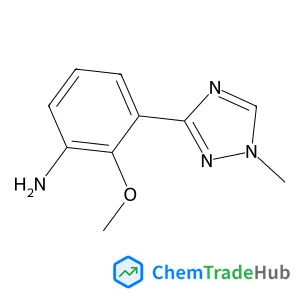
2-Methoxy-3-(1-methyl-1H-1,2,4-triazol-3-yl)aniline
CAS Number:
1609394-10-6
Molecular Formula:
C10H12N4O


Recommended Suppliers




Disclaimer
This page provides academic journal information for reference and research purposes only. We are not affiliated with any journal publishers and do not handle publication submissions. For publication-related inquiries, please contact the respective journal publishers directly.
If you notice any inaccuracies in the information displayed, please contact us at support@chemtradehub.com. We will promptly review and address your concerns.