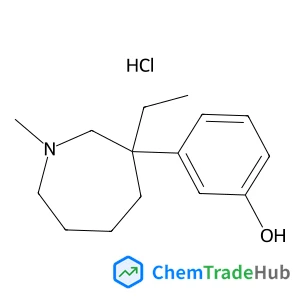
3-(3-Ethyl-1-methyl-3-azepanyl)phenol hydrochloride (1:1)
CAS Number:
59263-76-2
Molecular Formula:
C15H24ClNO
Lin Wang, Jinglin Shen, Fangrui Ji, Wenzhe Li, Chunyu Jia
Polyvinyl alcohol (PVA) hydrogels have been proposed for use as promising biomaterials in biomedical and tissue engineering, and graphene oxide (GO) has been recognized as a unique two-dimensional building block for various graphene-based supramolecular architectures. In this article, we systematically studied the influence of three kinds of PVA with different molecular weights on the interaction between PVA and GO. Moreover, the effects of PVA on the gelation of GO were also investigated. The native PVA hydrogel, as well as PVA–GO hybrid hydrogels, have been thoroughly characterized by the phase behavior study and various techniques including field emission scanning electron microscopy (FE-SEM), Fourier transform infrared (FT-IR) spectroscopy, thermogravimetric analysis (TGA) and rheological measurements. It can be seen that with the increase of the molecular weight of PVA, the addition of GO can effectively promote the gelation of PVA which can be reflected by a decrease of the critical gel concentration (CGC) for PVA–GO hydrogels. Dye adsorption experiments indicate that the toxic dye, i.e., methylene blue (MB), was efficiently entrapped in the PVA–GO xerogels. It is also demonstrated that the gelation of PVA and GO composites can be promoted by different supramolecular interactions, including hydrogen bonding and electrostatic interaction. This work indicates that the PVA–GO composite is a good candidate for preparing “super” and “smart” hydrogels and will enable further studies on the supramolecular chemistry of PVA, graphene and its derivatives.
Jiayue Yang, Bo Jiang
DOI: 10.1039/C7CP01428G
W. D. Stevenson, Z. Ahmed, X. B. Zeng, C. Welch, G. H. Mehl
DOI: 10.1039/C7CP01404J
Jing Wan, Likui Yang, Ning Wei, Jiao Shi, Qing-Hua Qin
DOI: 10.1039/C7CP01274H
Jorge A. Carrazana-García, Enrique M. Cabaleiro-Lago, Jesús Rodríguez-Otero
DOI: 10.1039/C7CP01491K
Xiaodan Xu, Lu Cai, Xiaoli Zheng, Qun Xu
DOI: 10.1039/C7CP01277B
Chun Du, Jun Wang, Xiao Liu, Jie Yang, Kun Cao, Yanwei Wen
DOI: 10.1039/C7CP01588G
Hong-Yu Fu, Ning Xu, Yi-Min Pan, Xiao-Lin Lu, Min Xia
DOI: 10.1039/C7CP01281K
Francesco Nastasi, Giuseppina La Ganga, Sebastiano Campagna, Zois Syrgiannis, Francesco Rigodanza, Stefania Vitale, Antonino Licciardello
DOI: 10.1039/C7CP01597F
J. F. Eckhard, D. Neuwirth, M. Tschurl, U. Heiz
DOI: 10.1039/C7CP01293D
Waste containing N-Methoxy-N-methyl-1,3-thiazole-5-carboxamide (CAS: 898825-89-3...
N-(4-Biphenylyl)dibenzo[b,d]furan-4-amine should be stored in a tightly sealed c...
The market for 3-Acetamido-5-amino-2,4,6-triiodobenzoic acid (CAS: 1713-07-1) is...
Benzyl 2-O-acetyl-3,4,6-tri-O-benzyl-beta-D-galactopyranoside (CAS: 61820-03-9) ...
2-Ethylpiperazine dihydrochloride (CAS: 438050-52-3) is regulated under the Glob...
1,1'-[1,3-Phenylenebis(methylene)]bis(3-methyl-1H-pyrrole-2,5-dione) (CAS: 11946...
Several alternatives can be used in the synthesis of 5-Fluoro-2-(1-pyrrolidinyl)...
Proper personal protective equipment (PPE) must be worn when handling this compo...
When handling 6-Bromoimidazo[1,2-a]pyridin-8-amine, it is important to wear appr...
Alternatives to (2S,4R)-4-(4-Nitrobenzyl)pyrrolidine-2-carboxylic acid hydrochlo...

Physical Chemistry Chemical Physics (PCCP) is an international journal co-owned by 19 physical chemistry and physics societies from around the world. This journal publishes original, cutting-edge research in physical chemistry, chemical physics and biophysical chemistry. To be suitable for publication in PCCP, articles must include significant innovation and/or insight into physical chemistry; this is the most important criterion that reviewers and Editors will judge against when evaluating submissions. The journal has a broad scope and welcomes contributions spanning experiment, theory, computation and data science. Topical coverage includes spectroscopy, dynamics, kinetics, statistical mechanics, thermodynamics, electrochemistry, catalysis, surface science, quantum mechanics, quantum computing and machine learning. Interdisciplinary research areas such as polymers and soft matter, materials, nanoscience, energy, surfaces/interfaces, and biophysical chemistry are welcomed if they demonstrate significant innovation and/or insight into physical chemistry. Joined experimental/theoretical studies are particularly appreciated when complementary and based on up-to-date approaches.
![1-Naphthalenesulfonic acid, 2-[(2-hydroxy-1-naphthalenyl)azo]-, bariumsalt (2:1) structure](https://static.chemtradehub.com/structs/110/1103-38-4-0b33.webp "1-Naphthalenesulfonic acid, 2-[(2-hydroxy-1-naphthalenyl)azo]-, bariumsalt (2:1) structure")