













Origins of improved carrier multiplication efficiency in elongated semiconductor nanostructures
Literature Information
Publication Date
2014-12-10
DOI
10.1039/C4CP03706E
Impact Factor
3.676
Authors
Andrew Sills, Marco Califano
View Original
Abstract
Nanorod solar cells have been attracting a lot of attention recently, as they have been shown to exhibit a lower carrier multiplication onset and a higher quantum efficiency than quantum dots with similar bandgaps. The underpinning theory for this phenomenon is not yet completely understood, and is still the subject of ongoing study. Here we conduct a theoretical investigation into CM efficiency in elongated semiconductor nanostructures with square cross section made of different materials (GaAs, GaSb, InAs, InP, InSb, CdSe, Ge, Si and PbSe), using a single-band effective mass model. Following Luo, Franceschetti and Zunger we adopt the CM figure of merit (the ratio between biexciton and single-exciton density of states) as a measure of CM efficiency and investigate its dependence on the aspect ratio for both (a) constant cross section (i.e. varying the volume) and (b) constant volume (i.e., varying the cross section), by decoupling electronic structure effects from surface-related effects, increased absorption and Coulomb coupling effects. The results show that in both (a) and (b) cases elongation causes an increase in both single- and bi-exciton density of states, with the latter, however, growing much faster with increasing energy. This leads to the availability of more bi-exciton states than single-exciton states for photon energies just above the bi-exciton ground state and therefore suggests a higher probability of CM at these energies for elongated structures. Our results therefore show that the origin of the observed decrease of the CM threshold in elongated structures can be attributed purely to electronic structure effects, paving the way to the implementation of CM-efficiency-boosting strategies in nanostructures based on the lowering of the CM onset.
Related Literature
Ionic liquid clusters: structure, formation mechanism, and effect on the behavior of ionic liquids
Shimou Chen, Suojiang Zhang, Xiaomin Liu, Jinquan Wang, Jianji Wang, Kun Dong, Jian Sun, Baohua Xu
2013-10-17
Perspective
DOI: 10.1039/C3CP53116C
Pushing the limits in accurate vibrational structure calculations: anharmonic frequencies of lithium fluoride clusters (LiF)n, n = 2–10
Dominik Oschetzki, Guntram Rauhut
2014-06-26
Paper
DOI: 10.1039/C4CP02264E
Design of nanoscaled materials based on tetraoxa[8]circulene
Gleb V. Baryshnikov, Nataliya N. Karaush, Valentina A. Minaeva
2014-01-10
Communication
DOI: 10.1039/C3CP55154G
Electron induced single strand break and cyclization: a DFT study on the radiosensitization mechanism of the nucleotide of 8-bromoguanine
Lidia Chomicz, Al'ona Furmanchuk, Jerzy Leszczynski, Janusz Rak
2014-02-06
Paper
DOI: 10.1039/C3CP55411B
Experimental and simulation studies of unusual current blockade induced by translocation of small oxidized PEG through a single nanopore
S. Cabello-Aguilar, A. Abou Chaaya, F. Picaud, M. Bechelany, C. Pochat-Bohatier, S. Yesylevskyy, S. Kraszewski, M. C. Bechelany, F. Rossignol, E. Balanzat, J. M. Janot, P. Miele, P. Dejardin, S. Balme
2014-07-08
Paper
DOI: 10.1039/C4CP01954G
Crystal and local structure refinement in Ca2Al3O6F explored by X-ray diffraction and Raman spectroscopy
Zhiguo Xia, Maxim S. Molokeev, Aleksandr S. Oreshonkov, Victor V. Atuchin, Ru-Shi Liu, Cheng Dong
2013-11-05
Paper
DOI: 10.1039/C3CP53816H
Ab initio molecular dynamics simulations of aqueous triflic acid confined in carbon nanotubes
Jeffrey K. Clark II, Bradley F. Habenicht, Stephen J. Paddison
2014-06-20
Paper
DOI: 10.1039/C4CP01066C
Determining the molecular basis for the pH-dependent interaction between 2′-deoxynucleotides and 9H-pyrido[3,4-b]indole in its ground and electronic excited states
M. Paula Denofrio, Fernando S. García Einschlag, Carlos A. Franca, Reinaldo Pis Diez, Rosa Erra-Balsells, Franco M. Cabrerizo
2014-06-18
Paper
DOI: 10.1039/C4CP01910E
Synthesis and photocatalysis performances of bismuth oxynitrate photocatalysts with layered structures
Y. Zhu
2014-07-02
Paper
DOI: 10.1039/C4CP01489H
You might also like
Compound Q&A
What are the main uses of (5-Sulfamoyl-3-pyridinyl)boronic acid (CAS: 951233-61-7)?
(5-Sulfamoyl-3-pyridinyl)boronic acid is primarily used in chemical synthesis, p...
951233-61-7(5-Sulfamoyl-3-pyrid...
Compound Q&A
How is Benzyl 2-methyl-2-(methylsulfonyl)-4-pentenoate (CAS: 1942858-50-5) typically synthesized?
Benzyl 2-methyl-2-(methylsulfonyl)-4-pentenoate is typically synthesized via est...
1942858-50-5Benzyl 2-methyl-2-(m...
Compound Q&A
What precautions should be taken when handling 8-Fluoroquinolin-6-ol (CAS: 209353-22-0)?
When handling 8-Fluoroquinolin-6-ol (CAS: 209353-22-0), it is important to use p...
209353-22-08-Fluoroquinolin-6-o...
Compound Q&A
What are the physical and chemical properties of 1,3-Dibromo-5-(2-methyl-2-propanyl)benzene (CAS: 129316-09-2)?
1,3-Dibromo-5-(2-methyl-2-propanyl)benzene (CAS: 129316-09-2) is a crystalline c...
129316-09-21,3-Dibromo-5-(2-met...
Compound Q&A
What industries use Ethyl 7-chloro-4-oxo-1-(1,3-thiazol-2-yl)-1,4-dihydro-1,8-naphthyridine-3-carboxylate (CAS: 174726-87-5)?
Ethyl 7-chloro-4-oxo-1-(1,3-thiazol-2-yl)-1,4-dihydro-1,8-naphthyridine-3-carbox...
174726-87-5Ethyl 7-chloro-4-oxo...
Compound Q&A
What precautions should be taken when handling Delta-7-Avenasterol (CAS: 23290-26-8)?
When handling Delta-7-Avenasterol (CAS: 23290-26-8), it is important to wear app...
23290-26-8Delta-7-Avenasterol
Compound Q&A
What precautions should be taken when handling N-({(5R)-3-[3-Fluoro-4-(4-morpholinyl)phenyl]-2-oxo-1,3-oxazolidin-5-yl}methyl)acetamide (CAS: 872992-20-6)?
Proper handling involves the use of personal protective equipment such as gloves...
872992-20-6N-({(5R)-3-[3-Fluoro...
Compound Q&A
What precautions should be taken when handling 2-Methyl-2-proanyl 4-[(2-aminophenyl)amino]-1-piperidinecarboxylate (CAS: 79099-00-6)?
When handling 2-Methyl-2-proanyl 4-[(2-aminophenyl)amino]-1-piperidinecarboxylat...
79099-00-62-Methyl-2-propanyl ...
Compound Q&A
What is N-Methyl-4-chlorobenzylamine hydrochloride (CAS: 65542-24-7)?
N-Methyl-4-chlorobenzylamine hydrochloride (CAS: 65542-24-7) is a organic compou...
65542-24-7N-Methyl-4-chloroben...
Compound Q&A
Is [2-(Dodecyloxy)ethoxy]acetic acid (CAS: 27306-90-7) safe?
[2-(Dodecyloxy)ethoxy]acetic acid (CAS: 27306-90-7) is generally considered safe...
27306-90-7[2-(Dodecyloxy)ethox...
Source Journal
Physical Chemistry Chemical Physics

CiteScore:
5.5
Self-citation Rate:
10.3%
Articles per Year:
3036
Physical Chemistry Chemical Physics (PCCP) is an international journal co-owned by 19 physical chemistry and physics societies from around the world. This journal publishes original, cutting-edge research in physical chemistry, chemical physics and biophysical chemistry. To be suitable for publication in PCCP, articles must include significant innovation and/or insight into physical chemistry; this is the most important criterion that reviewers and Editors will judge against when evaluating submissions. The journal has a broad scope and welcomes contributions spanning experiment, theory, computation and data science. Topical coverage includes spectroscopy, dynamics, kinetics, statistical mechanics, thermodynamics, electrochemistry, catalysis, surface science, quantum mechanics, quantum computing and machine learning. Interdisciplinary research areas such as polymers and soft matter, materials, nanoscience, energy, surfaces/interfaces, and biophysical chemistry are welcomed if they demonstrate significant innovation and/or insight into physical chemistry. Joined experimental/theoretical studies are particularly appreciated when complementary and based on up-to-date approaches.
Recommended Compounds
![4-Fluoro-2-(4-{[(3S,4R)-4-(2-hydroxy-2-propanyl)-3-pyrrolidinyl]amino}-6,7-dimethoxy-2-quinazolinyl)phenol hydrochloride (1:1) structure](https://static.chemtradehub.com/structs/143/1431697-96-9-619c.webp "4-Fluoro-2-(4-{[(3S,4R)-4-(2-hydroxy-2-propanyl)-3-pyrrolidinyl]amino}-6,7-dimethoxy-2-quinazolinyl)phenol hydrochloride (1:1) structure")
4-Fluoro-2-(4-{[(3S,4R)-4-(2-hydroxy-2-propanyl)-3-pyrrolidinyl]amino}-6,7-dimethoxy-2-quinazolinyl)phenol hydrochloride (1:1)
CAS Number:
1431697-96-9
Molecular Formula:
C23H28ClFN4O4
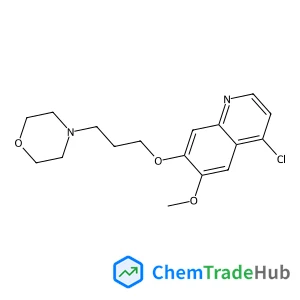
4-(3-((4-Chloro-6-methoxyquinolin-7-yl)oxy)propyl)morpholine
CAS Number:
205448-32-4
Molecular Formula:
C17H21ClN2O3
Recommended Suppliers






Disclaimer
This page provides academic journal information for reference and research purposes only. We are not affiliated with any journal publishers and do not handle publication submissions. For publication-related inquiries, please contact the respective journal publishers directly.
If you notice any inaccuracies in the information displayed, please contact us at support@chemtradehub.com. We will promptly review and address your concerns.