












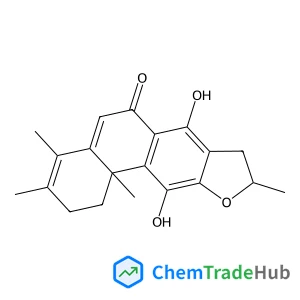
Phenanthro(3,2-b)furan-6(2H)-one, 1,8,9,11b-tetrahydro-7,11-dihydroxy-3,4,9,11b-tetramethyl-, cis-
CAS Number:
99624-92-7
Molecular Formula:
C20H22O4
R. H. Aguilera-del-Toro, A. Vega, L. C. Balbás
The favorable stoichiometry of ConOm+ clusters has been recently determined by means of multiphoton dissociation of oxide cluster beams coming from laser evaporation of metal rods seeded with 0.5–5% oxygen and selected by time of flight mass spectroscopy. It was observed that the prominent stoichiometry is n = m, and that the preferred dissociation channel is the loss of O2 molecules. The Co4O4+ cluster is found to be particularly abundant, an indication of its high stability. In this work we present density functional calculations, within the generalized gradient approximation, for the geometric, electronic, and magnetic properties of neutral and cationic ConOm0/+ clusters with n = 3–8 and m = 1–10. The ionic structures were determined after optimizing several initial geometries selected from previous calculations of pure Co clusters, with consecutive adsorbed oxygen atoms, as well as geometries constructed by assembling several CoO units and adding subsequent oxygen atoms. The fragmentation patterns were studied by comparing the energy separation of O2, CoO, Co2O, CoO2, and Co fragments. We obtain that the preferred fragmentation channel is the loss of O2, that the favourable stoichiometry is 1 : 1, and that Co4O4+ is especially stable, in full agreement with the experiments. In addition the magnetic properties related to spin isomeric configurations of (CoO)n+ clusters are studied in detail.
Gao Xue, Zhao Yue, Zhang Bing, Tang Yiwei, Liu Xiuying, Li Jianrong
DOI: 10.1039/C6AN00626D
Tamitake Itoh
DOI: 10.1039/C6AN00936K
Yoon Ho Roh
DOI: 10.1039/C6AN00188B
Huimin Sui, Yue Wang, Xiaolei Zhang, Xiaolei Wang, Weina Cheng, Hongyang Su, Xu Wang, Xiaoying Sun, Xiao Xia Han, Bing Zhao, Yukihiro Ozaki
DOI: 10.1039/C6AN00884D
Lluís Pascual, Inmaculada Campos, Alba Loras, Francisco Boronat
DOI: 10.1039/C6AN01044J
Christopher B. Lietz, Zhengwei Chen, Chang Yun Son, Xueqin Pang, Qiang Cui
DOI: 10.1039/C5AN00835B
David G. Smith, Simone Rehn, Ramya Chandramohan, Isaac J. Carney, Misbahul A. Khan, Elizabeth J. New
DOI: 10.1039/C6AN00510A
DOI: 10.1039/C6AN00650G
Yichu Shan, Zhigang Sui, Qi Wu, Lihua Zhang, Zhen Liang, Yukui Zhang
DOI: 10.1039/C6AN00388E
Grace Lu, Tori Z. Forbes, Amanda J. Haes
DOI: 10.1039/C6AN00891G
When handling 2-Chloro-1,2-bis(4-methylphenyl)ethanone (CAS: 71193-32-3), it is ...
4-Ethoxy-3-(5-methyl-4-oxo-7-propyl-1,4-dihydroimidazo[5,1-f][1,2,4]triazin-2-yl...
Methyl 3-Oxo-4-Androsten-17-Carboxylate (CAS: 2681-55-2) should be stored in a c...
(R)-3-Amino-4-(3-hexylphenylamino)-4-oxobutylphosphonic acid is primarily used i...
2-Methyl-2-propanyl 3-amino-3-carbamoyl-1-azetidinecarboxylate (CAS: 1254120-14-...
There are alternative reagents that can be used in synthesis instead of (E)-4-(t...
[2-(3-Chlorophenyl)-1,3-thiazol-4-yl]methanol (CAS: 121202-20-8) is a crystallin...
The market and research trends for Methyl (2S)-[(4S)-2,2-dimethyl-1,3-dioxolan-4...
The market for 1-Bromo-2-isocyanatoethane (CAS: 42865-19-0) is driven by its use...
4-Nitro-D-phenylalanine hydrochloride (CAS: 147065-06-3) is primarily used in re...

Physical Chemistry Chemical Physics (PCCP) is an international journal co-owned by 19 physical chemistry and physics societies from around the world. This journal publishes original, cutting-edge research in physical chemistry, chemical physics and biophysical chemistry. To be suitable for publication in PCCP, articles must include significant innovation and/or insight into physical chemistry; this is the most important criterion that reviewers and Editors will judge against when evaluating submissions. The journal has a broad scope and welcomes contributions spanning experiment, theory, computation and data science. Topical coverage includes spectroscopy, dynamics, kinetics, statistical mechanics, thermodynamics, electrochemistry, catalysis, surface science, quantum mechanics, quantum computing and machine learning. Interdisciplinary research areas such as polymers and soft matter, materials, nanoscience, energy, surfaces/interfaces, and biophysical chemistry are welcomed if they demonstrate significant innovation and/or insight into physical chemistry. Joined experimental/theoretical studies are particularly appreciated when complementary and based on up-to-date approaches.
![4-[2-(3,4-Dihydro-2H-chromen-6-yl)-1,3-oxazol-5-yl]-1-(3-{[(2,5-dioxo-1-pyrrolidinyl)oxy]carbonyl}benzyl)pyridinium bromide structure](https://static.chemtradehub.com/structs/155/155863-03-9-8183.webp "4-[2-(3,4-Dihydro-2H-chromen-6-yl)-1,3-oxazol-5-yl]-1-(3-{[(2,5-dioxo-1-pyrrolidinyl)oxy]carbonyl}benzyl)pyridinium bromide structure")
![6-Nitro-2-(4-nitrophenyl)imidazo[1,2-a]pyridine structure](https://static.chemtradehub.com/structs/118/118000-57-0-cb82.webp "6-Nitro-2-(4-nitrophenyl)imidazo[1,2-a]pyridine structure")




