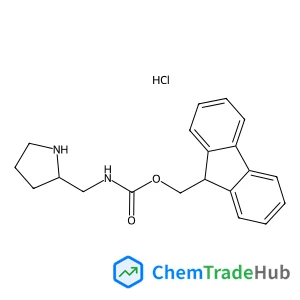
(S)-(9H-Fluoren-9-yl)methyl (pyrrolidin-2-ylmethyl)carbamate hydrochloride
CAS Number:
1217813-15-4
Molecular Formula:
C20H23ClN2O2
Yongjin Shin, Weng Hou Cheung, Tracey T. M. Ho, Kristen E. Bremmell, David A. Beattie
We report on the loading and release of curcumin (a hydrophobic polyphenol with anti-inflammatory and anti-bacterial properties) from polyelectrolyte multilayers composed of poly(diallyldimethylammonium chloride) (PDADMAC) and poly(sodium 4-styrenesulfonate) (PSS). We have used the in situ techniques of attenuated total reflectance (ATR) FTIR spectroscopy and quartz crystal microbalance with dissipation monitoring (QCM-D) to study the formation of the PEM and the incorporation of curcumin, providing direct evidence of the incorporation, in terms of molecular vibrations and gravimetric detection. The release of curcumin was followed using ex situ measurements of UV-visible spectroscopy of PEM films on quartz plates, in addition to in situ ATR FTIR measurements. Release was studied as a function of salt concentration of the release solution (0.001 M NaCl; 1 M NaCl). UV-visible spectroscopy indicated that salt concentration of the release solution had a major impact on release rates, with higher salt giving faster/more extensive release. However, prolonged timescale immersion and monitoring with UV-visible spectroscopy indicated that sample dehydration/rehydration cycling (required to measure UV absorbance) was responsible for the release of curcumin, rather than immersion time. In situ measurements of release kinetics with ATR FTIR confirmed that release does not occur spontaneously while the multilayer remains hydrated.
Donya Mohammadi Amidi, Kamran Akhbari
DOI: 10.1039/D3NJ05198F
Evan T. Miller, Oleg V. Tsodikov, Sylvie Garneau-Tsodikova
DOI: 10.1039/D3NP00036B
Zhiqiang Wang, Gen Li
DOI: 10.1039/D3NJ05280J
Jean-Alexandre Bureau, Magdalena Escobar Oliva, Yueming Dong, Codruta Ignea
DOI: 10.1039/D3NP00005B
Shuai Ma
DOI: 10.1039/D3TA04953A
Xu Wang, Yuhan Yang, Weifeng Zhao, Zhou Zhu, Xibo Pei
DOI: 10.1039/D3TB02355A
Marit Kauk-Kuusik, Kristi Timmo, Maris Pilvet, Katri Muska, Mati Danilson, Jüri Krustok, Raavo Josepson, Valdek Mikli, Maarja Grossberg-Kuusk
DOI: 10.1039/D3TA04541B
Tao Ban, Maolian Guo, Yajie Wang, Jiawang Ma, Xinxin Wang, Zihui Wang, Xiuling Zhu
DOI: 10.1039/D3TA05382B
Waste containing N-Methoxy-N-methyl-1,3-thiazole-5-carboxamide (CAS: 898825-89-3...
N-(4-Biphenylyl)dibenzo[b,d]furan-4-amine should be stored in a tightly sealed c...
The market for 3-Acetamido-5-amino-2,4,6-triiodobenzoic acid (CAS: 1713-07-1) is...
Benzyl 2-O-acetyl-3,4,6-tri-O-benzyl-beta-D-galactopyranoside (CAS: 61820-03-9) ...
2-Ethylpiperazine dihydrochloride (CAS: 438050-52-3) is regulated under the Glob...
1,1'-[1,3-Phenylenebis(methylene)]bis(3-methyl-1H-pyrrole-2,5-dione) (CAS: 11946...
Several alternatives can be used in the synthesis of 5-Fluoro-2-(1-pyrrolidinyl)...
Proper personal protective equipment (PPE) must be worn when handling this compo...
When handling 6-Bromoimidazo[1,2-a]pyridin-8-amine, it is important to wear appr...
Alternatives to (2S,4R)-4-(4-Nitrobenzyl)pyrrolidine-2-carboxylic acid hydrochlo...

Physical Chemistry Chemical Physics (PCCP) is an international journal co-owned by 19 physical chemistry and physics societies from around the world. This journal publishes original, cutting-edge research in physical chemistry, chemical physics and biophysical chemistry. To be suitable for publication in PCCP, articles must include significant innovation and/or insight into physical chemistry; this is the most important criterion that reviewers and Editors will judge against when evaluating submissions. The journal has a broad scope and welcomes contributions spanning experiment, theory, computation and data science. Topical coverage includes spectroscopy, dynamics, kinetics, statistical mechanics, thermodynamics, electrochemistry, catalysis, surface science, quantum mechanics, quantum computing and machine learning. Interdisciplinary research areas such as polymers and soft matter, materials, nanoscience, energy, surfaces/interfaces, and biophysical chemistry are welcomed if they demonstrate significant innovation and/or insight into physical chemistry. Joined experimental/theoretical studies are particularly appreciated when complementary and based on up-to-date approaches.