












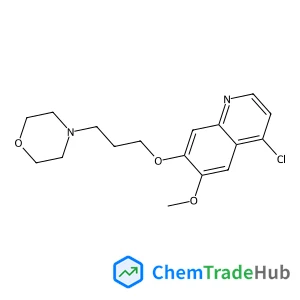
4-(3-((4-Chloro-6-methoxyquinolin-7-yl)oxy)propyl)morpholine
CAS Number:
205448-32-4
Molecular Formula:
C17H21ClN2O3
Maya Sharma, Giridhar Madras, Suryasarathi Bose
Shear induced crystallization in PVDF/PMMA blends, especially at higher fractions of PMMA, can be quite interesting in understanding the structure–property correlation and processing of these blends. In a recent submission (Phys. Chem. Chem. Phys., 2014, 16, 2693–2704), we clearly demonstrated, using dielectric spectroscopy, that the origin of segmental relaxations concerning the crystalline segments of PVDF in PVDF/PMMA blends in the presence of MWNTs (multiwalled nanotubes) was strongly contingent on the size of the crystallite. We now understand that the fraction of PMMA in the blends governs the origin of polymorphism in PVDF. This motivated us to systematically study the effect of shear on the crystallization behavior of PVDF especially in blends with different polymorphic forms of PVDF. Two model blends were selected; one with a mixture of α and β crystals and the other predominantly rich in α crystals. Initially, physical ageing, at different oscillation frequencies (1 rad s−1 and 0.1 rad s−1), was monitored by melt rheology and subsequently, the effect of steady shear was probed in situ without changing the history of the samples. Intriguingly, the rate of crystallization was observed to be significantly higher for higher oscillation frequencies, which essentially suggest that shear has induced crystallization in the blends. More interestingly, the effect of steady shear was more pronounced in the blends rich in α crystals (bigger crystallites as observed from SAXS) and at lower oscillation frequencies.
Christof Drechsel-Grau, Dominik Marx
DOI: 10.1039/C6CP05679B
Vladimir I. Novoderezhkin, Elisabet Romero, Javier Prior, Rienk van Grondelle
DOI: 10.1039/C6CP07308E
Claudio L. A. Berli, Magalí Mercuri, Martín G. Bellino
DOI: 10.1039/C6CP06602J
Dannie J. G. P. van Osch, Laura J. B. M. Kollau, Sari Asikainen, Marisa A. A. Rocha
DOI: 10.1039/C6CP07499E
Tânia F. G. G. Cova, Sandra C. C. Nunes, Alberto A. C. C. Pais
DOI: 10.1039/C6CP08081B
Elham Ashori, Francesc Illas
DOI: 10.1039/C6CP07898B
Sarawoot Impeng, Siwarut Siwaipram, Sareeya Bureekaew, Michael Probst
DOI: 10.1039/C6CP07771D
K. E. A. Hooper, H. K. H. Lee, M. J. Newman, S. Meroni, J. Baker, T. M. Watson, W. C. Tsoi
DOI: 10.1039/C6CP05123E
(5-Sulfamoyl-3-pyridinyl)boronic acid is primarily used in chemical synthesis, p...
Benzyl 2-methyl-2-(methylsulfonyl)-4-pentenoate is typically synthesized via est...
When handling 8-Fluoroquinolin-6-ol (CAS: 209353-22-0), it is important to use p...
1,3-Dibromo-5-(2-methyl-2-propanyl)benzene (CAS: 129316-09-2) is a crystalline c...
Ethyl 7-chloro-4-oxo-1-(1,3-thiazol-2-yl)-1,4-dihydro-1,8-naphthyridine-3-carbox...
When handling Delta-7-Avenasterol (CAS: 23290-26-8), it is important to wear app...
Proper handling involves the use of personal protective equipment such as gloves...
When handling 2-Methyl-2-proanyl 4-[(2-aminophenyl)amino]-1-piperidinecarboxylat...
N-Methyl-4-chlorobenzylamine hydrochloride (CAS: 65542-24-7) is a organic compou...
[2-(Dodecyloxy)ethoxy]acetic acid (CAS: 27306-90-7) is generally considered safe...

Physical Chemistry Chemical Physics (PCCP) is an international journal co-owned by 19 physical chemistry and physics societies from around the world. This journal publishes original, cutting-edge research in physical chemistry, chemical physics and biophysical chemistry. To be suitable for publication in PCCP, articles must include significant innovation and/or insight into physical chemistry; this is the most important criterion that reviewers and Editors will judge against when evaluating submissions. The journal has a broad scope and welcomes contributions spanning experiment, theory, computation and data science. Topical coverage includes spectroscopy, dynamics, kinetics, statistical mechanics, thermodynamics, electrochemistry, catalysis, surface science, quantum mechanics, quantum computing and machine learning. Interdisciplinary research areas such as polymers and soft matter, materials, nanoscience, energy, surfaces/interfaces, and biophysical chemistry are welcomed if they demonstrate significant innovation and/or insight into physical chemistry. Joined experimental/theoretical studies are particularly appreciated when complementary and based on up-to-date approaches.

![2-Azaspiro[4.5]decane-3,8-dione structure](https://static.chemtradehub.com/structs/914/914780-96-4-e94b.webp "2-Azaspiro[4.5]decane-3,8-dione structure")



