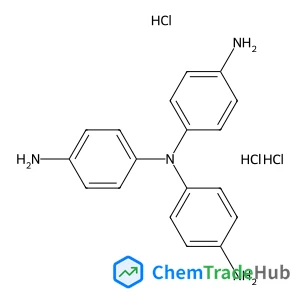
N1,N1-Bis(4-aminophenyl)benzene-1,4-diamine trihydrochloride
CAS Number:
114254-48-7
Molecular Formula:
C18H21Cl3N4
Juliana Agudelo, Crystal Huynh, Jan Halámek
A bioaffinity-driven cascade assay was developed to determine the time elapsed from the point a blood sample was left at a crime scene to the point of discovery. Two blood markers, creatine kinase (CK) and alanine transaminase (ALT), were utilized to determine the age of the blood spot based on their natural denaturation processes. The analysis with the proposed bioassay was performed in human serum samples, which underwent the aging process under environmental conditions that could be expected at crime scenes. The concentration of the markers in the sample was based on physiological levels present in healthy adults. These two markers were concerted in a biocatalytic cascade composed of two parallel subsystems, with each of them following the activity of one marker. Both markers have very distinct denaturation rates which would not allow them to be used in a single marker setup while still providing satisfactory results. However, by parallel tunable monitoring of both markers, it is possible to provide information of the blood sample age with low temporal error for a prolonged period of time. To mimic a possible real crime scene situation – the reliability of the proposed assay was then successfully tested on dried/aged serum samples (up to 5 days old) in environments with different temperatures.
D. Krishna Kumar, D. Amilan Jose, Amitava Das, Parthasarathi Dastidar
DOI: 10.1039/B506941F
Tim Phillips, Chatna Rajput, Lance Twyman, Ihtshamul Haq, Jim A. Thomas
DOI: 10.1039/B506946G
Peter B. Hitchcock, Gareth J. Rowlands, Rakesh Parmar
DOI: 10.1039/B507394D
Olalla Nieto Faza, Carlos Silva López, Rosana Álvarez, Ángel R. de Lera
DOI: 10.1039/B506601H
Takashi Jin, Fumihiko Fujii, Hiroshi Sakata, Mamoru Tamura, Masataka Kinjo
DOI: 10.1039/B506608E
Yoshiko K. Takahara, Koji Tachi, Takao Sakata, Toshiaki Hasegawa, Hirotaro Mori, Michio Matsumura, Bunsho Ohtani
DOI: 10.1039/B507123B
Jean-Paul Lellouche, Senthil Govindaraji, Augustine Joseph, Jyongsik Jang, Kyung Jin Lee
DOI: 10.1039/B502483H
Christian J. Baylies, John C. Jeffery, Tom A. Miller, Ryan Moon, Craig R. Rice, T. Riis-Johannessen
DOI: 10.1039/B506199G
Waste containing N-Methoxy-N-methyl-1,3-thiazole-5-carboxamide (CAS: 898825-89-3...
N-(4-Biphenylyl)dibenzo[b,d]furan-4-amine should be stored in a tightly sealed c...
The market for 3-Acetamido-5-amino-2,4,6-triiodobenzoic acid (CAS: 1713-07-1) is...
Benzyl 2-O-acetyl-3,4,6-tri-O-benzyl-beta-D-galactopyranoside (CAS: 61820-03-9) ...
2-Ethylpiperazine dihydrochloride (CAS: 438050-52-3) is regulated under the Glob...
1,1'-[1,3-Phenylenebis(methylene)]bis(3-methyl-1H-pyrrole-2,5-dione) (CAS: 11946...
Several alternatives can be used in the synthesis of 5-Fluoro-2-(1-pyrrolidinyl)...
Proper personal protective equipment (PPE) must be worn when handling this compo...
When handling 6-Bromoimidazo[1,2-a]pyridin-8-amine, it is important to wear appr...
Alternatives to (2S,4R)-4-(4-Nitrobenzyl)pyrrolidine-2-carboxylic acid hydrochlo...

Analyst publishes analytical and bioanalytical research that reports premier fundamental discoveries and inventions, and the applications of those discoveries, unconfined by traditional discipline barriers.
![2-Methyl-2-propanyl {3-[4-(4,4,5,5-tetramethyl-1,3,2-dioxaborolan-2-yl)phenyl]-3-oxetanyl}carbamate structure](https://static.chemtradehub.com/structs/127/1279090-25-3-1b84.webp "2-Methyl-2-propanyl {3-[4-(4,4,5,5-tetramethyl-1,3,2-dioxaborolan-2-yl)phenyl]-3-oxetanyl}carbamate structure")