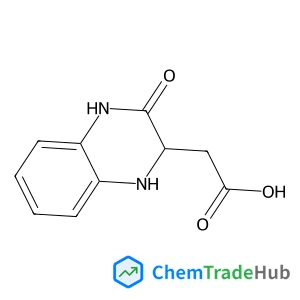
(3-Oxo-1,2,3,4-tetrahydro-2-quinoxalinyl)acetic acid
CAS Number:
136584-14-0
Molecular Formula:
C10H10N2O3
What is the relationship between the Green Chemistry initiative and the pharmaceutical industry? The intention is to shed some light on this issue by providing an historical overview spanning a period of about 20 years – from the start of the movement towards greener processes and manufacture in the early 1990s until today where greenness and sustainability are widely embraced throughout society. To understand and appreciate the approach to the green paradigm from a pharmaceutical business point of view, it is essential to paint the broader picture explaining the landscape in which this industry operates and its particular challenges. Looking at the special features that apply to chemical production of drug molecules for commercial use – in relative terms a low volume undertaking (from kg scale through to 10s or sometimes 100s of tons per annum) – the situation is vastly different compared to conventional bulk manufacture (for instance of commodity chemicals). After an initial lag phase, the drug industry has now caught up and is very eager to fully adopt green principles and to gather evidence on how it is performing. As an example, it is a well documented fact that more than half the mass constituting a process stream in the chemical manufacture of active pharmaceutical ingredients (APIs) stems from the solvent(s) utilized; 80–90% if water is included. In a multi-step synthesis on an average composed of 8–10 discrete chemical transformations which typically runs at a process mass intensity (PMI) factor of 100–200 kg kg−1 API, about 50–100 kg can be referred purely to the contribution from solvents; hence, the potential for improvements is huge. Thus, leaving the historic priorities behind in favor of drivers for change such as external pressure, goodwill, legislation, and company policies is a good strategy to ensure a rapid movement into a greener future, albeit without ignoring the existence of blockers that mainly relate to insufficient scientific and technological capabilities. From a chemical process point of view, there are several reasons to have an optimistic view about the prospects of a flourishing green agenda going forward as shown in a number of recent case studies.
Chun-Li Hu
DOI: 10.1039/D3SC05770D
Peter M. Waddell, Lei Tian, Anthony R. Scavuzzo, Lalu Venigalla, Gregory D. Scholes, Brad P. Carrow
DOI: 10.1039/D3SC02588H
Ran Liu, Zheng Liu, Mohan Chen, Hang Xing, Penghui Zhang, Jingjing Zhang
DOI: 10.1039/D3SC04249A
Lucas T. Göttemann, Stefan Wiesler, Richmond Sarpong
DOI: 10.1039/D3SC05414D
Charlie Ruffman, Krista G. Steenbergen, Anna L. Garden, Nicola Gaston
DOI: 10.1039/D3SC04416E
Sandra Díaz, Julian Bergueiro, Riccardo Capelli, Javier Montenegro
DOI: 10.1039/D3SC03930G
Hirotaka Inoue, Hongyao Zhou, Hideo Ando, Sakuya Nakagawa, Teppei Yamada
DOI: 10.1039/D3SC04955H
Dmitry L. Lipilin, Mikhail O. Zubkov, Mikhail D. Kosobokov, Alexander D. Dilman
DOI: 10.1039/D3SC05513B
When handling 4-(2-Furylmethyl)thiomorpholine 1,1-dioxide (CAS: 79206-94-3), it ...
When handling 4-Chloro-N-[2-(4-morpholinyl)ethyl]benzamide (CAS: 71320-77-9), it...
Waste containing this compound (CAS: 62921-74-8) should be handled according to ...
Waste containing (S)-Methyl 2-amino-3-cyclohexylpropanoate should be collected i...
This compound can be synthesized using a multi-step process involving the conjug...
There are several alternatives to (2E)-3-(3,4-Dichlorophenyl)acrylic acid in syn...
Ethyl 6-(2-nitrophenyl)imidazo[2,1-b][1,3]thiazole-3-carboxylate (CAS: 925437-84...
Waste containing 2-(1,3-Thiazol-2-yl)ethanamine (CAS: 18453-07-1) should be coll...
Methyl 5-iodo-2-methylbenzoate can be synthesized through the iodination of meth...
5-Chloro[1,2,4]triazolo[1,5-a]pyridine is commonly synthesized via the condensat...

Green Chemistry provides a unique forum for the publication of innovative research on the development of alternative green and sustainable technologies. The scope of Green Chemistry is based on, but not limited to, the definition proposed by Anastas and Warner (Green Chemistry: Theory and Practice, P T Anastas and J C Warner, Oxford University Press, Oxford, 1998). Green chemistry is the utilisation of a set of principles that reduces or eliminates the use or generation of hazardous substances in the design, manufacture and application of chemical products. Green Chemistry is at the frontiers of this continuously-evolving interdisciplinary science and publishes research that attempts to reduce the environmental impact of the chemical enterprise by developing a technology base that is inherently non-toxic to living things and the environment. Submissions on all aspects of research relating to the endeavour are welcome. The journal publishes original and significant cutting-edge research that is likely to be of wide general appeal. To be published, work must present a significant advance in green chemistry. Papers must contain a comparison with existing methods and demonstrate advantages over those methods before publication can be considered. For more information please see this Editorial. Coverage includes the following, but is not limited to: Design (e.g. biomimicry, design for degradation/recycling/reduced toxicity…) Reagents & Feedstocks (e.g. renewables, CO2, solvents, auxiliary agents, waste utilization…) Synthesis (e.g. organic, inorganic, synthetic biology…) Catalysis (e.g. homogeneous, heterogeneous, enzyme, whole cell…) Process (e.g. process design, intensification, separations, recycling, efficiency…) Energy (e.g. renewable energy, fuels, photovoltaics, fuel cells, energy storage, energy carriers…) Applications (e.g. electronics, dyes, consumer products, coatings, pharmaceuticals, preservatives, building materials, chemicals for industry/agriculture/mining…) Impact (e.g. safety, metrics, LCA, sustainability, (eco)toxicology…) Green chemistry is, by definition, a continuously-evolving frontier. Therefore, the inclusion of a particular material or technology does not, of itself, guarantee that a paper is suitable for the journal. To be suitable, the novel advance should have the potential for reduced environmental impact relative to the state of the art. Green Chemistry does not normally deal with research associated with 'end-of-pipe' or remediation issues.