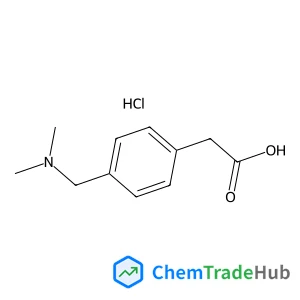
4-(Dimethylaminomethyl)phenylacetic acid hydrochloride
CAS Number:
99985-52-1
Molecular Formula:
C11H16ClNO2
Ping Wu, Pan Du, Hui Zhang, Chenxin Cai
The oxidation of CO has attracted great interest in recent years because of its important role in enhancing the catalyst durability in fuel cells and in solving the growing environmental problems caused by CO emission. The usually used noble metal nanocatalysts are costly and require high reaction temperature for efficient operation. We report here a density functional theory (DFT) study of low-temperature CO oxidation catalyzed by graphdiyne, which is a new two-dimensional periodic carbon allotrope with a one-atom-thick sheet of carbon building of sp- and sp2-hybridized carbon atoms and has been shown in our recent work to have high catalytic activity for oxygen reduction reactions (ORRs). We studied the adsorption properties of CO and O2 on graphdiyne, simulated the reaction mechanism of CO oxidation involving graphdiyne, and analyzed electronic structures at each step of reaction progress. The simulation results indicate that the adsorption of O2 prevails over CO adsorption on the graphdiyne sheet; the reaction of CO oxidation by adsorbed O2 on graphdiyne proceeds via the Eley–Rideal (ER) mechanism with a decrease in the energy of the system and the energy barrier as low as 0.18 eV in the rate-limiting step. The oxidation reaction includes the breakage of the O–O bond in the adsorbed O2, formation of the metastable carbonate-like intermediate state, and the creation of CO2 molecules. The results presented here demonstrate that graphdiyne is a good, low-cost, and metal-free catalyst for low-temperature CO oxidation, can be used to solve problems caused by environmental CO emission and has a high ability of CO tolerance by its removal through oxidation in fuel cells.
Yongliang Zhang, Xilong Zhang, Mingjie Li, Yunfei Liu, Zhen Hu
DOI: 10.1039/D3SE00989K
Zifeng Song, Haoliang Liu, Baiyi Chen, Qin Jiang, Fengxiang Sui, Kai Wu, Yonghong Cheng, Bing Xiao
DOI: 10.1039/D3CP05035A
Michael Walsh, Jeannie Z. Y. Tan, Sanjay Nagarajan, Kenneth Macgregor, John M. Andresen, M. Mercedes Maroto-Valer, Sudhagar Pitchaimuthu
DOI: 10.1039/D3SE01445B
Raquel Yanes-Rodríguez, Rita Prosmiti
DOI: 10.1039/D3CP05410A
Riku Okamoto, Akira Kimura, Yuhi Nakayasu, Akira Yamakata, Ryota Tomizawa, Taizo Masuda, Koichiro Nakatani
DOI: 10.1039/D3SE01408H
Fakhrul H. Bhuiyan, Ashlie Martini
DOI: 10.1039/D3CP05320B
Yue Lou
DOI: 10.1039/D3CP04958B
Vikki Anand Varma, Simmie Jaglan, Mohd Yasir Khan, Sujin B. Babu
DOI: 10.1039/D3CP03681B
Novrita Idayanti
DOI: 10.1039/D4SE90004A
Yan Sun, Zhongzhu Jiang, Yang Li, Lanxin Liu, Hui Liang, Yiyan Wang, Dandan Wu, Na Li, Ying Zhou, Qiuju Li, Xiaoyu Yue, Wei Tong, Xuan Luo, Jianghe Lan, Xuefeng Sun
DOI: 10.1039/D3CP03854H
Waste containing N-Methoxy-N-methyl-1,3-thiazole-5-carboxamide (CAS: 898825-89-3...
N-(4-Biphenylyl)dibenzo[b,d]furan-4-amine should be stored in a tightly sealed c...
The market for 3-Acetamido-5-amino-2,4,6-triiodobenzoic acid (CAS: 1713-07-1) is...
Benzyl 2-O-acetyl-3,4,6-tri-O-benzyl-beta-D-galactopyranoside (CAS: 61820-03-9) ...
2-Ethylpiperazine dihydrochloride (CAS: 438050-52-3) is regulated under the Glob...
1,1'-[1,3-Phenylenebis(methylene)]bis(3-methyl-1H-pyrrole-2,5-dione) (CAS: 11946...
Several alternatives can be used in the synthesis of 5-Fluoro-2-(1-pyrrolidinyl)...
Proper personal protective equipment (PPE) must be worn when handling this compo...
When handling 6-Bromoimidazo[1,2-a]pyridin-8-amine, it is important to wear appr...
Alternatives to (2S,4R)-4-(4-Nitrobenzyl)pyrrolidine-2-carboxylic acid hydrochlo...

Physical Chemistry Chemical Physics (PCCP) is an international journal co-owned by 19 physical chemistry and physics societies from around the world. This journal publishes original, cutting-edge research in physical chemistry, chemical physics and biophysical chemistry. To be suitable for publication in PCCP, articles must include significant innovation and/or insight into physical chemistry; this is the most important criterion that reviewers and Editors will judge against when evaluating submissions. The journal has a broad scope and welcomes contributions spanning experiment, theory, computation and data science. Topical coverage includes spectroscopy, dynamics, kinetics, statistical mechanics, thermodynamics, electrochemistry, catalysis, surface science, quantum mechanics, quantum computing and machine learning. Interdisciplinary research areas such as polymers and soft matter, materials, nanoscience, energy, surfaces/interfaces, and biophysical chemistry are welcomed if they demonstrate significant innovation and/or insight into physical chemistry. Joined experimental/theoretical studies are particularly appreciated when complementary and based on up-to-date approaches.