












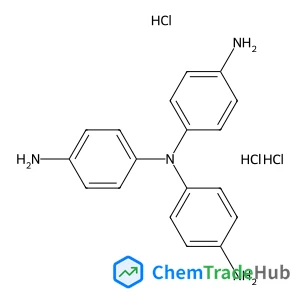
N1,N1-Bis(4-aminophenyl)benzene-1,4-diamine trihydrochloride
CAS Number:
114254-48-7
Molecular Formula:
C18H21Cl3N4
Carmen Tiseanu, Vasile Parvulescu, Daniel Avram, Bogdan Cojocaru, Nicoleta Apostol, Andrea V. Vela-Gonzalez, Margarita Sanchez-Dominguez
We report on structure–property relationships in Pr-doped CeO2 and ZrO2 using X-ray diffraction (XRD), Raman, UV to Vis Diffuse Reflectance (DR-UV/Vis), X-ray Photoelectron (XPS), and luminescence (PL) spectroscopies. Both 3+ and 4+ valence states of Pr are evidenced, irrespective of the host and calcination temperature, T (T = 500 and 1000 °C) with consequences on absorption, surface, vibrational and luminescence properties. Only zirconia represents a suitable host for Pr3+ luminescence. The distinct trivalent Pr centers and their excitation mechanism are identified in relation to the tetragonal and monoclinic phases of ZrO2. A near-infrared to visible up-conversion (UPC) emission of Pr3+ is observed upon excitation at 959 nm which occurs, most probably, via a two-photon excited state process. By using a multi-wavelength, time-gated excitation, the UPC process is established as phase selective, i.e. only Pr3+ located in the monoclinic sites of the mixed phase, monoclinic and tetragonal ZrO2 (T = 1000 °C) contribute to the UPC emission. We believe that, besides the local symmetry, a key role in phase selective UPC is played by the presence of Pr3+ low-lying 4f 5d levels. To the best of our knowledge, this is the first report of phase selective up-conversion emission in a lanthanide doped multi-phase host.
Xiao-Juan Wang, Yan Long, Chuan-Wan Wei, Shu-Qin Gao
DOI: 10.1039/D3CP05403A
Margarita Bužančić Milosavljević
DOI: 10.1039/D3CP05291E
Qian Wang, Yu Zhuang, Abuduwayiti Aierken, Qiaogang Song, Qin Zhang, Youbo Dou, Qiuli Zhang, Shuyi Zhang
DOI: 10.1039/D3CP05309A
Edward R. Smith, Panagiotis E. Theodorakis
DOI: 10.1039/D3CP03579D
Yi-Rong Liu, Yan Jiang
DOI: 10.1039/D3CP04702D
Sergey S. Nikitin, Alexander D. Koryakov, Elizaveta A. Antipinskaya, Mikhail V. Patrakeev
DOI: 10.1039/D3CP05421G
Zhifeng Lin, Xueding Jiang, Weicheng Xu, Fuhua Li, Xin Chen, Si Liu, Xihong Lu
DOI: 10.1039/D3CP04350A
Alexander Jankowski, Paul Fischer, Klavs Hansen, Lutz Schweikhard
DOI: 10.1039/D3CP04476A
Ekaterina A. Konopkina, Alexander V. Gopin, Anton S. Pozdeev, Maria G. Chernysheva, Paulina Kalle, Elizaveta A. Pavlova, Stepan N. Kalmykov, Vladimir G. Petrov, Nataliya E. Borisova, Alexander A. Guda, Petr I. Matveev
DOI: 10.1039/D3CP05081E
Waste containing N-Methoxy-N-methyl-1,3-thiazole-5-carboxamide (CAS: 898825-89-3...
N-(4-Biphenylyl)dibenzo[b,d]furan-4-amine should be stored in a tightly sealed c...
The market for 3-Acetamido-5-amino-2,4,6-triiodobenzoic acid (CAS: 1713-07-1) is...
Benzyl 2-O-acetyl-3,4,6-tri-O-benzyl-beta-D-galactopyranoside (CAS: 61820-03-9) ...
2-Ethylpiperazine dihydrochloride (CAS: 438050-52-3) is regulated under the Glob...
1,1'-[1,3-Phenylenebis(methylene)]bis(3-methyl-1H-pyrrole-2,5-dione) (CAS: 11946...
Several alternatives can be used in the synthesis of 5-Fluoro-2-(1-pyrrolidinyl)...
Proper personal protective equipment (PPE) must be worn when handling this compo...
When handling 6-Bromoimidazo[1,2-a]pyridin-8-amine, it is important to wear appr...
Alternatives to (2S,4R)-4-(4-Nitrobenzyl)pyrrolidine-2-carboxylic acid hydrochlo...

Physical Chemistry Chemical Physics (PCCP) is an international journal co-owned by 19 physical chemistry and physics societies from around the world. This journal publishes original, cutting-edge research in physical chemistry, chemical physics and biophysical chemistry. To be suitable for publication in PCCP, articles must include significant innovation and/or insight into physical chemistry; this is the most important criterion that reviewers and Editors will judge against when evaluating submissions. The journal has a broad scope and welcomes contributions spanning experiment, theory, computation and data science. Topical coverage includes spectroscopy, dynamics, kinetics, statistical mechanics, thermodynamics, electrochemistry, catalysis, surface science, quantum mechanics, quantum computing and machine learning. Interdisciplinary research areas such as polymers and soft matter, materials, nanoscience, energy, surfaces/interfaces, and biophysical chemistry are welcomed if they demonstrate significant innovation and/or insight into physical chemistry. Joined experimental/theoretical studies are particularly appreciated when complementary and based on up-to-date approaches.

![4-Chloro-2-{[(2-chlorophenoxy)acetyl]amino}benzoic acid structure](https://static.chemtradehub.com/structs/351/351424-20-9-9467.webp "4-Chloro-2-{[(2-chlorophenoxy)acetyl]amino}benzoic acid structure")








