













Synergy between polymorphism, pressure, spin-crossover and temperature in [Fe(PM-BiA)2(NCS)2]: a neutron powder diffraction investigation
Literature Information
Publication Date
2013-06-17
DOI
10.1039/C3CP51444G
Impact Factor
3.676
Authors
Vincent Legrand, Stanislav Pechev, Jean-François Létard, Philippe Guionneau
View Original
Abstract
The pressure dependencies of the lattice parameters of the spin transition compound [Fe(PM-BiA)2(NCS)2] have been derived from neutron powder diffraction measurements at low temperature. The study of the compound [Fe(PM-BiA)2(NCS)2]-pI has first confirmed the atypical spin crossover behaviour under pressure of this compound that shows a pressure induced structural transition inducing the transformation into a different polymorph, [Fe(PM-BiA)2(NCS)2]-pII. This phenomenon avoids a first-order spin transition in favour of continuous transition around 0.75 GPa at ambient temperature. Low temperature measurements under pressure up to 1.07 GPa allowed us not only to describe the spin-crossover for both polymorphs but also to reach phase-diagram regions where both polymorphs co-exist in different spin-states. Finally, the reversibility of the structural variations has been demonstrated.
Related Literature
Solvation structure of coronene–transition metal complex: a RISM-SCF study
Hirofumi Sato, Chisa Kikumori, Shigeyoshi Sakaki
2010-11-19
Paper
DOI: 10.1039/C0CP01464H
A theoretical study of the interactions of NF3 with neutral ambidentate electron donor and acceptor molecules
Fernando Blanco, Ibon Alkorta, Isabel Rozas, Mohammad Solimannejad, José Elguero
2010-10-29
Paper
DOI: 10.1039/C0CP00199F
Protein–water electrostatics and principles of bioenergetics
David N. LeBard, Dmitry V. Matyushov
2010-10-25
Perspective
DOI: 10.1039/C0CP01004A
Chiral supramolecular self-assembly of rubrene
Huihui Kong, Xing Song, Xiaoqing Liu, Hongming Wang
2010-08-27
Paper
DOI: 10.1039/C0CP00512F
Benchmarks for the generation of interaction potentials for scattering calculations: applications to rotationally inelastic collisions of C4 (X3Σ −g) with He
Jacek Kłos, Majdi Hochlaf
2010-08-20
Paper
DOI: 10.1039/C004945J
Can Na2[B12H12] be a decomposition product of NaBH4?
Riccarda Caputo, Sebastiano Garroni, David Olid, Francesc Teixidor, Santiago Suriñach, Maria Dolors Baró
2010-10-21
Paper
DOI: 10.1039/C0CP00877J
Autocatalytic sonolysis of iron pentacarbonyl in room temperature ionic liquid [BuMeIm][Tf2N]
Lenaïc Lartigue, Rachel Pflieger, Sergey I. Nikitenko, Yannick Guari, Lorenzo Stievano, Moulay T. Sougrati, Joulia Larionova
2010-12-10
Communication
DOI: 10.1039/C0CP01670E
Holstein–Peirls–Hubbard trimer as a model for quadrupolar two-photon absorbing dyes
Robertino Pilot, Renato Bozio
2010-11-16
Paper
DOI: 10.1039/C0CP00998A
Zinc coverage dependent structure of PdZn surface alloy
Yucheng Huang, Zhao-Xu Chen
2010-11-16
Communication
DOI: 10.1039/C0CP01344G
Progress in design and architecture of metal nanoparticles for catalytic applications
Kohsuke Mori, Hiromi Yamashita
2010-09-30
Perspective
DOI: 10.1039/C0CP00988A
You might also like
Compound Q&A
What are the main uses of (5-Sulfamoyl-3-pyridinyl)boronic acid (CAS: 951233-61-7)?
(5-Sulfamoyl-3-pyridinyl)boronic acid is primarily used in chemical synthesis, p...
951233-61-7(5-Sulfamoyl-3-pyrid...
Compound Q&A
How is Benzyl 2-methyl-2-(methylsulfonyl)-4-pentenoate (CAS: 1942858-50-5) typically synthesized?
Benzyl 2-methyl-2-(methylsulfonyl)-4-pentenoate is typically synthesized via est...
1942858-50-5Benzyl 2-methyl-2-(m...
Compound Q&A
What precautions should be taken when handling 8-Fluoroquinolin-6-ol (CAS: 209353-22-0)?
When handling 8-Fluoroquinolin-6-ol (CAS: 209353-22-0), it is important to use p...
209353-22-08-Fluoroquinolin-6-o...
Compound Q&A
What are the physical and chemical properties of 1,3-Dibromo-5-(2-methyl-2-propanyl)benzene (CAS: 129316-09-2)?
1,3-Dibromo-5-(2-methyl-2-propanyl)benzene (CAS: 129316-09-2) is a crystalline c...
129316-09-21,3-Dibromo-5-(2-met...
Compound Q&A
What industries use Ethyl 7-chloro-4-oxo-1-(1,3-thiazol-2-yl)-1,4-dihydro-1,8-naphthyridine-3-carboxylate (CAS: 174726-87-5)?
Ethyl 7-chloro-4-oxo-1-(1,3-thiazol-2-yl)-1,4-dihydro-1,8-naphthyridine-3-carbox...
174726-87-5Ethyl 7-chloro-4-oxo...
Compound Q&A
What precautions should be taken when handling Delta-7-Avenasterol (CAS: 23290-26-8)?
When handling Delta-7-Avenasterol (CAS: 23290-26-8), it is important to wear app...
23290-26-8Delta-7-Avenasterol
Compound Q&A
What precautions should be taken when handling N-({(5R)-3-[3-Fluoro-4-(4-morpholinyl)phenyl]-2-oxo-1,3-oxazolidin-5-yl}methyl)acetamide (CAS: 872992-20-6)?
Proper handling involves the use of personal protective equipment such as gloves...
872992-20-6N-({(5R)-3-[3-Fluoro...
Compound Q&A
What precautions should be taken when handling 2-Methyl-2-proanyl 4-[(2-aminophenyl)amino]-1-piperidinecarboxylate (CAS: 79099-00-6)?
When handling 2-Methyl-2-proanyl 4-[(2-aminophenyl)amino]-1-piperidinecarboxylat...
79099-00-62-Methyl-2-propanyl ...
Compound Q&A
What is N-Methyl-4-chlorobenzylamine hydrochloride (CAS: 65542-24-7)?
N-Methyl-4-chlorobenzylamine hydrochloride (CAS: 65542-24-7) is a organic compou...
65542-24-7N-Methyl-4-chloroben...
Compound Q&A
Is [2-(Dodecyloxy)ethoxy]acetic acid (CAS: 27306-90-7) safe?
[2-(Dodecyloxy)ethoxy]acetic acid (CAS: 27306-90-7) is generally considered safe...
27306-90-7[2-(Dodecyloxy)ethox...
Source Journal
Physical Chemistry Chemical Physics

CiteScore:
5.5
Self-citation Rate:
10.3%
Articles per Year:
3036
Physical Chemistry Chemical Physics (PCCP) is an international journal co-owned by 19 physical chemistry and physics societies from around the world. This journal publishes original, cutting-edge research in physical chemistry, chemical physics and biophysical chemistry. To be suitable for publication in PCCP, articles must include significant innovation and/or insight into physical chemistry; this is the most important criterion that reviewers and Editors will judge against when evaluating submissions. The journal has a broad scope and welcomes contributions spanning experiment, theory, computation and data science. Topical coverage includes spectroscopy, dynamics, kinetics, statistical mechanics, thermodynamics, electrochemistry, catalysis, surface science, quantum mechanics, quantum computing and machine learning. Interdisciplinary research areas such as polymers and soft matter, materials, nanoscience, energy, surfaces/interfaces, and biophysical chemistry are welcomed if they demonstrate significant innovation and/or insight into physical chemistry. Joined experimental/theoretical studies are particularly appreciated when complementary and based on up-to-date approaches.
Recommended Compounds
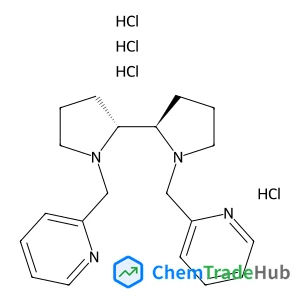
(2R,2'R)-1,1'-Bis(2-pyridinylmethyl)-2,2'-bipyrrolidine tetrahydrochloride
CAS Number:
1228077-88-0
Molecular Formula:
C20H30Cl4N4

![Bis(N,N''-dimethylpiperazine)tetra[copper(I) iodide] structure](https://static.chemtradehub.com/structs/140/1401708-91-5-2b86.webp "Bis(N,N''-dimethylpiperazine)tetra[copper(I) iodide] structure")
Bis(N,N''-dimethylpiperazine)tetra[copper(I) iodide]
CAS Number:
1401708-91-5
Molecular Formula:
C12H28Cu4I4N4

Recommended Suppliers





Disclaimer
This page provides academic journal information for reference and research purposes only. We are not affiliated with any journal publishers and do not handle publication submissions. For publication-related inquiries, please contact the respective journal publishers directly.
If you notice any inaccuracies in the information displayed, please contact us at support@chemtradehub.com. We will promptly review and address your concerns.