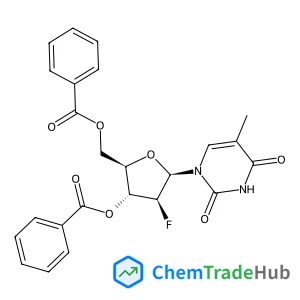
1-(3',5'-Di-O-benzoyl-2'-deoxy-2'-fluoro-b-D-arabinofuranosyl)thymine
CAS Number:
97614-47-6
Molecular Formula:
C24H21FN2O7
Michaël Rey, Vladimir G. Tyuterev
We report global calculations of rovibrational spectra and dipole transition intensities of methane using our recent ab initio dipole moment and potential surfaces [Nikitin et al., Chem. Phys. Lett., 2011, 501, 179; 2013, 565, 5]. For the full symmetry account, a recently published variational tensor formalism in normal modes [Rey et al., J. Chem. Phys., 2012, 136, 244106] is applied, the convergence of high-J calculations being improved by the use of vibrational eigenfunctions to make a compressed basis set for solving the rovibrational problem. Comparisons of theoretical predictions up to J = 25 for various complex polyads of methane involving strongly coupled vibration–rotation bands support the validity of this new approach. For the first time, positions and line intensities at 80 K and 296 K are shown to be in excellent agreement with raw experimental data, even for high energy ranges. The theoretical predictions also correctly describe the isotopic effects in line positions and intensities due to the CH4 → CD4 substitution which is considered as the test for the method. This work is a first step toward the theoretical interpretation of numerous methane bands which remain still unassigned and detailed line-by-line absorption/emission spectra analyses for atmospheric and planetological applications.
Nate C.-M. Bartlett, Justinas Jankunas, Richard N. Zare, John A. Harrison
DOI: 10.1039/C0CP00518E
Larissa S. Fenn, John A. McLean
DOI: 10.1039/C0CP01414A
F. Marinetti, F. A. Gianturco
DOI: 10.1039/C0CP01342K
Haitang Wang, Shawn D. Wettig
DOI: 10.1039/C0CP00146E
Hyosung Choi, Heesook Cho, Suhee Song, Hongsuk Suh, Soojin Park, Jin Young Kim
DOI: 10.1039/C0CP01754J
Tsutomu Uchida, Satoshi Takeya
DOI: 10.1039/C0CP01059F
Weijia Zhou, Hong Liu, Jiyang Wang, Duo Liu, Guojun Du, Shujuan Han, Jianjian Lin, Ruijun Wang
DOI: 10.1039/C0CP00734J
Yevhen Polyhach, Enrica Bordignon, Gunnar Jeschke
DOI: 10.1039/C0CP01865A
(5-Sulfamoyl-3-pyridinyl)boronic acid is primarily used in chemical synthesis, p...
Benzyl 2-methyl-2-(methylsulfonyl)-4-pentenoate is typically synthesized via est...
When handling 8-Fluoroquinolin-6-ol (CAS: 209353-22-0), it is important to use p...
1,3-Dibromo-5-(2-methyl-2-propanyl)benzene (CAS: 129316-09-2) is a crystalline c...
Ethyl 7-chloro-4-oxo-1-(1,3-thiazol-2-yl)-1,4-dihydro-1,8-naphthyridine-3-carbox...
When handling Delta-7-Avenasterol (CAS: 23290-26-8), it is important to wear app...
Proper handling involves the use of personal protective equipment such as gloves...
When handling 2-Methyl-2-proanyl 4-[(2-aminophenyl)amino]-1-piperidinecarboxylat...
N-Methyl-4-chlorobenzylamine hydrochloride (CAS: 65542-24-7) is a organic compou...
[2-(Dodecyloxy)ethoxy]acetic acid (CAS: 27306-90-7) is generally considered safe...

Physical Chemistry Chemical Physics (PCCP) is an international journal co-owned by 19 physical chemistry and physics societies from around the world. This journal publishes original, cutting-edge research in physical chemistry, chemical physics and biophysical chemistry. To be suitable for publication in PCCP, articles must include significant innovation and/or insight into physical chemistry; this is the most important criterion that reviewers and Editors will judge against when evaluating submissions. The journal has a broad scope and welcomes contributions spanning experiment, theory, computation and data science. Topical coverage includes spectroscopy, dynamics, kinetics, statistical mechanics, thermodynamics, electrochemistry, catalysis, surface science, quantum mechanics, quantum computing and machine learning. Interdisciplinary research areas such as polymers and soft matter, materials, nanoscience, energy, surfaces/interfaces, and biophysical chemistry are welcomed if they demonstrate significant innovation and/or insight into physical chemistry. Joined experimental/theoretical studies are particularly appreciated when complementary and based on up-to-date approaches.
![N-[(6-Bromo-3-pyridinyl)methyl]ethanamine structure](https://static.chemtradehub.com/structs/120/120740-05-8-ca55.webp "N-[(6-Bromo-3-pyridinyl)methyl]ethanamine structure")