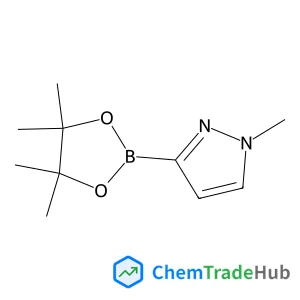
1-Methyl-3-(4,4,5,5-tetramethyl-1,3,2-dioxaborolan-2-yl)-1H-pyrazole
CAS Number:
1020174-04-2
Molecular Formula:
C10H17BN2O2
K. Don Dasitha Gunaratne, C. L. Harmon
Evolution of electronic properties and the nature of bonding of the 4d-transition metal silicides (ZrSi, NbSi, MoSi and PdSi) are discussed, revealing interesting trends in the transition metal–silicon interactions across the period. The electronic properties of select transition metal silicide diatomics have been determined by anion photoelectron imaging spectroscopy and theoretical methods. The electron binding energy spectra and photoelectron angular distributions obtained by 2.33 eV (532 nm) photons have revealed the distinct features of these diatomics. The theoretical calculations were performed at the density functional theory (DFT) level using the unrestricted B3LYP hybrid functional and at the ab initio unrestricted coupled cluster singles and doubles (triplets) (UCCSD(T)) methods to assign the ground electronic states of the neutral and anionic diatomics. The excited electronic states were calculated by the DFT (TD-DFT)/UB3LYP method. We have observed that the valence molecular orbital configuration of the ZrSi and NbSi anions are significantly different from that of the MoSi and PdSi anions. By combining our experimental and theoretical results, we report that the composition of the highest occupied molecular orbitals shift from a majority of transition metal s- and d-orbital contribution in ZrSi and NbSi, to mainly silicon p-orbital contribution for MoSi and PdSi. We expect these observed atomic scale transition metal–silicon interactions to be of increasing importance with the miniaturization of devices approaching the sub-nanometer size regime.

Polycyclic Aromatic Compounds

Medicinal Chemistry Research

Bioorganic & Medicinal Chemistry Letters

Acta Metallurgica Sinica-English Letters

Bioorganic & Medicinal Chemistry

Chinese Journal of Chemistry

Cellulose

NDT & E International

Journal of the Indian Institute of Science

Journal of Asian Natural Products Research
Xin Wang, Xiangqun Guo
DOI: 10.1039/B822744F
Grégoire Herzog, Waleed Moujahid, Jörg Strutwolf, Damien W. M. Arrigan
DOI: 10.1039/B905441N
Paul Bassan, Hugh J. Byrne, Joe Lee, Franck Bonnier, Colin Clarke, Paul Dumas, Ehsan Gazi, Michael D. Brown, Peter Gardner
DOI: 10.1039/B821349F
Keith B. Male, Yew-Min Tzeng, Johnny Montes, Bing-Lan Liu, Wan-Chun Liao, Amine Kamen
DOI: 10.1039/B822133B
Quan Yu, Jing Gao, Xiaohua Yu, Jianbo Shi, Lin Lin, Xiaohao Wang
DOI: 10.1039/D2AN01422J
Yuyuan Zhang, Jing Lei, Wei Liu, Yan Jin, Baoxin Li
DOI: 10.1039/D2AN01735K
Taijie Zhan, Wenya Niu, Mengdong Cui, Hengxin Han, Ding Wang, Yi Xu
DOI: 10.1039/D2AN01288J
Kai-Chi Chang, Chan-Yu Chen, Li-Wei Lee
DOI: 10.1039/D2AN01201D
Junqing He, Junyan Wang, Min Zhang, Guoyue Shi
DOI: 10.1039/D2AN01658C
Yu-Chin Lin, Ying-Yu Chen, Bang-Ying Yu, Wei-Chun Lin
DOI: 10.1039/B814729A
When handling 4-(2-Furylmethyl)thiomorpholine 1,1-dioxide (CAS: 79206-94-3), it ...
When handling 4-Chloro-N-[2-(4-morpholinyl)ethyl]benzamide (CAS: 71320-77-9), it...
Waste containing this compound (CAS: 62921-74-8) should be handled according to ...
Waste containing (S)-Methyl 2-amino-3-cyclohexylpropanoate should be collected i...
This compound can be synthesized using a multi-step process involving the conjug...
There are several alternatives to (2E)-3-(3,4-Dichlorophenyl)acrylic acid in syn...
Ethyl 6-(2-nitrophenyl)imidazo[2,1-b][1,3]thiazole-3-carboxylate (CAS: 925437-84...
Waste containing 2-(1,3-Thiazol-2-yl)ethanamine (CAS: 18453-07-1) should be coll...
Methyl 5-iodo-2-methylbenzoate can be synthesized through the iodination of meth...
5-Chloro[1,2,4]triazolo[1,5-a]pyridine is commonly synthesized via the condensat...

Physical Chemistry Chemical Physics (PCCP) is an international journal co-owned by 19 physical chemistry and physics societies from around the world. This journal publishes original, cutting-edge research in physical chemistry, chemical physics and biophysical chemistry. To be suitable for publication in PCCP, articles must include significant innovation and/or insight into physical chemistry; this is the most important criterion that reviewers and Editors will judge against when evaluating submissions. The journal has a broad scope and welcomes contributions spanning experiment, theory, computation and data science. Topical coverage includes spectroscopy, dynamics, kinetics, statistical mechanics, thermodynamics, electrochemistry, catalysis, surface science, quantum mechanics, quantum computing and machine learning. Interdisciplinary research areas such as polymers and soft matter, materials, nanoscience, energy, surfaces/interfaces, and biophysical chemistry are welcomed if they demonstrate significant innovation and/or insight into physical chemistry. Joined experimental/theoretical studies are particularly appreciated when complementary and based on up-to-date approaches.