













The far infrared spectrum of naphthalene characterized by high resolution synchrotronFTIR spectroscopy and anharmonic DFT calculations
Literature Information
Publication Date
2013-03-22
DOI
10.1039/C3CP44305A
Impact Factor
3.676
Authors
M. Goubet, T. R. Huet, R. Georges, P. Soulard, P. Asselin, J. Courbe, P. Roy, M. Vervloet
View Original
Abstract
Using synchrotron radiation, we performed the rotationally resolved Fourier transform infrared absorption spectroscopy of three bands of naphthalene C10H8, namely ν46-0 (centered at 782 cm−1, 12.7 μm), ν47-0 (centered at 474 cm−1, 21 μm), and ν48-0 (centered at 167 cm−1, 60 μm). The intense CH bending out of plane ν46-0 band was recorded under supersonic jet-cooled conditions using a molecular beam (the Jet-AILES apparatus) and the low frequency ν47-0 and ν48-0 bands were measured at room temperature in a long absorption path cell. The simultaneous rotational analysis of these bands permitted us to refine the ground state (GS) and ν46 rotational spectroscopic constants and to provide the first sets of constants for the ν47 and ν48 modes. The experimental rotational constants were then used as reference data to calibrate theoretical models in order to provide new insights into the accuracy of anharmonic calculations. The B97-1 functional associated with the cc-pVTZ and ANO-RCC basis sets gave a consistent set of results, for rotational constants and fundamental frequencies. The data presented here pave the way for the search of naphthalene through its far-infrared spectrum in different objects of the interstellar medium.
Related Literature
Folding dynamics of a small protein at room temperature via simulated coherent two-dimensional infrared spectroscopy
Yun Xiang, Lili Duan
2010-08-02
Paper
DOI: 10.1039/C0CP00375A
Structure and dynamics of the Zr4+ ion in water
Christoph B. Messner, Thomas S. Hofer, Bernhard R. Randolf, Bernd M. Rode
2010-11-22
Paper
DOI: 10.1039/C0CP01330G
Internal dynamics in complexes of water with organic molecules. Details of the internal motions in tert-butylalcohol–water
Luca Evangelisti, Walther Caminati
2010-10-13
Perspective
DOI: 10.1039/C0CP01195A
A stochastic, local mode study of neon–liquid surface collision dynamics
Daniel M. Packwood, Leon F. Phillips
2010-11-01
Paper
DOI: 10.1039/C0CP00787K
Benchmarks for the generation of interaction potentials for scattering calculations: applications to rotationally inelastic collisions of C4 (X3Σ −g) with He
Jacek Kłos, Majdi Hochlaf
2010-08-20
Paper
DOI: 10.1039/C004945J
Chemical reactions inside structured nano-environment: SN2vs. E2 reactions for the F− + CH3CH2Cl system
Josefredo R. Pliego Jr.
2010-10-29
Paper
DOI: 10.1039/C0CP01182G
Time-dependent depolarization of aligned D2 caused by hyperfine coupling
Nate C.-M. Bartlett, Justinas Jankunas, Richard N. Zare, John A. Harrison
2010-07-29
Paper
DOI: 10.1039/C0CP00518E
Conformational analysis and UV/Vis spectroscopic properties of a rotaxane-based molecular machine in acetonitrile dilute solution: when simulations meet experiments
Giordano Mancini, Costantino Zazza, Massimiliano Aschi, Nico Sanna
2010-12-06
Paper
DOI: 10.1039/C0CP01773F
Infrared spectra and quantum chemical characterization of weakly bound clusters of the benzoyl cation with Ar and H2O
Alexander Patzer, Shamik Chakraborty, Otto Dopfer
2010-08-16
Paper
DOI: 10.1039/C0CP00696C
Angular distributions and angular momentum alignment of O(3PJ) atoms formed in the photolysis of O2via the Herzberg continuum
Dmitri Chestakov, Wim J. van der Zande, David H. Parker, Claire Vallance
2010-11-16
Paper
DOI: 10.1039/C0CP01645D
You might also like
Compound Q&A
What are the main uses of (5-Sulfamoyl-3-pyridinyl)boronic acid (CAS: 951233-61-7)?
(5-Sulfamoyl-3-pyridinyl)boronic acid is primarily used in chemical synthesis, p...
951233-61-7(5-Sulfamoyl-3-pyrid...
Compound Q&A
How is Benzyl 2-methyl-2-(methylsulfonyl)-4-pentenoate (CAS: 1942858-50-5) typically synthesized?
Benzyl 2-methyl-2-(methylsulfonyl)-4-pentenoate is typically synthesized via est...
1942858-50-5Benzyl 2-methyl-2-(m...
Compound Q&A
What precautions should be taken when handling 8-Fluoroquinolin-6-ol (CAS: 209353-22-0)?
When handling 8-Fluoroquinolin-6-ol (CAS: 209353-22-0), it is important to use p...
209353-22-08-Fluoroquinolin-6-o...
Compound Q&A
What are the physical and chemical properties of 1,3-Dibromo-5-(2-methyl-2-propanyl)benzene (CAS: 129316-09-2)?
1,3-Dibromo-5-(2-methyl-2-propanyl)benzene (CAS: 129316-09-2) is a crystalline c...
129316-09-21,3-Dibromo-5-(2-met...
Compound Q&A
What industries use Ethyl 7-chloro-4-oxo-1-(1,3-thiazol-2-yl)-1,4-dihydro-1,8-naphthyridine-3-carboxylate (CAS: 174726-87-5)?
Ethyl 7-chloro-4-oxo-1-(1,3-thiazol-2-yl)-1,4-dihydro-1,8-naphthyridine-3-carbox...
174726-87-5Ethyl 7-chloro-4-oxo...
Compound Q&A
What precautions should be taken when handling Delta-7-Avenasterol (CAS: 23290-26-8)?
When handling Delta-7-Avenasterol (CAS: 23290-26-8), it is important to wear app...
23290-26-8Delta-7-Avenasterol
Compound Q&A
What precautions should be taken when handling N-({(5R)-3-[3-Fluoro-4-(4-morpholinyl)phenyl]-2-oxo-1,3-oxazolidin-5-yl}methyl)acetamide (CAS: 872992-20-6)?
Proper handling involves the use of personal protective equipment such as gloves...
872992-20-6N-({(5R)-3-[3-Fluoro...
Compound Q&A
What precautions should be taken when handling 2-Methyl-2-proanyl 4-[(2-aminophenyl)amino]-1-piperidinecarboxylate (CAS: 79099-00-6)?
When handling 2-Methyl-2-proanyl 4-[(2-aminophenyl)amino]-1-piperidinecarboxylat...
79099-00-62-Methyl-2-propanyl ...
Compound Q&A
What is N-Methyl-4-chlorobenzylamine hydrochloride (CAS: 65542-24-7)?
N-Methyl-4-chlorobenzylamine hydrochloride (CAS: 65542-24-7) is a organic compou...
65542-24-7N-Methyl-4-chloroben...
Compound Q&A
Is [2-(Dodecyloxy)ethoxy]acetic acid (CAS: 27306-90-7) safe?
[2-(Dodecyloxy)ethoxy]acetic acid (CAS: 27306-90-7) is generally considered safe...
27306-90-7[2-(Dodecyloxy)ethox...
Source Journal
Physical Chemistry Chemical Physics

CiteScore:
5.5
Self-citation Rate:
10.3%
Articles per Year:
3036
Physical Chemistry Chemical Physics (PCCP) is an international journal co-owned by 19 physical chemistry and physics societies from around the world. This journal publishes original, cutting-edge research in physical chemistry, chemical physics and biophysical chemistry. To be suitable for publication in PCCP, articles must include significant innovation and/or insight into physical chemistry; this is the most important criterion that reviewers and Editors will judge against when evaluating submissions. The journal has a broad scope and welcomes contributions spanning experiment, theory, computation and data science. Topical coverage includes spectroscopy, dynamics, kinetics, statistical mechanics, thermodynamics, electrochemistry, catalysis, surface science, quantum mechanics, quantum computing and machine learning. Interdisciplinary research areas such as polymers and soft matter, materials, nanoscience, energy, surfaces/interfaces, and biophysical chemistry are welcomed if they demonstrate significant innovation and/or insight into physical chemistry. Joined experimental/theoretical studies are particularly appreciated when complementary and based on up-to-date approaches.
Recommended Compounds
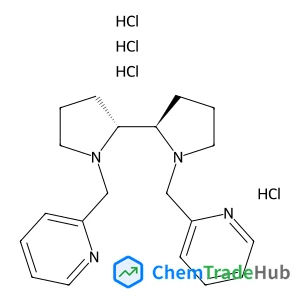
(2R,2'R)-1,1'-Bis(2-pyridinylmethyl)-2,2'-bipyrrolidine tetrahydrochloride
CAS Number:
1228077-88-0
Molecular Formula:
C20H30Cl4N4
![5,7-Dihydroxy-3-(4-hydroxyphenyl)-6-[(1R,6R)-3-methyl-6-prop-1-en-2-ylcyclohex-2-en-1-yl]chromen-4-one structure](https://static.chemtradehub.com/structs/191/1914963-20-4-2b05.webp "5,7-Dihydroxy-3-(4-hydroxyphenyl)-6-[(1R,6R)-3-methyl-6-prop-1-en-2-ylcyclohex-2-en-1-yl]chromen-4-one structure")
5,7-Dihydroxy-3-(4-hydroxyphenyl)-6-[(1R,6R)-3-methyl-6-prop-1-en-2-ylcyclohex-2-en-1-yl]chromen-4-one
CAS Number:
1914963-20-4
Molecular Formula:
C25H24O5
amine structure](https://static.chemtradehub.com/structs/629/62924-61-2-0728.webp "[(2-chlorophenyl)methyl](ethyl)amine structure")
Recommended Suppliers




Disclaimer
This page provides academic journal information for reference and research purposes only. We are not affiliated with any journal publishers and do not handle publication submissions. For publication-related inquiries, please contact the respective journal publishers directly.
If you notice any inaccuracies in the information displayed, please contact us at support@chemtradehub.com. We will promptly review and address your concerns.