












Controllable preparation and structures of two zinc phosphonocarboxylate frameworks with MER and RHO zeolitic topologies
Literature Information
Publication Date
2013-07-08
DOI
10.1039/C3CE40673C
Impact Factor
3.545
Authors
Mingli Deng, Xiaofeng Liu, Qingshu Zheng, Zhenxia Chen, Changye Fang, Bin Yue, Heyong He
View Original
Abstract
3-Phosphonobenzoic acid (3-H3pbc) was designed as an extended 4-connected ligand to build zeolite-like metal–organic frameworks (ZMOFs). Controlled assembly of Zn2+ with ligand 3-H3pbc results in two distinct structures with zeolitic topologies of MER and RHO, namely [Zn(3-pbc)]·H3O·0.5H2O (1) and Zn2.5(3-pbc)2(H2O)·nS (S represents the disordered solvent molecules) (2), respectively. The framework of 1 consists of double crankshaft chains formed by alternating ZnO4 and O3PC tetrahedra that are cross-linked by 3-pbc to generate a three-dimensional zeolitic open-framework. It is worth noting that structure 2 builds a zeolitic framework in a novel way, which has not been found in other metal phosphonocarboxylates. The organic part of 3-pbc does not participate in the construction of zeolitic topology and only plays a decorative role inside the cages.
Related Literature
Missing levels lead to additional lines: the influence of nuclear spin statistics on femtosecond degenerate four wave mixingspectroscopy of polyatomic systems
C. Riehn, M. I. Kunitski, V. V. Matylitsky, M. F. Gelin, B. Brutschy
2005-09-23
Paper
DOI: 10.1039/B510363K
A laser induced fluorescence technique for determining the pH of water droplets and probing uptake dynamics
Robert M. Sayer, Robert D. B. Gatherer, Jonathan P. Reid
2003-08-01
Paper
DOI: 10.1039/B307002F
Rotationally resolved electronic spectroscopy of tryptophol in the gas phase
John T. Yi, David W. Pratt
2005-09-12
Paper
DOI: 10.1039/B508610H
EXAFS analysis of an Ir/γ-Al2O3catalyst at elevated temperatures: evidence for a Gaussian pair distribution function
G. E. van Dorssen, D. C. Koningsberger
2003-07-15
Paper
DOI: 10.1039/B306127M
Theoretical maximal storage of hydrogen in zeolitic frameworks
Jenny G. Vitillo, Gabriele Ricchiardi, Giuseppe Spoto, Adriano Zecchina
2005-09-23
Paper
DOI: 10.1039/B510989B
Measurements of pressure broadening coefficients of selected transitions in the 2ν5 band of formaldehyde
2003-07-02
Paper
DOI: 10.1039/B304139P
Hyperfine coupling constants, electron-spin g-factors and vertical spectra of the X2Σ+ radicals BeH, MgH, CaH and BZ+, AlZ+, GaZ+ (Z = H, Li, Na, K). A theoretical study
Pablo J. Bruna, Friedrich Grein
2003-06-26
Paper
DOI: 10.1039/B303698G
Sr diffusion in undoped and La-doped SrTiO3 single crystals under oxidizing conditions
Karsten Gömann, Günter Borchardt, Michał Schulz, Anissa Gömann, Wolfgang Maus-Friedrichs, Bernard Lesage, Odile Kaïtasov, Susanne Hoffmann-Eifert, Theodor Schneller
2005-03-21
Paper
DOI: 10.1039/B418824A
Low energy electron driven reactions in single formic acid molecules (HCOOH) and their homogeneous clusters
Michal Stano, Stefan Matejcik
2005-04-25
Paper
DOI: 10.1039/B503517A
The interaction of CO2 with sodium-promoted W(011)
F. Viñes, A. Borodin, O. Höfft, V. Kempter, F. Illas
2005-09-15
Paper
DOI: 10.1039/B508748A
You might also like
Compound Q&A
What is 1-(2,4,6-Trifluorophenyl)ethanol (CAS: 1250113-83-7)?
1-(2,4,6-Trifluorophenyl)ethanol is an organic compound with the CAS number 1250...
1250113-83-71-(2,4,6-Trifluoroph...
Compound Q&A
Is 1-(2,4-Dimethoxybenzyl)-4-(hydroxymethyl)-2-pyrrolidinone (CAS: 919111-34-5) safe?
1-(2,4-Dimethoxybenzyl)-4-(hydroxymethyl)-2-pyrrolidinone (CAS: 919111-34-5) is ...
919111-34-51-(2,4-Dimethoxybenz...
Compound Q&A
What are the physical and chemical properties of (7S,15R)-6β,15-Diacetoxy-7α,20-epoxy-7-hydroxykaura-2,16-dien-1-one (CAS: 51419-51-3)?
(7S,15R)-6β,15-Diacetoxy-7α,20-epoxy-7-hydroxykaura-2,16-dien-1-one is a crystal...
51419-51-3(7S,15R)-6β,15-Diace...
Compound Q&A
What regulatory guidelines apply to rac-ethyl (1r,4r)-4-hydroxycyclohexane-1-carboxylate, trans (CAS: 3618-04-0)?
The compound rac-ethyl (1r,4r)-4-hydroxycyclohexane-1-carboxylate, trans (CAS: 3...
3618-04-0rac-ethyl (1r,4r)-4-...
Compound Q&A
What is the market or research trend for 2-(2,4-Difluorophenoxy)-3-nitropyridine (CAS: 175135-62-3)?
The market for 2-(2,4-Difluorophenoxy)-3-nitropyridine (CAS: 175135-62-3) is cur...
175135-62-32-(2,4-Difluoropheno...
Compound Q&A
What are the main uses of 6-Diazo-5-oxo-L-norleucine (CAS: 157-03-9)?
The main uses of 6-Diazo-5-oxo-L-norleucine (CAS: 157-03-9) include research in ...
157-03-96-Diazo-5-oxo-L-norl...
Compound Q&A
What precautions should be taken when handling 2-Aminoethyl-mono-amide-DOTA-tris(tBu ester) (CAS: 173308-19-5)?
When handling 2-Aminoethyl-mono-amide-DOTA-tris(tBu ester) (CAS: 173308-19-5), i...
173308-19-52-Aminoethyl-mono-am...
Compound Q&A
How is 5-Methylimidazo[1,2-a]pyridine-3-carbaldehyde (CAS: 178488-37-4) typically synthesized?
5-Methylimidazo[1,2-a]pyridine-3-carbaldehyde (CAS: 178488-37-4) can be synthesi...
178488-37-45-Methylimidazo[1,2-...
Compound Q&A
Are there alternatives to 2,4,6-Trihydroxyisophthalaldehyde (CAS: 4396-13-8) in synthesis?
There are alternative reagents that can be used in the synthesis of 2,4,6-Trihyd...
4396-13-82,4,6-Trihydroxyisop...
Compound Q&A
What is (2Z)-3-(5-Fluoro-1H-indol-3-yl)-2-sulfanylacrylic acid (CAS: 179461-52-0)?
(2Z)-3-(5-Fluoro-1H-indol-3-yl)-2-sulfanylacrylic acid is a chemical compound wi...
179461-52-0(2Z)-3-(5-Fluoro-1H-...
Source Journal
CrystEngComm

CiteScore:
5.5
Self-citation Rate:
7.7%
Articles per Year:
643
CrystEngComm is the forum for the design and understanding of crystalline materials. We welcome studies on the investigation of molecular behaviour within crystals, control of nucleation and crystal growth, engineering of crystal structures, and construction of crystalline materials with tuneable properties and functions. We publish hypothesis-driven research into… how crystal design affects thermodynamics, phase transitional behaviours, polymorphism, morphology control, solid state reactivity (crystal-crystal solution-crystal, and gas-crystal reactions), optoelectronics, ferroelectric materials, non-linear optics, molecular and bulk magnetism, conductivity and quantum computing, catalysis, absorption and desorption, and mechanical properties. Using Techniques and methods including… Single crystal and powder X-ray, electron, and neutron diffraction, solid-state spectroscopy, spectrometry, and microscopy, modelling and data mining, and empirical, semi-empirical and ab-initio theoretical evaluations. On crystalline and solid-state materials. We particularly welcome work on MOFs, coordination polymers, nanocrystals, host-guest and multi-component molecular materials. We also accept work on peptides and liquid crystals. All papers should involve the use or development of a design or optimisation strategy. Routine structural reports or crystal morphology descriptions, even when combined with an analysis of properties or potential applications, are generally considered to be outside the scope of the journal and are unlikely to be accepted.
Recommended Compounds
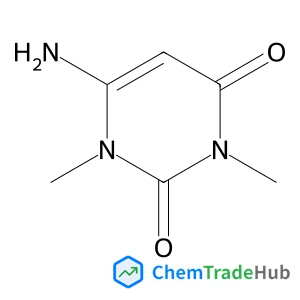
6-amino-1,3-dimethyl-1,2,3,4-tetrahydropyrimidine-2,4-dione
CAS Number:
6642-31-5
Molecular Formula:
C6H9N3O2
Recommended Suppliers




Disclaimer
This page provides academic journal information for reference and research purposes only. We are not affiliated with any journal publishers and do not handle publication submissions. For publication-related inquiries, please contact the respective journal publishers directly.
If you notice any inaccuracies in the information displayed, please contact us at support@chemtradehub.com. We will promptly review and address your concerns.