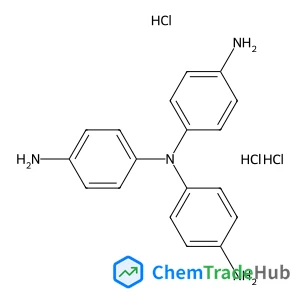
N1,N1-Bis(4-aminophenyl)benzene-1,4-diamine trihydrochloride
CAS Number:
114254-48-7
Molecular Formula:
C18H21Cl3N4
Sonya Beccaceci, Nerina Armata, J. Steven Ogden, John M. Dyke, Lydia Rhyman, Ponnadurai Ramasami
The reactions of dimethylsulfide (DMS) with molecular iodine (I2) and iodine monochloride (ICl) have been studied by infrared matrix isolation spectroscopy by co-condensation of the reagents in an inert gas matrix. Molecular adducts of DMS + I2 and DMS + ICl have also been prepared using standard synthetic methods. The vapour above each of these adducts trapped in an inert gas matrix gave the same infrared spectrum as that recorded for the corresponding co-condensation reaction. In each case, the infrared spectrum has been interpreted in terms of a van der Waals adduct, DMS : I2 and DMS : ICl, with the aid of infrared spectra computed for their minimum energy structures at the MP2 level. Computed relative energies of minima and transition states on the potential energy surfaces of these reactions were used to understand why they do not proceed further than the reactant complexes DMS : I2 and DMS : ICl. The main findings of this research are compared with results obtained earlier for the DMS + Cl2 and DMS + Br2 reactions, and the atmospheric implications of the conclusions are also considered.
T. Menanteau, E. Levillain, A. J. Downard, T. Breton
DOI: 10.1039/C5CP01401H
Jinfeng Zhao, Junsheng Chen, Jianyong Liu, Mark R. Hoffmann
DOI: 10.1039/C4CP05651E
Yuan Li
DOI: 10.1039/C5CP00928F
Toru Utsunomiya, Shoko Tatsumi, Yasuyuki Yokota, Ken-ichi Fukui
DOI: 10.1039/C5CP01156F
M. Kazemi, D. Biria, H. Rismani-Yazdi
DOI: 10.1039/C5CP00904A
Lanqing Xu, Xiaoman Zhang, Yongping Zheng
DOI: 10.1039/C4CP06014H
Bo Cai, Shengli Zhang, Ziyu Hu, Yonghong Hu, Yousheng Zou, Haibo Zeng
DOI: 10.1039/C5CP00563A
Khalid Elamin, Helén Jansson, Jan Swenson
DOI: 10.1039/C5CP00751H
V. L. Chandraboss, B. Karthikeyan, S. Senthilvelan
DOI: 10.1039/C5CP00451A
Akansha Singh, Prasenjit Sen
DOI: 10.1039/C5CP01016K
Waste containing N-Methoxy-N-methyl-1,3-thiazole-5-carboxamide (CAS: 898825-89-3...
N-(4-Biphenylyl)dibenzo[b,d]furan-4-amine should be stored in a tightly sealed c...
The market for 3-Acetamido-5-amino-2,4,6-triiodobenzoic acid (CAS: 1713-07-1) is...
Benzyl 2-O-acetyl-3,4,6-tri-O-benzyl-beta-D-galactopyranoside (CAS: 61820-03-9) ...
2-Ethylpiperazine dihydrochloride (CAS: 438050-52-3) is regulated under the Glob...
1,1'-[1,3-Phenylenebis(methylene)]bis(3-methyl-1H-pyrrole-2,5-dione) (CAS: 11946...
Several alternatives can be used in the synthesis of 5-Fluoro-2-(1-pyrrolidinyl)...
Proper personal protective equipment (PPE) must be worn when handling this compo...
When handling 6-Bromoimidazo[1,2-a]pyridin-8-amine, it is important to wear appr...
Alternatives to (2S,4R)-4-(4-Nitrobenzyl)pyrrolidine-2-carboxylic acid hydrochlo...

Physical Chemistry Chemical Physics (PCCP) is an international journal co-owned by 19 physical chemistry and physics societies from around the world. This journal publishes original, cutting-edge research in physical chemistry, chemical physics and biophysical chemistry. To be suitable for publication in PCCP, articles must include significant innovation and/or insight into physical chemistry; this is the most important criterion that reviewers and Editors will judge against when evaluating submissions. The journal has a broad scope and welcomes contributions spanning experiment, theory, computation and data science. Topical coverage includes spectroscopy, dynamics, kinetics, statistical mechanics, thermodynamics, electrochemistry, catalysis, surface science, quantum mechanics, quantum computing and machine learning. Interdisciplinary research areas such as polymers and soft matter, materials, nanoscience, energy, surfaces/interfaces, and biophysical chemistry are welcomed if they demonstrate significant innovation and/or insight into physical chemistry. Joined experimental/theoretical studies are particularly appreciated when complementary and based on up-to-date approaches.
![2-Methyl-2-propanyl {3-[4-(4,4,5,5-tetramethyl-1,3,2-dioxaborolan-2-yl)phenyl]-3-oxetanyl}carbamate structure](https://static.chemtradehub.com/structs/127/1279090-25-3-1b84.webp "2-Methyl-2-propanyl {3-[4-(4,4,5,5-tetramethyl-1,3,2-dioxaborolan-2-yl)phenyl]-3-oxetanyl}carbamate structure")
![2-Methylbenzo[h]quinoline structure](https://static.chemtradehub.com/structs/605/605-88-9-ac43.webp "2-Methylbenzo[h]quinoline structure")