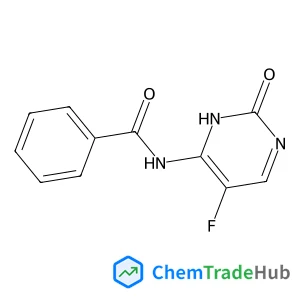
N-(5-Fluoro-2-oxo-2,3-dihydro-4-pyrimidinyl)benzamide
CAS Number:
10357-07-0
Molecular Formula:
C11H8FN3O2
Samir H. Mushrif, Stavros Caratzoulas, Dionisios G. Vlachos
Selective conversion of fructose to 5-hydroxymethyl-furfural (HMF) involves the participation of high-boiling solvents like dimethyl sulfoxide (DMSO). In order to replace DMSO with low-boiling solvents, it is imperative that we understand the effect of DMSO solvation in protecting (i) HMF from rehydration and humins formation reactions and (ii) fructose from side reactions, other than its dehydration to HMF. In the present work, molecular dynamics simulations of HMF and fructose in water and in water–DMSO mixtures are carried out using the OPLS-AA force field. Radial pair distribution functions, coordination numbers and the hydrogen-bond network between the HMF/fructose molecule and the solvent molecules are analysed. The local 3-dimensional picture of the arrangement of solvent molecules around the solute, which cannot be accessed from pair distribution functions, is also computed. We show preferential coordination of DMSO around HMF and explain how this could provide a shielding effect to the HMF molecule, thus protecting it from further rehydration to levulinic acid and formic acid and from humins formation. In the case of fructose, the presence of DMSO also reduces the number of water molecules in the immediate vicinity of fructose. Though fewer water molecules coordinate around fructose, they are bound strongly to it. Analysis of the local 3-dimensional arrangement of DMSO molecules suggests that it protects the fructose molecule from side reactions that would lead to condensation or reversion products. However, the presence of DMSO molecules does not hamper the water molecules coming into contact with the oxygen atom of the hydroxyl groups of fructose, which is required for a proton transfer from water to fructose, to initiate the dehydration reaction to HMF.
Fabian Pianezzi, Patrick Reinhard, Adrian Chirilă, Benjamin Bissig, Shiro Nishiwaki, Stephan Buecheler, Ayodhya N. Tiwari
DOI: 10.1039/C4CP00614C
Michael Kagan, Glenn K. Lockwood, Stephen H. Garofalini
DOI: 10.1039/C4CP00030G
DOI: 10.1039/C4CP04194A
Isabelle L. Kirby, Mark Brightwell, Mateusz B. Pitak, Claire Wilson, Simon J. Coles
DOI: 10.1039/C3CP54858A
Samim Sardar, Siddhi Chaudhuri, Prasenjit Kar, Soumik Sarkar, Samir Kumar Pal
DOI: 10.1039/C4CP03749A
Yao Jiang, Hongkunag Yuan
DOI: 10.1039/C4CP03631J
P. Giridhar, B. Weidenfeller, F. Endres
DOI: 10.1039/C4CP00613E
C. Stefaniu, I. Vilotijevic, G. Brezesinski
DOI: 10.1039/C4CP00567H
Joo Chuan Ang, Mark J. Henderson, Richard A. Campbell, Jhih-Min Lin, Peter N. Yaron, Andrew Nelson, Thomas Faunce, John W. White
DOI: 10.1039/C4CP00293H
Junfeng Liu, Li Wang, Guoxin Zhang, Xiaoming Sun
DOI: 10.1039/C4CP00155A
Waste containing N-Methoxy-N-methyl-1,3-thiazole-5-carboxamide (CAS: 898825-89-3...
N-(4-Biphenylyl)dibenzo[b,d]furan-4-amine should be stored in a tightly sealed c...
The market for 3-Acetamido-5-amino-2,4,6-triiodobenzoic acid (CAS: 1713-07-1) is...
Benzyl 2-O-acetyl-3,4,6-tri-O-benzyl-beta-D-galactopyranoside (CAS: 61820-03-9) ...
2-Ethylpiperazine dihydrochloride (CAS: 438050-52-3) is regulated under the Glob...
1,1'-[1,3-Phenylenebis(methylene)]bis(3-methyl-1H-pyrrole-2,5-dione) (CAS: 11946...
Several alternatives can be used in the synthesis of 5-Fluoro-2-(1-pyrrolidinyl)...
Proper personal protective equipment (PPE) must be worn when handling this compo...
When handling 6-Bromoimidazo[1,2-a]pyridin-8-amine, it is important to wear appr...
Alternatives to (2S,4R)-4-(4-Nitrobenzyl)pyrrolidine-2-carboxylic acid hydrochlo...

Physical Chemistry Chemical Physics (PCCP) is an international journal co-owned by 19 physical chemistry and physics societies from around the world. This journal publishes original, cutting-edge research in physical chemistry, chemical physics and biophysical chemistry. To be suitable for publication in PCCP, articles must include significant innovation and/or insight into physical chemistry; this is the most important criterion that reviewers and Editors will judge against when evaluating submissions. The journal has a broad scope and welcomes contributions spanning experiment, theory, computation and data science. Topical coverage includes spectroscopy, dynamics, kinetics, statistical mechanics, thermodynamics, electrochemistry, catalysis, surface science, quantum mechanics, quantum computing and machine learning. Interdisciplinary research areas such as polymers and soft matter, materials, nanoscience, energy, surfaces/interfaces, and biophysical chemistry are welcomed if they demonstrate significant innovation and/or insight into physical chemistry. Joined experimental/theoretical studies are particularly appreciated when complementary and based on up-to-date approaches.