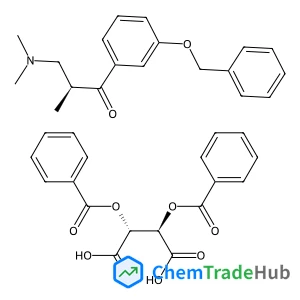
(S)-1-(3-(Benzyloxy)phenyl)-3-(dimethylamino)-2-methylpropan-1-one (2r,3r)-2,3-bis(benzoyloxy)succinate
CAS Number:
1004315-81-4
Molecular Formula:
C37H37NO10
Tadashi Okada
The excited state dynamics of periodic mesoporous organosilica (powder) bearing biphenylylene moieties densely in the silica framework (Bp-PMO) is investigated for the first time using femtosecond time-resolved diffuse reflectance (TDR) and picosecond time-resolved fluorescence spectroscopies. The TDR spectra revealed the excitation-relaxation process of the biphenylylene moieties, including the relaxation of the twisted Frank-Condon (FC) state to the lowest singlet excited state (S1) with a time constant of 730 ± 95 fs, and efficient quenching of the S1 state by excimer (E) formations with two time constants of 7.0 ± 0.2 ps (E1: ca. 64%) and 170 ± 47 ps (E2 and E3: ca. 36%). The individual absorption spectra of the FC, S1, and E states were reconstructed by the TDR spectral analysis. The time-resolved fluorescence spectra showed that the excimers decayed with three time constants of 1.3 ± 0.2 ns (E1), 8.2 ± 0.7 ns (E2) and 27 ± 2 ns (E3). The fluorescence quantum yields of the excimers are suggested to be almost zero for E1, and unity for E2 and E3, which implies that the fluorescence quantum yield of Bp-PMO (ΦF = 0.38) can be explained by the fraction of the highly emissive excimers (E2 and E3). The excited state dynamics of Bp-PMO is quite different from those of a solution of 4,4′-bis-(triethoxysilyl)biphenyl precursor and a biphenyl molecular crystal (powder).
Huadong Tang, Weilin Sun, Henry Plancher, Maciej Radosz, Youqing Shen
DOI: 10.1039/B501940K
Neil J. Shirtcliffe, Glen McHale, Michael I. Newton, Carole C. Perry, Paul Roach
DOI: 10.1039/B502896E
DOI: 10.1039/B502573G
Simon Burk, Giancarlo Franciò
DOI: 10.1039/B505195A
Samer N. Arafat, Samrat Dutta, Mathew Perring, Michael Mitchell, Paul J. A. Kenis, Ned B. Bowden
DOI: 10.1039/B503271G
Yusuke Fujii, Yasuchika Hasegawa, Shozo Yanagida, Yuji Wada
DOI: 10.1039/B502991K
Rositsa Karamanska, Balaram Mukhopadhyay, David A. Russell, Robert A. Field
DOI: 10.1039/B503843J
2-Methylbenzene-1,4-diamine dihydrochloride (CAS: 615-45-2) should be stored in ...
(1S,4S)-2,5-Diazabicyclo[2.2.1]heptane dihydrobromide is generally considered sa...
(6-Chloropyridazin-3-YL)methanamine finds applications in the pharmaceutical ind...
2-Fluoro-3-methylphenol is primarily used in the synthesis of pharmaceuticals, p...
When handling 3-Methoxy-4-nitrobenzonitrile, it is important to wear appropriate...
When handling 1,3-Oxazolo[4,5-b]pyridine-2(3H)-thione (CAS: 211949-57-4), it is ...
4-Ethynylbenzamide (CAS: 90347-86-7) falls under various regulatory guidelines i...
3-(2-Ethylphenyl)-2-thioxo-4-imidazolidinone is primarily used as an intermediat...
(2-Fluoro-6-methoxyphenyl)acetic acid, also known as 4-fluoro-3-methoxybenzoic a...
Market trends for 2-[4-(Hydroxymethyl)phenoxy]ethanol (CAS: 102196-18-9) indicat...

Physical Chemistry Chemical Physics (PCCP) is an international journal co-owned by 19 physical chemistry and physics societies from around the world. This journal publishes original, cutting-edge research in physical chemistry, chemical physics and biophysical chemistry. To be suitable for publication in PCCP, articles must include significant innovation and/or insight into physical chemistry; this is the most important criterion that reviewers and Editors will judge against when evaluating submissions. The journal has a broad scope and welcomes contributions spanning experiment, theory, computation and data science. Topical coverage includes spectroscopy, dynamics, kinetics, statistical mechanics, thermodynamics, electrochemistry, catalysis, surface science, quantum mechanics, quantum computing and machine learning. Interdisciplinary research areas such as polymers and soft matter, materials, nanoscience, energy, surfaces/interfaces, and biophysical chemistry are welcomed if they demonstrate significant innovation and/or insight into physical chemistry. Joined experimental/theoretical studies are particularly appreciated when complementary and based on up-to-date approaches.
![[1-(5-Methyl-2-pyridinyl)-1H-pyrazol-4-yl]methanol structure](https://static.chemtradehub.com/structs/143/1439822-99-7-6cc9.webp "[1-(5-Methyl-2-pyridinyl)-1H-pyrazol-4-yl]methanol structure")