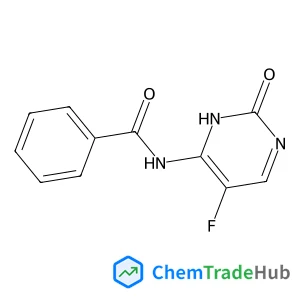
N-(5-Fluoro-2-oxo-2,3-dihydro-4-pyrimidinyl)benzamide
CAS Number:
10357-07-0
Molecular Formula:
C11H8FN3O2
Peter Politzer, Jane S. Murray
A halogen bond is a highly directional, electrostatically-driven noncovalent interaction between a region of positive electrostatic potential on the outer side of the halogen X in a molecule R–X and a negative site B, such as a lone pair of a Lewis base or the π-electrons of an unsaturated system. The positive region on X corresponds to the electronically-depleted outer lobe of the half-filled p-type orbital of X that is involved in forming the covalent bond to R. This depletion is labeled a σ-hole. The resulting positive electrostatic potential is along the extension of the R–X bond, which accounts for the directionality of halogen bonding. Positive σ-holes can also be found on covalently-bonded Group IV–VI atoms, which can similarly interact electrostatically with negative sites. Since positive σ-holes often exist in conjunction with negative potentials on other portions of the atom's surface, such atoms can interact electrostatically with both nucleophiles and electrophiles, as has been observed in surveys of crystallographic structures. Experimental as well as computational studies indicate that halogen and other σ-hole interactions can be competitive with hydrogen bonding, which itself can be viewed as a subset of σ-hole bonding.
Rabban Rabban, Jinti Moni Kumar, Naiwrit Karmodak, Bappaditya Gole
DOI: 10.1039/D3NJ05283D
DOI: 10.1039/D3NP00011G
DOI: 10.1039/D3TA03720G
Maria Bastianini, Michele Sisani, Annarita Petracci, Irene Di Guida, Riccardo Narducci
DOI: 10.1039/D3NJ04942F
Musa Dirak, Jefferson Chan, Safacan Kolemen
DOI: 10.1039/D3TB02468G
Dunren He, Wanyi Nie, Huihui Huang
DOI: 10.1039/D3TA06080B
Gurjaspreet Singh, Mohit, Akshpreet Singh, Priyanka, Sumesh Khurana, Mithun, K. N. Singh, Jasamrit Nayyar, Brij Mohan
DOI: 10.1039/D3NJ05199D
Sung-Jun Lee, Yoon-Gyung Sung, Santhia Kesavan, Chang-Lae Kim
DOI: 10.1039/D3NJ04802K
Le Wang, Yong-Shuang Li, Yu Cao
DOI: 10.1039/D3NJ05053J
Fangming Yang, Duanzhi Li, Zhihao Chen, Wenzhong Yang
DOI: 10.1039/D3NJ05155B
Waste containing N-Methoxy-N-methyl-1,3-thiazole-5-carboxamide (CAS: 898825-89-3...
N-(4-Biphenylyl)dibenzo[b,d]furan-4-amine should be stored in a tightly sealed c...
The market for 3-Acetamido-5-amino-2,4,6-triiodobenzoic acid (CAS: 1713-07-1) is...
Benzyl 2-O-acetyl-3,4,6-tri-O-benzyl-beta-D-galactopyranoside (CAS: 61820-03-9) ...
2-Ethylpiperazine dihydrochloride (CAS: 438050-52-3) is regulated under the Glob...
1,1'-[1,3-Phenylenebis(methylene)]bis(3-methyl-1H-pyrrole-2,5-dione) (CAS: 11946...
Several alternatives can be used in the synthesis of 5-Fluoro-2-(1-pyrrolidinyl)...
Proper personal protective equipment (PPE) must be worn when handling this compo...
When handling 6-Bromoimidazo[1,2-a]pyridin-8-amine, it is important to wear appr...
Alternatives to (2S,4R)-4-(4-Nitrobenzyl)pyrrolidine-2-carboxylic acid hydrochlo...

Physical Chemistry Chemical Physics (PCCP) is an international journal co-owned by 19 physical chemistry and physics societies from around the world. This journal publishes original, cutting-edge research in physical chemistry, chemical physics and biophysical chemistry. To be suitable for publication in PCCP, articles must include significant innovation and/or insight into physical chemistry; this is the most important criterion that reviewers and Editors will judge against when evaluating submissions. The journal has a broad scope and welcomes contributions spanning experiment, theory, computation and data science. Topical coverage includes spectroscopy, dynamics, kinetics, statistical mechanics, thermodynamics, electrochemistry, catalysis, surface science, quantum mechanics, quantum computing and machine learning. Interdisciplinary research areas such as polymers and soft matter, materials, nanoscience, energy, surfaces/interfaces, and biophysical chemistry are welcomed if they demonstrate significant innovation and/or insight into physical chemistry. Joined experimental/theoretical studies are particularly appreciated when complementary and based on up-to-date approaches.
![4-Chloro-2-{[(2-chlorophenoxy)acetyl]amino}benzoic acid structure](https://static.chemtradehub.com/structs/351/351424-20-9-9467.webp "4-Chloro-2-{[(2-chlorophenoxy)acetyl]amino}benzoic acid structure")