













Application of multinuclear magnetic resonance and gauge-including projector-augmented-wave calculations to the study of solid group 13 chlorides
Literature Information
Publication Date
2009-06-18
DOI
10.1039/B906627F
Impact Factor
3.676
Authors
Rebecca P. Chapman, David L. Bryce
View Original
Abstract
A series of four anhydrous group 13 chloride salts has been studied by 35/37Cl solid-state NMR spectroscopy and complementary quantum chemical calculations. Due to the large 35/37Cl quadrupolar interactions in these salts, a high magnetic field (21.1 T) and the variable-offset QCPMG technique was used to obtain full chlorine central transition (m = −1/2 ↔ 1/2) NMR spectra. Analyses of the NMR spectra of the synthetically important Lewis acid trichlorides of aluminium, gallium, and indium, as well as gallium dichloride, allowed for characterisation of the chlorine electric field gradient (EFG) tensors and, in three cases, the chlorine chemical shift (CS) tensors. The quadrupolar interaction was found to dominate the central transition chlorine NMR spectrum in all cases, with chlorine-35 quadrupolar coupling constants (CQ) ranging in magnitude from 22.45 ± 2.00 to 40.44 ± 2.00 MHz, and the spectral breadths ranging from approximately 1.0 to 2.5 MHz. For the trichloride salt of gallium, it was confirmed that the terminal chlorine sites exhibit larger chlorine CQ values than do the bridging chlorines. The isotropic chemical shifts range from 150 ± 100 to 375 ± 100 ppm while the largest CS tensor span is 500 ± 200 ppm, for InCl3. The chlorine chemical shift was found to increase with increasing M–Cl distance in all cases. Quantum chemical calculations of the EFG and magnetic shielding tensors, performed using the gauge-including projector-augmented-wave (GIPAW) method as implemented in the CASTEP program, were found to be in excellent agreement with the experimentally determined values, reproducing CQ(35Cl) to within 7% in all cases. The agreement between experiment and theory substantiates the accuracy of the NMR parameters. Solid-state NMR spectra of the cation species (aluminium-27, gallium-69/71 and indium-113/115) were also collected, and the EFG and CS parameters were determined in some cases. The study demonstrates the utility of multinuclear solid-state magnetic resonance studies of half-integer spin quadrupolar nuclei in ionic systems when the central transition is broadened greatly by the quadrupolar interaction, and in particular contributes to our understanding of the relationship between solid-state structure and chlorine NMR interaction tensors.
Recommended Journals
Related Literature
Influence of adsorption thermodynamics on guest diffusivities in nanoporous crystalline materials
Rajamani Krishna, Jasper M. van Baten
2013-03-26
Perspective
DOI: 10.1039/C3CP50449B
CVD formation of graphene on SiC surface in argon atmosphere
Małgorzata Wierzbowska, Adam Dominiak, Kamil Tokar
2013-04-03
Paper
DOI: 10.1039/C3CP44378G
A time resolved high energy X-ray diffraction study of cooling liquid SiO2
C. J. Benmore, M. C. Wilding, S. K. Tumber
2013-04-05
Paper
DOI: 10.1039/C3CP44347G
Pair distribution function (PDF) analysis of mesoporous α-Fe2O3 and Cr2O3
Adrian H. Hill, Mattia Allieta
2013-04-17
Paper
DOI: 10.1039/C3CP44322A
Assessment of density functional methods with correct asymptotic behavior
Chen-Wei Tsai, Yu-Chuan Su, Guan-De Li
2013-03-28
Paper
DOI: 10.1039/C3CP50441G
Local electronic structure of aqueous zinc acetate: oxygen K-edge X-ray absorption and emission spectroscopy on micro-jets
Edlira Suljoti, Kai F. Hodeck, Kathrin M. Lange, Mikhail A. Soldatov
2013-04-17
Communication
DOI: 10.1039/C3CP50686J
Powder crystallography of pharmaceutical materials by combined crystal structure prediction and solid-state 1H NMR spectroscopy
Maria Baias, Cory M. Widdifield, Jean-Nicolas Dumez, Hugh P. G. Thompson, Timothy G. Cooper, Elodie Salager, Sirena Bassil, Robin S. Stein, Anne Lesage, Graeme M. Day, Lyndon Emsley
2013-02-19
Paper
DOI: 10.1039/C3CP41095A
A physicochemical mechanism of chemical gas sensors using an AC analysis
Jaehyun Moon, Jin-Ah Park, Su-Jae Lee, Jeong-Ik Lee, Taehyong Zyung, Eui-Chol Shin, Jong-Sook Lee
2013-04-16
Paper
DOI: 10.1039/C3CP44684K
Influence of the Ce–Zr promoter on Pd behaviour under dynamic CO/NO cycling conditions: a structural and chemical approach
Anna Kubacka, Ana Iglesias-Juez, M. Di Michiel, Mark A. Newton, Marcos Fernández-García
2013-03-18
Paper
DOI: 10.1039/C3CP44293D
Single-molecule assays for investigating protein misfolding and aggregation
Armin Hoffmann, Krishna Neupane
2013-04-18
Perspective
DOI: 10.1039/C3CP44564J
You might also like
Compound Q&A
What precautions should be taken when handling 2-Chloro-1,2-bis(4-methylphenyl)ethanone (CAS: 71193-32-3)?
When handling 2-Chloro-1,2-bis(4-methylphenyl)ethanone (CAS: 71193-32-3), it is ...
71193-32-32-Chloro-1,2-bis(4-m...
Compound Q&A
What industries use 4-Ethoxy-3-(5-methyl-4-oxo-7-propyl-1,4-dihydroimidazo[5,1-f][1,2,4]triazin-2-yl)benzenesulfonyl chloride (CAS: 224789-26-8)?
4-Ethoxy-3-(5-methyl-4-oxo-7-propyl-1,4-dihydroimidazo[5,1-f][1,2,4]triazin-2-yl...
224789-26-84-Ethoxy-3-(5-methyl...
Compound Q&A
How should Methyl 3-Oxo-4-Androsten-17-Carboxylate (CAS: 2681-55-2) be stored?
Methyl 3-Oxo-4-Androsten-17-Carboxylate (CAS: 2681-55-2) should be stored in a c...
2681-55-2Methyl 3-Oxo-4-Andro...
Compound Q&A
What are the main uses of (R)-3-Amino-4-(3-hexylphenylamino)-4-oxobutylphosphonic acid (CAS: 909725-61-7)?
(R)-3-Amino-4-(3-hexylphenylamino)-4-oxobutylphosphonic acid is primarily used i...
909725-61-7(R)-3-Amino-4-(3-hex...
Compound Q&A
What regulatory guidelines apply to 2-Methyl-2-propanyl 3-amino-3-carbamoyl-1-azetidinecarboxylate (CAS: 1254120-14-3)?
2-Methyl-2-propanyl 3-amino-3-carbamoyl-1-azetidinecarboxylate (CAS: 1254120-14-...
1254120-14-32-Methyl-2-propanyl ...
Compound Q&A
Are there alternatives to (E)-4-(tert-Butoxy)-4-oxobut-2-enoic acid (CAS: 135355-96-3) in synthesis?
There are alternative reagents that can be used in synthesis instead of (E)-4-(t...
135355-96-3(E)-4-(tert-Butoxy)-...
Compound Q&A
What are the physical and chemical properties of [2-(3-Chlorophenyl)-1,3-thiazol-4-yl]methanol (CAS: 121202-20-8)?
[2-(3-Chlorophenyl)-1,3-thiazol-4-yl]methanol (CAS: 121202-20-8) is a crystallin...
121202-20-8[2-(3-Chlorophenyl)-...
Compound Q&A
What is the market or research trend for Methyl (2S)-[(4S)-2,2-dimethyl-1,3-dioxolan-4-yl]{[(4-methylphenyl)sulfonyl]oxy}acetate (CAS: 166249-17-8)?
The market and research trends for Methyl (2S)-[(4S)-2,2-dimethyl-1,3-dioxolan-4...
166249-17-8Methyl (2S)-[(4S)-2,...
Compound Q&A
What is the market or research trend for 1-Bromo-2-isocyanatoethane (CAS: 42865-19-0)?
The market for 1-Bromo-2-isocyanatoethane (CAS: 42865-19-0) is driven by its use...
42865-19-01-Bromo-2-isocyanato...
Compound Q&A
What are the main uses of 4-Nitro-D-phenylalanine hydrochloride (CAS: 147065-06-3)?
4-Nitro-D-phenylalanine hydrochloride (CAS: 147065-06-3) is primarily used in re...
147065-06-34-Nitro-D-phenylalan...
Source Journal
Physical Chemistry Chemical Physics

CiteScore:
5.5
Self-citation Rate:
10.3%
Articles per Year:
3036
Physical Chemistry Chemical Physics (PCCP) is an international journal co-owned by 19 physical chemistry and physics societies from around the world. This journal publishes original, cutting-edge research in physical chemistry, chemical physics and biophysical chemistry. To be suitable for publication in PCCP, articles must include significant innovation and/or insight into physical chemistry; this is the most important criterion that reviewers and Editors will judge against when evaluating submissions. The journal has a broad scope and welcomes contributions spanning experiment, theory, computation and data science. Topical coverage includes spectroscopy, dynamics, kinetics, statistical mechanics, thermodynamics, electrochemistry, catalysis, surface science, quantum mechanics, quantum computing and machine learning. Interdisciplinary research areas such as polymers and soft matter, materials, nanoscience, energy, surfaces/interfaces, and biophysical chemistry are welcomed if they demonstrate significant innovation and/or insight into physical chemistry. Joined experimental/theoretical studies are particularly appreciated when complementary and based on up-to-date approaches.
Recommended Compounds
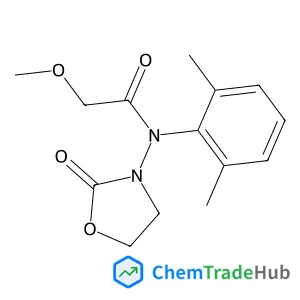
N-(2,6-Dimethylphenyl)-2-methoxy-N-(2-oxo-1,3-oxazolidin-3-yl)acetamide
CAS Number:
77732-09-3
Molecular Formula:
C14H18N2O4

![4-[2-(Trichlorosilyl)ethyl]benzenesulfonyl chloride structure](https://static.chemtradehub.com/structs/797/79793-00-3-de16.webp "4-[2-(Trichlorosilyl)ethyl]benzenesulfonyl chloride structure")
4-[2-(Trichlorosilyl)ethyl]benzenesulfonyl chloride
CAS Number:
79793-00-3
Molecular Formula:
C8H8Cl4O2SSi
Recommended Suppliers






Disclaimer
This page provides academic journal information for reference and research purposes only. We are not affiliated with any journal publishers and do not handle publication submissions. For publication-related inquiries, please contact the respective journal publishers directly.
If you notice any inaccuracies in the information displayed, please contact us at support@chemtradehub.com. We will promptly review and address your concerns.