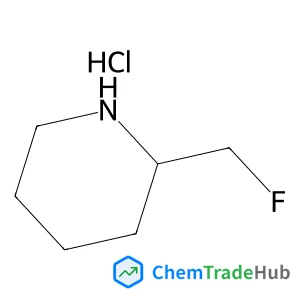
(2S)-2-(Fluoromethyl)piperidine hydrochloride (1:1)
CAS Number:
886216-73-5
Molecular Formula:
C6H13ClFN
The question of how to compute acidity constants (pKa) treating solvent and solute at the same level of theory remains of some interest, for example in the case of high or low pH conditions. We have developed a density functional theory based molecular dynamics implementation of such a method. The method is based on a half reaction scheme computing free energies of dissociation from the vertical energy gaps for insertion or removal of protons. Finite system size effects are important, but largely cancel when half reactions are combined to full reactions. We verified the method by investigating a series of organic and inorganic acids and bases spanning a wide range of pKa values (20 units). We find that the response of the aqueous solvent to vertical protonation/deprotonation is almost always asymmetric and correlated with the strength of the hydrogen bonding of the deprotonated base. We interpret these observations in analogy with the picture of solvent response to electronic ionization.

Biopolymers

Doklady Chemistry

Cement and Concrete Research

Advances in Colloid and Interface Science

Anti-Corrosion Methods and Materials

Journal of the American Chemical Society

Chemical & Pharmaceutical Bulletin

Bulletin of the Chemical Society of Japan

Corrosion Science

Chemistry of Heterocyclic Compounds
Charng-Sheng Tsai, Ting-Bin Yu, Chao-Tsen Chen
DOI: 10.1039/B507237A
Riichi Miyamoto, Rika Tanaka Hamazawa, Masakazu Hirotsu, Takanori Nishioka, Isamu Kinoshita, L. James Wright
DOI: 10.1039/B505681K
Jean-Paul Lellouche, Senthil Govindaraji, Augustine Joseph, Jyongsik Jang, Kyung Jin Lee
DOI: 10.1039/B502483H
Sibylle Müller, Klaus Müllen
DOI: 10.1039/B509220E
Md. Badruz Zaman, Dmitrii F. Perepichka
DOI: 10.1039/B506138E
Peter Nockemann, Eva Beurer, Kris Driesen, Rik Van Deun, Kristof Van Hecke, Luc Van Meervelt, Koen Binnemans
DOI: 10.1039/B506915G
Liang Li, Huifeng Qian, Jicun Ren
DOI: 10.1039/B505791D
Weigang Ju, Mingming Gu, Xiangmin Meng, Wensheng Shi, Xiaohong Zhang, Shuittong Lee
DOI: 10.1039/B506459G
Hanh. V. Ly, Taryn. D. Forster, Darren Maley, Masood Parvez, Roland Roesler
DOI: 10.1039/B508152A
DOI: 10.1039/B502849N
Waste containing N-Methoxy-N-methyl-1,3-thiazole-5-carboxamide (CAS: 898825-89-3...
N-(4-Biphenylyl)dibenzo[b,d]furan-4-amine should be stored in a tightly sealed c...
The market for 3-Acetamido-5-amino-2,4,6-triiodobenzoic acid (CAS: 1713-07-1) is...
Benzyl 2-O-acetyl-3,4,6-tri-O-benzyl-beta-D-galactopyranoside (CAS: 61820-03-9) ...
2-Ethylpiperazine dihydrochloride (CAS: 438050-52-3) is regulated under the Glob...
1,1'-[1,3-Phenylenebis(methylene)]bis(3-methyl-1H-pyrrole-2,5-dione) (CAS: 11946...
Several alternatives can be used in the synthesis of 5-Fluoro-2-(1-pyrrolidinyl)...
Proper personal protective equipment (PPE) must be worn when handling this compo...
When handling 6-Bromoimidazo[1,2-a]pyridin-8-amine, it is important to wear appr...
Alternatives to (2S,4R)-4-(4-Nitrobenzyl)pyrrolidine-2-carboxylic acid hydrochlo...

Physical Chemistry Chemical Physics (PCCP) is an international journal co-owned by 19 physical chemistry and physics societies from around the world. This journal publishes original, cutting-edge research in physical chemistry, chemical physics and biophysical chemistry. To be suitable for publication in PCCP, articles must include significant innovation and/or insight into physical chemistry; this is the most important criterion that reviewers and Editors will judge against when evaluating submissions. The journal has a broad scope and welcomes contributions spanning experiment, theory, computation and data science. Topical coverage includes spectroscopy, dynamics, kinetics, statistical mechanics, thermodynamics, electrochemistry, catalysis, surface science, quantum mechanics, quantum computing and machine learning. Interdisciplinary research areas such as polymers and soft matter, materials, nanoscience, energy, surfaces/interfaces, and biophysical chemistry are welcomed if they demonstrate significant innovation and/or insight into physical chemistry. Joined experimental/theoretical studies are particularly appreciated when complementary and based on up-to-date approaches.