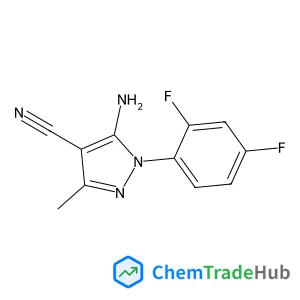
5-Amino-1-(2,4-difluorophenyl)-3-methyl-1H-pyrazole-4-carbonitrile
CAS Number:
1020057-92-4
Molecular Formula:
C11H8F2N4
Yi Liu, Xiyun Zhang, Liana M. Klivansky
A face-to-face binding motif between dibenzylammonium ions and macrocycles containing 1,2,3-triazoles was established, which operates cooperatively to enhance the reactivity of 1,2,3-triazoles in an Arbuzov-type dealkylation reaction.
Shan Yu, Yun-Qian Zhong, Bao-Quan Yu, Shi-Yi Cai, Li-Zhu Wu
DOI: 10.1039/C6CP02561G
W. Ruchira Silva, Renee R. Frontiera
DOI: 10.1039/C5CP06195D
N. Hohlbein, A. Shaaban, A. R. Bras, W. Pyckhout-Hintzen, A. M. Schmidt
DOI: 10.1039/C5CP00620A
Shaohong L. Li, Xuefei Xu, Donald G. Truhlar
DOI: 10.1039/C5CP02461G
Dong-Kwan Kim, Yoon Jo Hwang, Cheolho Yoon, Hye-On Yoon, Ki Soo Chang, Gi-Ra Yi
DOI: 10.1039/C5CP02968F
Sheng-Jie Lu, Lian-Rui Hu, Xi-Ling Xu, Hong-Guang Xu, Hui Chen, Wei-Jun Zheng
DOI: 10.1039/C6CP00373G
DOI: 10.1039/C5CP04272K
Benjamin B. Kirk, John D. Savee, Adam J. Trevitt, David L. Osborn, Kevin R. Wilson
DOI: 10.1039/C5CP02589C
1-(2,4,6-Trifluorophenyl)ethanol is an organic compound with the CAS number 1250...
1-(2,4-Dimethoxybenzyl)-4-(hydroxymethyl)-2-pyrrolidinone (CAS: 919111-34-5) is ...
(7S,15R)-6β,15-Diacetoxy-7α,20-epoxy-7-hydroxykaura-2,16-dien-1-one is a crystal...
The compound rac-ethyl (1r,4r)-4-hydroxycyclohexane-1-carboxylate, trans (CAS: 3...
The market for 2-(2,4-Difluorophenoxy)-3-nitropyridine (CAS: 175135-62-3) is cur...
The main uses of 6-Diazo-5-oxo-L-norleucine (CAS: 157-03-9) include research in ...
When handling 2-Aminoethyl-mono-amide-DOTA-tris(tBu ester) (CAS: 173308-19-5), i...
5-Methylimidazo[1,2-a]pyridine-3-carbaldehyde (CAS: 178488-37-4) can be synthesi...
There are alternative reagents that can be used in the synthesis of 2,4,6-Trihyd...
(2Z)-3-(5-Fluoro-1H-indol-3-yl)-2-sulfanylacrylic acid is a chemical compound wi...

ChemComm publishes urgent research which is of outstanding significance and interest to experts in the field, while also appealing to the journal’s broad chemistry readership. Our communication format is ideally suited to short, urgent studies that are of such importance that they require accelerated publication. Our scope covers all topics in chemistry, and research at the interface of chemistry and other disciplines (such as materials science, nanoscience, physics, engineering and biology) where there is a significant novelty in the chemistry aspects. Major topic areas covered include: Analytical Chemistry Catalysis Chemical Biology and medicinal chemistry Computational Chemistry and Machine Learning Energy and sustainable chemistry Environmental Chemistry Green Chemistry Inorganic Chemistry Materials Chemistry Nanoscience Organic Chemistry Physical Chemistry Polymer Chemistry Supramolecular Chemistry

![4-[(1-Methyl-1H-pyrrol-2-yl)methylene]-1,3(2H,4H)-isoquinolinedione structure](https://static.chemtradehub.com/structs/110/1104546-89-5-a600.webp "4-[(1-Methyl-1H-pyrrol-2-yl)methylene]-1,3(2H,4H)-isoquinolinedione structure")