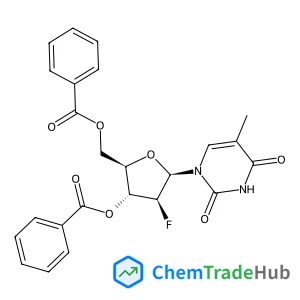
1-(3',5'-Di-O-benzoyl-2'-deoxy-2'-fluoro-b-D-arabinofuranosyl)thymine
CAS Number:
97614-47-6
Molecular Formula:
C24H21FN2O7
Jonathan D. Wilden, Lynsey Geldeard, Chieh C. Lee, Duncan B. Judd, Stephen Caddick
2,4,6-Trichlorophenol (TCP) sulfonate esters undergo effective aminolysis under conventional heating and microwave irradiation; the reactivity of these species is such that chemoselective transformations of PFP sulfonate esters can be achieved.
Ian Clegg, Anna Codina
DOI: 10.1039/D2RE00123C
Zeynep Tunalı, Bengi Özgün Öztürk
DOI: 10.1039/D2RE00058J
Snehasis Dutta, Trilochan Gadly, Amey P. Wadawale, Mayur Darekar, Sulekha Mukhopadhay, Sunil K. Ghosh, Birija S. Patro
DOI: 10.1039/D2RE00047D
Liuyong Shi
DOI: 10.1039/D2RE00103A
Sebastian Knoll, Martin Horn
DOI: 10.1039/D2RE00208F
Liping Zhou
DOI: 10.1039/D2RE00286H
DOI: 10.1039/D2RE00044J
Vida Khodkari, Mohammad Taghi Nazeri, Siamak Javanbakht
DOI: 10.1039/D2RE00195K
Jahaziel Amaya, Cesar Calderón, Rafael Molina, Sonia Moreno
DOI: 10.1039/D2RE00353H
(3.beta.)-3-Hydroxy-N,N-dimethyl-chol-5-en-24-amide (CAS: 79066-03-8) is primari...
5-(Aminomethyl)-2-methoxyphenol (CAS: 89702-89-6) is classified under GHS as a s...
Thieno[2,3-c]pyridin-7(6H)-one (CAS: 28981-13-7) is a heterocyclic organic compo...
1-[(6-Methoxy-3-pyridinyl)methyl]-4-piperidinamine dihydrochloride is generally ...
[(2E)-3-Phenyl-2-propen-1-yl]phosphonic acid (CAS: 146404-58-2) is regulated und...
6-Bromo-7-methoxyquinoline (CAS: 1620515-86-7) falls under the scope of the Glob...
This compound is primarily used in the pharmaceutical industry for the developme...
1-Ethyl-7-[2-methyl-6-(4H-1,2,4-triazol-3-yl)-3-pyridinyl]-3,5-dihydropyrazino[2...
Alternative reagents such as 2-[(dimethylamino)methyl]phenylboronic acid or rela...
3-(Piperidin-4-yloxy)pyridine (CAS: 310881-48-2) is an organic compound with the...

ChemComm publishes urgent research which is of outstanding significance and interest to experts in the field, while also appealing to the journal’s broad chemistry readership. Our communication format is ideally suited to short, urgent studies that are of such importance that they require accelerated publication. Our scope covers all topics in chemistry, and research at the interface of chemistry and other disciplines (such as materials science, nanoscience, physics, engineering and biology) where there is a significant novelty in the chemistry aspects. Major topic areas covered include: Analytical Chemistry Catalysis Chemical Biology and medicinal chemistry Computational Chemistry and Machine Learning Energy and sustainable chemistry Environmental Chemistry Green Chemistry Inorganic Chemistry Materials Chemistry Nanoscience Organic Chemistry Physical Chemistry Polymer Chemistry Supramolecular Chemistry