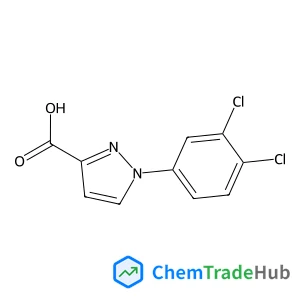
1-(3,4-Dichlorophenyl)-1H-pyrazole-3-carboxylic acid
CAS Number:
1152949-12-6
Molecular Formula:
C10H6Cl2N2O2
Mari Nishimine, Kei Ohkubo, Takashi Komori, Shunichi Fukuzumi
DNA inhibits hydride transfer from 1-benzyl-1,4-dihydronicotinamide to the 10-methylacridinium ion, whereas DNA accelerates photoinduced electron transfer from the excited state of Ru(bpy)32+ to the 1-methylquinolinium ion. The reason of such reversed effects of DNA on the hydride transfer and electron transfer reactions is clarified.
Jonas Elm, Nanna Myllys, Tinja Olenius, Roope Halonen, Theo Kurtén, Hanna Vehkamäki
DOI: 10.1039/C6CP08127D
Arianna Bartolini, Paolo Tempesti, Claudio Resta, Debora Berti, Johan Smets, Yousef G. Aouad, Piero Baglioni
DOI: 10.1039/C6CP07967A
Fenghua Liu, Dongxu Dai, Wenrui Dong, Xueming Yang
DOI: 10.1039/C7CP04336H
Shuixing Li, Zhongqiang Zhang, Minmin Shi, Chang-Zhi Li, Hongzheng Chen
DOI: 10.1039/C6CP07465K
Chengzhen Sun, Bofeng Bai
DOI: 10.1039/C6CP06267A
Gopal Datt, Chetan Kotabage, A. C. Abhyankar
DOI: 10.1039/C7CP03953K
R. Hu, Z. H. Zhang, Z. Q. Fan
DOI: 10.1039/C7CP02391J
P. Jasik, J. E. Sienkiewicz, J. Domsta, N. E. Henriksen
DOI: 10.1039/C7CP02097J
Ana Gamarra, Lourdes Urpí, Antxon Martínez de Ilarduya, Sebastián Muñoz-Guerra
DOI: 10.1039/C6CP08304H
Waste containing N-Methoxy-N-methyl-1,3-thiazole-5-carboxamide (CAS: 898825-89-3...
N-(4-Biphenylyl)dibenzo[b,d]furan-4-amine should be stored in a tightly sealed c...
The market for 3-Acetamido-5-amino-2,4,6-triiodobenzoic acid (CAS: 1713-07-1) is...
Benzyl 2-O-acetyl-3,4,6-tri-O-benzyl-beta-D-galactopyranoside (CAS: 61820-03-9) ...
2-Ethylpiperazine dihydrochloride (CAS: 438050-52-3) is regulated under the Glob...
1,1'-[1,3-Phenylenebis(methylene)]bis(3-methyl-1H-pyrrole-2,5-dione) (CAS: 11946...
Several alternatives can be used in the synthesis of 5-Fluoro-2-(1-pyrrolidinyl)...
Proper personal protective equipment (PPE) must be worn when handling this compo...
When handling 6-Bromoimidazo[1,2-a]pyridin-8-amine, it is important to wear appr...
Alternatives to (2S,4R)-4-(4-Nitrobenzyl)pyrrolidine-2-carboxylic acid hydrochlo...

ChemComm publishes urgent research which is of outstanding significance and interest to experts in the field, while also appealing to the journal’s broad chemistry readership. Our communication format is ideally suited to short, urgent studies that are of such importance that they require accelerated publication. Our scope covers all topics in chemistry, and research at the interface of chemistry and other disciplines (such as materials science, nanoscience, physics, engineering and biology) where there is a significant novelty in the chemistry aspects. Major topic areas covered include: Analytical Chemistry Catalysis Chemical Biology and medicinal chemistry Computational Chemistry and Machine Learning Energy and sustainable chemistry Environmental Chemistry Green Chemistry Inorganic Chemistry Materials Chemistry Nanoscience Organic Chemistry Physical Chemistry Polymer Chemistry Supramolecular Chemistry
![[5-fluoro-2-(morpholine-4-carbonyl)phenyl]boronic acid structure](https://static.chemtradehub.com/structs/121/1217501-26-2-505c.webp "[5-fluoro-2-(morpholine-4-carbonyl)phenyl]boronic acid structure")
![[(5-Methyl-1,3,4-thiadiazol-2-yl)sulfanyl]acetic acid structure](https://static.chemtradehub.com/structs/509/50918-26-8-4ce8.webp "[(5-Methyl-1,3,4-thiadiazol-2-yl)sulfanyl]acetic acid structure")