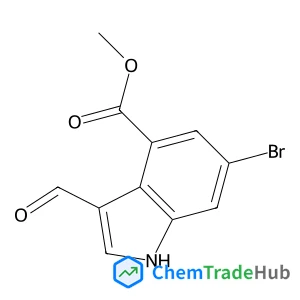
methyl 6-bromo-3-formyl-1H-indole-4-carboxylate
CAS Number:
1353636-63-1
Molecular Formula:
C11H8BrNO3
Matteo Conza, Helma Wennemers
The scope of a solid phase binding assay for the determination of binding affinities between a solid supported substrate and a coloured host has been studied by investigating the influence of the nature and the loading of the solid support.
Hwee Ting Ang, Jason P. G. Rygus, Dennis G. Hall
DOI: 10.1039/C9OB01043B
Paige Dickson, Thomas Kodadek
DOI: 10.1039/C9OB00581A
Yufeng Wu, Bing Tian, Chao Hu, Kohei Sekine, Matthias Rudolph, Frank Rominger
DOI: 10.1039/C9OB00740G
Debabrata Maity, Alba Gigante, Pedro A. Sánchez-Murcia, Eline Sijbesma, Mao Li, David Bier, Stefanie Mosel, Shirley Knauer, Carsten Schmuck
DOI: 10.1039/C9OB00620F
Ze-Nan Feng, Jin-Yun Luo, Yang Zhang, Guang-Fen Du, Lin He
DOI: 10.1039/C9OB00210C
Shinichi Sato, Hiroya Asami, Tomoko Hasegawa, Jun-Ya Kohno, Hiroyuki Nakamura
DOI: 10.1039/C9OB00584F
Katharina Schmölzer, Melanie Weingarten, Kai Baldenius
DOI: 10.1039/C9OB90088H
Jingbo Yu, Chao Zhang, Xinjie Yang, Weike Su
DOI: 10.1039/C9OB00622B
Samantha L. Pilicer, Michele Mancinelli, Andrea Mazzanti, Christian Wolf
DOI: 10.1039/C9OB01265F
(3.beta.)-3-Hydroxy-N,N-dimethyl-chol-5-en-24-amide (CAS: 79066-03-8) is primari...
5-(Aminomethyl)-2-methoxyphenol (CAS: 89702-89-6) is classified under GHS as a s...
Thieno[2,3-c]pyridin-7(6H)-one (CAS: 28981-13-7) is a heterocyclic organic compo...
1-[(6-Methoxy-3-pyridinyl)methyl]-4-piperidinamine dihydrochloride is generally ...
[(2E)-3-Phenyl-2-propen-1-yl]phosphonic acid (CAS: 146404-58-2) is regulated und...
6-Bromo-7-methoxyquinoline (CAS: 1620515-86-7) falls under the scope of the Glob...
This compound is primarily used in the pharmaceutical industry for the developme...
1-Ethyl-7-[2-methyl-6-(4H-1,2,4-triazol-3-yl)-3-pyridinyl]-3,5-dihydropyrazino[2...
Alternative reagents such as 2-[(dimethylamino)methyl]phenylboronic acid or rela...
3-(Piperidin-4-yloxy)pyridine (CAS: 310881-48-2) is an organic compound with the...

ChemComm publishes urgent research which is of outstanding significance and interest to experts in the field, while also appealing to the journal’s broad chemistry readership. Our communication format is ideally suited to short, urgent studies that are of such importance that they require accelerated publication. Our scope covers all topics in chemistry, and research at the interface of chemistry and other disciplines (such as materials science, nanoscience, physics, engineering and biology) where there is a significant novelty in the chemistry aspects. Major topic areas covered include: Analytical Chemistry Catalysis Chemical Biology and medicinal chemistry Computational Chemistry and Machine Learning Energy and sustainable chemistry Environmental Chemistry Green Chemistry Inorganic Chemistry Materials Chemistry Nanoscience Organic Chemistry Physical Chemistry Polymer Chemistry Supramolecular Chemistry
amine structure](https://static.chemtradehub.com/structs/629/62924-61-2-0728.webp "[(2-chlorophenyl)methyl](ethyl)amine structure")
![N-[(6-Bromo-3-pyridinyl)methyl]ethanamine structure](https://static.chemtradehub.com/structs/120/120740-05-8-ca55.webp "N-[(6-Bromo-3-pyridinyl)methyl]ethanamine structure")