












Theoretical study of the hydrogen abstraction reactions for CH3R + Cl → CH2R + HCl (R = Cl and Br)
Literature Information
Publication Date
2001-08-29
DOI
10.1039/B104667P
Impact Factor
3.676
Authors
Jing-Fa Xiao, Ze-Sheng Li, Yi-Hong Ding, Jing-Yao Liu, Xu-Ri Huang, Chia-Chung Sun
View Original
Abstract
The dynamical properties of the hydrogen abstraction reactions of chloromethane (CH3Cl) and bromomethane (CH3Br) with chlorine atoms in the temperature range 200–800 K are investigated theoretically. The minimum energy paths (MEPs) of both reactions are calculated at the BH&H-LYP/6-311G(d,p) level, and the energies along the MEPs are further refined at the QCISD(T)/6-311 + G(d,p) (single-point) level. For the CH3Cl + Cl reaction, the theoretical rate constants are in good agreement with available experimental results, yet the Arrhenius slope is somewhat steeper. Compared with one previous theoretical investigation at a lower level, our calculated rate constants are closer to the experimental values. For the CH3Br + Cl reaction that has no previous theoretical comparison, our calculated rate constants are in reasonable agreement with experiment, although again the Arrhenius slope is steeper than the experimental one. It is shown that the vibrational adiabatic potential energy curves for both reactions have two barriers, a situation similar to the analogous CH3F + Cl reaction. For both reactions, the variational and small-curvature tunneling effects are found to be small over the temperature range considered.
Recommended Journals
Related Literature
Growth kinetic of single and double-walled aluminogermanate imogolite-like nanotubes: an experimental and modeling approach
Perrine Maillet
2010-12-09
Paper
DOI: 10.1039/C0CP01851A
Basicity, complexation ability and interfacial behavior of BTBPs: a simulation study
G. Benay, R. Schurhammer, G. Wipff
2010-12-16
Paper
DOI: 10.1039/C0CP01975E
Synthesis and characterization of nanogels of poly(N-isopropylacrylamide) by a combination of light and small-angle X-ray scattering
Thomas Alsted, Walter Richtering, Jan Skov Pedersen
2010-10-07
Paper
DOI: 10.1039/C0CP01359E
Two-mode dynamics in dispersed systems: the case of particle-stabilized foams studied by diffusing wave spectroscopy
Antonio Stocco, Jérôme Crassous, Anniina Salonen, Arnaud Saint-Jalmes, Dominique Langevin
2010-11-25
Paper
DOI: 10.1039/C0CP01152E
Hydrogen bond strength and network structure effects on hydration of non-polar molecules
R. M. Lynden-Bell, N. Giovambattista, P. G. Debenedetti, T. Head-Gordon, P. J. Rossky
2010-12-10
Paper
DOI: 10.1039/C0CP01701A
Ammonia IRMS-TPD measurements on Brønsted acidity of proton-formed SAPO-34
Katsuki Suzuki, Takuma Nishio, Naonobu Katada, German Sastre, Miki Niwa
2010-12-20
Paper
DOI: 10.1039/C0CP00961J
One-pot generation of mesoporous carbon supported nanocrystalline calcium oxides capable of efficient CO2 capture over a wide range of temperatures
Na Hao, Gongkui Xiao, Liying Liu, Paul Webley
2010-12-06
Paper
DOI: 10.1039/C0CP01807D
Low-temperature decomposition of methanol on Au nanoclusters supported on a thin film of Al2O3/NiAl(100)
Guo-Rue Hu, Chen-Sheng Chao, Hong-Wan Shiu, Cheng-Ting Wang, Won-Ru Lin, Yao-Jane Hsu, Meng-Fan Luo
2011-01-24
Paper
DOI: 10.1039/C0CP00526F
You might also like
Compound Q&A
What are the main uses of 1H-Indazole-6-carbonitrile (CAS: 141290-59-7)?
1H-Indazole-6-carbonitrile finds applications in pharmaceuticals, where it serve...
141290-59-71H-Indazole-6-carbon...
Compound Q&A
How should waste containing Dioctyl (2E)-2-butenedioate (CAS: 2997-85-5) be handled?
Waste containing Dioctyl (2E)-2-butenedioate (CAS: 2997-85-5) should be collecte...
2997-85-5Dioctyl (2E)-2-buten...
Compound Q&A
What industries use Sodium [(1,2-benzoxazol-3-ylmethyl)sulfonyl]azanide (CAS: 68291-98-5)?
Sodium [(1,2-benzoxazol-3-ylmethyl)sulfonyl]azanide is primarily used in pharmac...
68291-98-5Sodium [(1,2-benzoxa...
Compound Q&A
Are there alternatives to Dimethyl 4-(4,4,5,5-tetramethyl-1,3,2-dioxaborolan-2-yl)-2,6-pyridinedicarboxylate (CAS: 741709-66-0) in synthesis?
Dimethyl 4-(4,4,5,5-tetramethyl-1,3,2-dioxaborolan-2-yl)-2,6-pyridinedicarboxyla...
741709-66-0Dimethyl 4-(4,4,5,5-...
Compound Q&A
How should waste containing 2-Fluoro-6-hydrazinopyridine (CAS: 80714-39-2) be handled?
Waste containing 2-Fluoro-6-hydrazinopyridine (CAS: 80714-39-2) should be manage...
80714-39-22-Fluoro-6-hydrazino...
Compound Q&A
What is 6-Formyl-2-pyridinecarboxylic acid (CAS: 499214-11-8)?
6-Formyl-2-pyridinecarboxylic acid is an organic compound with the molecular for...
499214-11-86-Formyl-2-pyridinec...
Compound Q&A
What is the market or research trend for 3-(3,4-dimethoxyphenyl)-2,5-dimethyl-N-(2-morpholin-4-ylethyl)pyrazolo[1,5-a]pyrimidin-7-amine (CAS: 900874-91-1)?
Research trends for this compound indicate a focus on its potential applications...
900874-91-13-(3,4-dimethoxyphen...
Compound Q&A
How is 9H-Tribenzo[b,d,f]azepine (CAS: 29875-73-8) typically synthesized?
9H-Tribenzo[b,d,f]azepine is typically synthesized via a multi-step process invo...
29875-73-89H-Tribenzo[b,d,f]az...
Compound Q&A
How is 1-Cyclopropyl-7-ethoxy-6-fluoro-8-methoxy-4-oxo-1,4-dihydro-3-quinolinecarboxylic acid (CAS: 1797982-51-4) typically synthesized?
1-Cyclopropyl-7-ethoxy-6-fluoro-8-methoxy-4-oxo-1,4-dihydro-3-quinolinecarboxyli...
1797982-51-41-Cyclopropyl-7-etho...
Compound Q&A
How should waste containing Methyl 3-oxo-1,2,3,4-tetrahydro-6-quinoxalinecarboxylate (CAS: 671820-52-3) be handled?
Waste containing Methyl 3-oxo-1,2,3,4-tetrahydro-6-quinoxalinecarboxylate (CAS: ...
671820-52-3Methyl 3-oxo-1,2,3,4...
Source Journal
Physical Chemistry Chemical Physics

CiteScore:
5.5
Self-citation Rate:
10.3%
Articles per Year:
3036
Physical Chemistry Chemical Physics (PCCP) is an international journal co-owned by 19 physical chemistry and physics societies from around the world. This journal publishes original, cutting-edge research in physical chemistry, chemical physics and biophysical chemistry. To be suitable for publication in PCCP, articles must include significant innovation and/or insight into physical chemistry; this is the most important criterion that reviewers and Editors will judge against when evaluating submissions. The journal has a broad scope and welcomes contributions spanning experiment, theory, computation and data science. Topical coverage includes spectroscopy, dynamics, kinetics, statistical mechanics, thermodynamics, electrochemistry, catalysis, surface science, quantum mechanics, quantum computing and machine learning. Interdisciplinary research areas such as polymers and soft matter, materials, nanoscience, energy, surfaces/interfaces, and biophysical chemistry are welcomed if they demonstrate significant innovation and/or insight into physical chemistry. Joined experimental/theoretical studies are particularly appreciated when complementary and based on up-to-date approaches.
Recommended Compounds


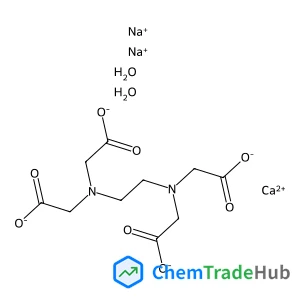
EthylenediaminetetraaceticacidcalciumDisodiumsalthydrate
CAS Number:
23411-34-9
Molecular Formula:
C10H16CaN2Na2O10
Recommended Suppliers




Disclaimer
This page provides academic journal information for reference and research purposes only. We are not affiliated with any journal publishers and do not handle publication submissions. For publication-related inquiries, please contact the respective journal publishers directly.
If you notice any inaccuracies in the information displayed, please contact us at support@chemtradehub.com. We will promptly review and address your concerns.