












The transient absorption of 1,3,5-tri-tert-butyl-pentalene
Literature Information
Publication Date
2001-07-11
DOI
10.1039/B103114G
Impact Factor
3.676
Authors
Laura Bussotti, Cristina Gellini, Laura Moroni, Pier Remigio Salvi
View Original
Abstract
The transient absorption of 1,3,5-tri-tert-butyl-pentalene in cyclohexane solution has been measured at room temperature exciting at 340 nm with femtosecond pulses. Two relaxation processes have been determined, the first, very rapid, with time constant 650 fs and the second, occurring on a picosecond timescale, with estimated decay time 13 ps. The former is due to the vibronic relaxation from upper S3 levels to the S3 minimum, the latter to the decay from S3 to S0. This interpretation is in good agreement with results of ab initio calculations on pentalene and its alkyl derivatives, 1,3,5-tri-ethyl, 1,3,5-tri-sec-propyl and 1,3,5-tri-tert-butyl. MCSCF/CAS calculations, perturbatively corrected within the scheme of quasi-degenerate perturbation theory (QDPT), of vertical S0 → Sn excitation energies allow us to study the dependence of excitation energies on substitution. Calculated S3 → Sn and S4 → Sn absorption spectra of pentalene at the S0, S3 and S4 equilibrium geometries indicate that vibronic levels of S3 rather than of S4 are excited by the strong pump pulse with subsequent decay within this state.
Related Literature
Electrically precise control of the spin polarization of electronic transport at the single-molecule level
Hong-Li Zeng, Yu-Rong Yang
2020-07-08
Paper
DOI: 10.1039/D0CP01868F
Bilayer thickness determines the alignment of model polyproline helices in lipid membranes
Stephan L. Grage
2019-09-18
Paper
DOI: 10.1039/C9CP02996F
Rotational quenching of an interstellar gas thermometer: CH3CN⋯He collisions
E. Quintas-Sánchez, R. Dawes, K. Hammami, L. Wiesenfeld
2020-07-23
Paper
DOI: 10.1039/D0CP02985H
Structure of water and polymer at the buried polymer/water interface unveiled using heterodyne-detected vibrational sum frequency generation
Sanat Ghosh, Shu-hei Urashima, Shoichi Yamaguchi, Takashi Aoki
2020-07-07
Communication
DOI: 10.1039/D0CP02618B
Advancing predictions of protein stability in the solid state‡
Maarten Batens, Talia A. Shmool, Jan Massant, J. Axel Zeitler, Guy Van den Mooter
2020-07-07
Paper
DOI: 10.1039/D0CP00341G
A DFT study for CO2 hydrogenation on W(111) and Ni-doped W(111) surfaces
2020-07-10
Paper
DOI: 10.1039/D0CP02285C
Emergent multiferroicity and strain-driven metal–semiconductor transitions in LaMnO3/RMnO3 superlattices (R = Pr, Pm, Sm and Gd)
Pengxia Zhou, Hengchang Liu, Lichang Zhao, Qu Yang, Zhiyun Zhao, Lihua Qu, Zhengchao Dong
2020-07-13
Paper
DOI: 10.1039/D0CP02625E
Spectroscopic identification of fragment ions of DNA/RNA building blocks: the case of pyrimidine
Kuntal Chatterjee, Otto Dopfer
2020-07-07
Paper
DOI: 10.1039/D0CP02919J
Distonic radical anion species in cysteine oxidation processes
Zhengbo Qin, Gao-Lei Hou, Zheng Yang, Marat Valiev, Xue-Bin Wang
2020-07-10
Paper
DOI: 10.1039/D0CP02165B
You might also like
Compound Q&A
Are there alternatives to 1-(4-Chlorophenyl)-N-hydroxymethanimine (CAS: 3848-36-0) in synthesis?
When considering alternatives to 1-(4-Chlorophenyl)-N-hydroxymethanimine (CAS: 3...
3848-36-01-(4-Chlorophenyl)-N...
Compound Q&A
How should (1R,9S,10S,12S,14E,16S,19R,20R,21S,22R)-3,9,21-Trihydroxy-5,10,12,14,16,20,22-heptamethyl-23,24-dioxatetracyclo[17.3.1.1~6,9~.0~2,7~]tetracosa-2,5,7,14-tetraen-4-one (CAS: 183202-73-5) be stored?
This compound should be stored in a cool, dry place away from direct sunlight. I...
183202-73-5(1R,9S,10S,12S,14E,1...
Compound Q&A
How is 3-(4-Bromophenyl)-5-(2-fluorophenyl)-1,2,4-oxadiazole (CAS: 419553-16-5) typically synthesized?
3-(4-Bromophenyl)-5-(2-fluorophenyl)-1,2,4-oxadiazole is synthesized through a m...
419553-16-53-(4-Bromophenyl)-5-...
Compound Q&A
How is 5-Chloro-2-(4-chlorophenyl)-4-methyl-6-[3-(1-piperidinyl)propoxy]pyrimidine (CAS: 1639220-19-1) typically synthesized?
5-Chloro-2-(4-chlorophenyl)-4-methyl-6-[3-(1-piperidinyl)propoxy]pyrimidine (CAS...
1639220-19-15-Chloro-2-(4-chloro...
Compound Q&A
What industries use 2-Chloro-4-(difluoromethoxy)pyridine (CAS: 1206978-15-5)?
2-Chloro-4-(difluoromethoxy)pyridine is used in the pharmaceutical industry for ...
1206978-15-52-Chloro-4-(difluoro...
Compound Q&A
What regulatory guidelines apply to 3-Chloro-6-methylpyridazine (CAS: 1121-79-5)?
3-Chloro-6-methylpyridazine (CAS: 1121-79-5) is classified under the Globally Ha...
1121-79-53-Chloro-6-methylpyr...
Compound Q&A
Are there alternatives to Methyl 4,5-dimethyl-2-nitrobenzoate in synthesis?
Several alternatives can be used in the synthesis of Methyl 4,5-dimethyl-2-nitro...
90922-74-0Methyl 4,5-dimethyl-...
Compound Q&A
Are there alternatives to (2E,2'E)-3,3'-(1,4-Phenylene)bisacrylaldehyde in synthesis?
Alternatives to (2E,2'E)-3,3'-(1,4-Phenylene)bisacrylaldehyde include other acry...
63405-68-5(2E,2'E)-3,3'-(1,4-P...
Compound Q&A
What is 3-Amino-5-chloropyridin-2-ol hydrochloride (CAS: 1261906-29-9)?
3-Amino-5-chloropyridin-2-ol hydrochloride is an organic compound with the CAS n...
1261906-29-93-Amino-5-chloropyri...
Compound Q&A
What precautions should be taken when handling 6,7-Difluoro-2,3-dihydro-4H-chromen-4-one (CAS: 1092349-93-3)?
When handling 6,7-Difluoro-2,3-dihydro-4H-chromen-4-one, it is essential to wear...
1092349-93-36,7-Difluoro-2,3-dih...
Source Journal
Physical Chemistry Chemical Physics

CiteScore:
5.5
Self-citation Rate:
10.3%
Articles per Year:
3036
Physical Chemistry Chemical Physics (PCCP) is an international journal co-owned by 19 physical chemistry and physics societies from around the world. This journal publishes original, cutting-edge research in physical chemistry, chemical physics and biophysical chemistry. To be suitable for publication in PCCP, articles must include significant innovation and/or insight into physical chemistry; this is the most important criterion that reviewers and Editors will judge against when evaluating submissions. The journal has a broad scope and welcomes contributions spanning experiment, theory, computation and data science. Topical coverage includes spectroscopy, dynamics, kinetics, statistical mechanics, thermodynamics, electrochemistry, catalysis, surface science, quantum mechanics, quantum computing and machine learning. Interdisciplinary research areas such as polymers and soft matter, materials, nanoscience, energy, surfaces/interfaces, and biophysical chemistry are welcomed if they demonstrate significant innovation and/or insight into physical chemistry. Joined experimental/theoretical studies are particularly appreciated when complementary and based on up-to-date approaches.
Recommended Compounds
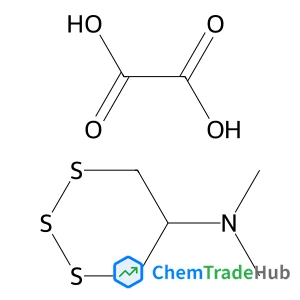
Oxalic acid compound with cyclohexylsulfamothioic O-acid (11)
CAS Number:
31895-22-4
Molecular Formula:
C7H13NO4S3
Recommended Suppliers




Disclaimer
This page provides academic journal information for reference and research purposes only. We are not affiliated with any journal publishers and do not handle publication submissions. For publication-related inquiries, please contact the respective journal publishers directly.
If you notice any inaccuracies in the information displayed, please contact us at support@chemtradehub.com. We will promptly review and address your concerns.