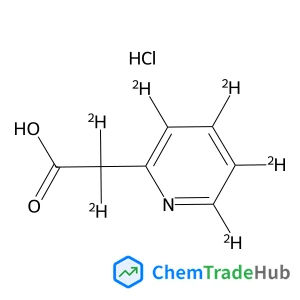
2,2-dideuterio-2-(3,4,5,6-tetradeuterio-2-pyridyl)acetic acid;hydrochloride
CAS Number:
1329799-67-8
Molecular Formula:
C7H2ClD6NO2
Alejandro L. Cardona, María B. Blanco, Mariano A. Teruel, Oscar N. Ventura
The addition mechanism of the OH-initiated oxidation of allyl methyl sulfide (AMS) under atmospheric conditions was studied theoretically using both density functional theory (DFT) and the SVECV-f12 composite method. We found that the addition does not occur directly but rather through a pre-reactive complex that serves as a previous stage for addition at both the C1 and C2 positions. However, based on thermodynamics the addition at C2 possibly occurs by branching of the C1 addition mechanism. Once the addition proceeds, the reaction with O2 under atmospheric conditions produces RO2 radicals that can decompose in multiple ways. Complex mechanisms of intramolecular rearrangement and decomposition both in the absence and presence of NOx have been examined. The thermodynamically most favourable decomposition paths produce 2-hydroxy-acetaldehyde, 2-methyl-thio-acetaldehyde, formaldehyde, and the methyl thiomethyl peroxy (MSP) intermediate. This latter species is proposed as the main source of sulfur dioxide (SO2), which is the product found in the highest yield during the experimental determinations.
Marc Guerre, Bruno Ameduri, Vincent Ladmiral
DOI: 10.1039/C5PY01651G
Vu H. Dao, Kei Saito
DOI: 10.1039/C5PY01572C
Zicheng Ding, Chuandong Dou, Jun Liu, Lixiang Wang
DOI: 10.1039/C5PY01389E
James Gardiner, Ivan Martinez-Botella, John Tsanaktsidis, Graeme Moad
DOI: 10.1039/C5PY01382H
Yusuke Ogura, Takaya Terashima, Mitsuo Sawamoto
DOI: 10.1039/C7PY00073A
Li-Yang Lin, Po-Chiao Huang, Deng-Jie Yang, Jhen-Yan Gao, Jin-Long Hong
DOI: 10.1039/C5PY01485A
Khooi Y. Tan, Madeleine Ramstedt, Wilhelm T. S. Huck
DOI: 10.1039/C5PY01687H
Dawei Chen, Dongxia Wu, Guochen Cheng, Hanying Zhao
DOI: 10.1039/C5PY01299F
Paul H. M. Van Steenberge, Pieter Derboven, Marie-Françoise Reyniers, Guy B. Marin
DOI: 10.1039/C5PY01069A
4-Nitrophenyl phosphate disodium salt hexahydrate is primarily used as a substra...
2-(Trifluoromethyl)-1,3-oxazole-4-carboxylic Acid (CAS: 1060816-01-4) is widely ...
2-Fluoro-4-biphenylcarboxylic acid should be stored in a cool, dry place at room...
Prednisolone-21-Carboxylic Acid is primarily used in the pharmaceutical industry...
4-(Hydrazinomethyl)-1,2,3-benzenetriol (CAS: 3614-72-0) should be stored in a co...
4-Amino-1-methyl-1H-pyrazole-5-carboxylic acid hydrochloride (CAS: 92534-70-8) i...
Dehydropachymic acid (CAS: 77012-31-8) is regulated by various agencies. It fall...
The market and research trends for 6-[(2,2-Dimethylpropanoyl)amino]nicotinic aci...
1,10-Phenanthroline-2,9-dicarbaldehyde should be stored in a cool, dry place awa...
5-Carbamoyl-11-oxo-10,11-dihydro-5H-dibenzo[b,f]azepin-10-yl acetate can be synt...