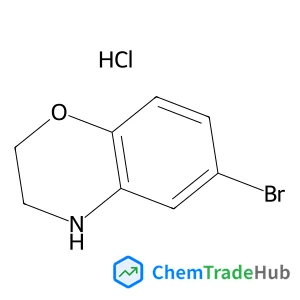
6-Bromo-3,4-dihydro-2H-1,4-benzoxazine hydrochloride (1:1)
CAS Number:
1260803-10-8
Molecular Formula:
C8H9BrClNO
Weiqiang Sun, Xueli Cui, Jing Qu, Xiaojia Cai, Jinhui Hu, Zhuang Xiong, Suqin Guo, Wen-Hua Chen, Jia-Qiang Wu
This paper reports a practical and versatile oxidative cyclization of 2-arylethynylanilines towards 2-hydroxy-2-substituted indol-3-ones via a copper-catalyzed radical approach in the presence of O2. The transformation of 2-hydroxy-2-arylindol-3-ones to 3-hydroxy-3-arylindol-2-ones proceeds well with good yields and highlights the practicability and utility of this catalytic system. Mechanistic investigations showed that the acetyl substituent on 2-arylaethynylanilines played an important role in the formation of the cyclic products and the reaction proceeded via an N-center radical-based 5-endo-dig aza-cyclization pathway.
Subrata Chattopadhyay, Elisabeth Heine, Ahmed Mourran, Walter Richtering, Helmut Keul, Martin Möller
DOI: 10.1039/C5PY01566A
N. J. W. Penfold, J. R. Lovett, N. J. Warren, P. Verstraete, J. Smets, S. P. Armes
DOI: 10.1039/C5PY01510C
Mei Tan, Yulin Cui, Aidi Zhu, Han Han, Mingyu Guo, Ming Jiang
DOI: 10.1039/C5PY01073J
Zicheng Ding, Chuandong Dou, Jun Liu, Lixiang Wang
DOI: 10.1039/C5PY01389E
Vasilios Tsanaktsis, Zoe Terzopoulou, Dimitrios N. Bikiaris, Dimitris S. Achilias, Dimitrios G. Papageorgiou, George Z. Papageorgiou
DOI: 10.1039/C5PY01367D
Alexander S. Shaplov, Sofia M. Morozova, Elena I. Lozinskaya, Petr S. Vlasov, Andreia S. L. Gouveia, Liliana C. Tomé, Isabel M. Marrucho, Yakov S. Vygodskii
DOI: 10.1039/C5PY01553G
Tao Zhang, Yunhao Du, Jana Kalbacova, René Schubel, Raul D. Rodriguez, Tao Chen, Dietrich R. T. Zahn, Rainer Jordan
DOI: 10.1039/C5PY01274K
Ankit Vora, Rudy J. Wojtecki, Kristin Schmidt, Anindarupa Chunder, Joy Y. Cheng, Alshakim Nelson, Daniel P. Sanders
DOI: 10.1039/C5PY01846C
4-Nitrophenyl phosphate disodium salt hexahydrate is primarily used as a substra...
2-(Trifluoromethyl)-1,3-oxazole-4-carboxylic Acid (CAS: 1060816-01-4) is widely ...
2-Fluoro-4-biphenylcarboxylic acid should be stored in a cool, dry place at room...
Prednisolone-21-Carboxylic Acid is primarily used in the pharmaceutical industry...
4-(Hydrazinomethyl)-1,2,3-benzenetriol (CAS: 3614-72-0) should be stored in a co...
4-Amino-1-methyl-1H-pyrazole-5-carboxylic acid hydrochloride (CAS: 92534-70-8) i...
Dehydropachymic acid (CAS: 77012-31-8) is regulated by various agencies. It fall...
The market and research trends for 6-[(2,2-Dimethylpropanoyl)amino]nicotinic aci...
1,10-Phenanthroline-2,9-dicarbaldehyde should be stored in a cool, dry place awa...
5-Carbamoyl-11-oxo-10,11-dihydro-5H-dibenzo[b,f]azepin-10-yl acetate can be synt...

ChemComm publishes urgent research which is of outstanding significance and interest to experts in the field, while also appealing to the journal’s broad chemistry readership. Our communication format is ideally suited to short, urgent studies that are of such importance that they require accelerated publication. Our scope covers all topics in chemistry, and research at the interface of chemistry and other disciplines (such as materials science, nanoscience, physics, engineering and biology) where there is a significant novelty in the chemistry aspects. Major topic areas covered include: Analytical Chemistry Catalysis Chemical Biology and medicinal chemistry Computational Chemistry and Machine Learning Energy and sustainable chemistry Environmental Chemistry Green Chemistry Inorganic Chemistry Materials Chemistry Nanoscience Organic Chemistry Physical Chemistry Polymer Chemistry Supramolecular Chemistry