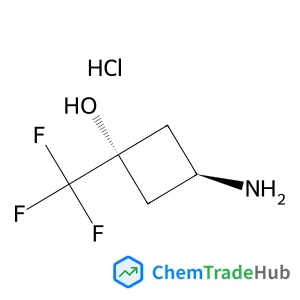
cis-3-Amino-1-(trifluoromethyl)cyclobutanol hydrochloride (1:1)
CAS Number:
1408075-16-0
Molecular Formula:
C5H9ClF3NO
Zhengxin Yu, Weijie Guo, Shrey Patel, Hong-Jun Cho, Liang Sun
The misfolded proteins or polypeptides commonly observed in neurodegenerative diseases, including Alzheimer's disease (AD), are promising drug targets for developing therapeutic agents. To target the amyloid-β (Aβ) peptide plaques and oligomers, the hallmarks of AD, we have developed twelve amphiphilic small molecules with different hydrophobic and hydrophilic fragments. In vitro fluorescence binding assays demonstrate that these amphiphilic compounds show high binding affinity to both Aβ plaques and oligomers, and six of them exhibit selective binding toward Aβ oligomers. These amphiphilic compounds can also label the Aβ species in the brain sections of transgenic AD mice, as shown by immunostaining with an Aβ antibody. Molecular docking studies were performed to obtain structure–affinity relationships. To our delight, four amphiphilic compounds can alleviate the Cu2+–Aβ induced toxicity in cell viability assays. In addition, confocal fluorescence imaging studies provide evidence that two compounds, ZY-15-MT and ZY-15-OMe, can disrupt the interactions between Aβ oligomers and human neuroblastoma SH-SY5Y cell membranes. Overall, these studies strongly suggest that developing compounds with amphiphilic properties that target Aβ oligomers and modulate the Aβ oligomer–cell membrane interactions can be an effective strategy for the development of small molecule AD therapeutics.

Current Medicinal Chemistry

Diamond and Related Materials

Composite Interfaces

Computational Materials Science

Journal of Computer-Aided Molecular Design

Bio-Medical Materials and Engineering

Cement and Concrete Composites

Advanced Composite Materials

Advances in Cement Research

Construction and Building Materials
Mahesh Potnuru, Nandita Madhavan
DOI: 10.1039/C5PY01313E
Yusheng Qin, Lijun Qiao, Yuyang Miao, Xianhong Wang, Fosong Wang
DOI: 10.1039/C5PY01338K
Dakota J. Suchyta, Robert J. Soto, Mark H. Schoenfisch
DOI: 10.1039/C7PY00123A
Tao Zhang, Yunhao Du, Jana Kalbacova, René Schubel, Raul D. Rodriguez, Tao Chen, Dietrich R. T. Zahn, Rainer Jordan
DOI: 10.1039/C5PY01274K
Ilka E. Paulus, Andreas Greiner
DOI: 10.1039/C5PY01343G
Vasilios Tsanaktsis, Zoe Terzopoulou, Dimitrios N. Bikiaris, Dimitris S. Achilias, Dimitrios G. Papageorgiou, George Z. Papageorgiou
DOI: 10.1039/C5PY01367D
H. Park, S. Walta, R. R. Rosencrantz, A. Körner, C. Schulte, L. Elling, W. Richtering, A. Böker
DOI: 10.1039/C5PY00797F
Xu Zhi, Jingjing Liu, Zhenjiang Li, Huiying Wang, Xin Wang, Saide Cui, Cheng Chen, Chengxu Zhao, Xiaopei Li, Kai Guo
DOI: 10.1039/C5PY01315A
N. J. W. Penfold, J. R. Lovett, N. J. Warren, P. Verstraete, J. Smets, S. P. Armes
DOI: 10.1039/C5PY01510C
Mingming Zhou, Fan Lu, Xiaomei Jiang, Qingshi Wu, Aiping Chang, Weitai Wu
DOI: 10.1039/C5PY01441G
4-Nitrophenyl phosphate disodium salt hexahydrate is primarily used as a substra...
2-(Trifluoromethyl)-1,3-oxazole-4-carboxylic Acid (CAS: 1060816-01-4) is widely ...
2-Fluoro-4-biphenylcarboxylic acid should be stored in a cool, dry place at room...
Prednisolone-21-Carboxylic Acid is primarily used in the pharmaceutical industry...
4-(Hydrazinomethyl)-1,2,3-benzenetriol (CAS: 3614-72-0) should be stored in a co...
4-Amino-1-methyl-1H-pyrazole-5-carboxylic acid hydrochloride (CAS: 92534-70-8) i...
Dehydropachymic acid (CAS: 77012-31-8) is regulated by various agencies. It fall...
The market and research trends for 6-[(2,2-Dimethylpropanoyl)amino]nicotinic aci...
1,10-Phenanthroline-2,9-dicarbaldehyde should be stored in a cool, dry place awa...
5-Carbamoyl-11-oxo-10,11-dihydro-5H-dibenzo[b,f]azepin-10-yl acetate can be synt...

Our journal has a wide-ranging scope which covers the full breadth of the chemical sciences. The research we publish contains the sorts of novel ideas, challenging questions and progressive thinking that bring undiscovered breakthroughs within reach. Your paper could focus on a single area, or cross many. It could be beyond the accepted bounds of the chemical sciences. It might address an immediate challenge, contribute to a future breakthrough or be wholly conceptual. We’re a team from every field of the chemical sciences, and know from experience that breakthroughs that drive the solutions to global challenges can come from anywhere, at any time. You could even start an entirely new area of research. Too bold? Too progressive? No such thing