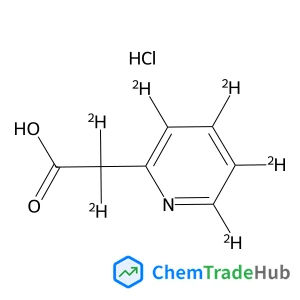
2,2-dideuterio-2-(3,4,5,6-tetradeuterio-2-pyridyl)acetic acid;hydrochloride
CAS Number:
1329799-67-8
Molecular Formula:
C7H2ClD6NO2
Yu-Jie Zhang, Zhi-Rong Tan, Yu-Qin Xing, Zhengwang Chen, Jia-Bin Qiu, Shi-Yong Liu
2-Styrylthiophene-based donor–acceptor linear conjugated polymers with tunable cyano substituents are atom-economically obtained via direct C–H arylation for platinum-free photocatalytic hydrogen production, affording a HER of up to 9.79 mmol h−1 g−1.
Ling-Bao Xing, Xiao-Jun Wang, Jing-Li Zhang, Ziyan Zhou, Shuping Zhuo
DOI: 10.1039/C5PY01741F
Haotian Du, Min Zeng, Long Pan, Tommy Fang, Xuming Xie, Yen Wei, Jinying Yuan
DOI: 10.1039/C7PY00214A
Yan-Shuang Xu, Dong Shi, Jun Gu, Zhen Lei, He-Lou Xie, Ti-Peng Zhao, Shuang Yang, Er-Qiang Chen
DOI: 10.1039/C5PY01508A
J. Areephong, J. W. Kramer, H. A. Sprafke
DOI: 10.1039/C5PY01563D
Yusheng Qin, Lijun Qiao, Yuyang Miao, Xianhong Wang, Fosong Wang
DOI: 10.1039/C5PY01338K
Ning Zhu, Xin Hu, Yajun Zhang, Kai Zhang, Zhenjiang Li, Kai Guo
DOI: 10.1039/C5PY01728A
Subrata Chattopadhyay, Elisabeth Heine, Ahmed Mourran, Walter Richtering, Helmut Keul, Martin Möller
DOI: 10.1039/C5PY01566A
DooLi Kim, Suzana Pereira Nunes
DOI: 10.1039/C5PY01344E
Yeonkyung Lee, Lydia Braun, Wan Ki Bae, Kookheon Char, Changhee Lee, Rudolf Zentel
DOI: 10.1039/C5PY01492A
4-Nitrophenyl phosphate disodium salt hexahydrate is primarily used as a substra...
2-(Trifluoromethyl)-1,3-oxazole-4-carboxylic Acid (CAS: 1060816-01-4) is widely ...
2-Fluoro-4-biphenylcarboxylic acid should be stored in a cool, dry place at room...
Prednisolone-21-Carboxylic Acid is primarily used in the pharmaceutical industry...
4-(Hydrazinomethyl)-1,2,3-benzenetriol (CAS: 3614-72-0) should be stored in a co...
4-Amino-1-methyl-1H-pyrazole-5-carboxylic acid hydrochloride (CAS: 92534-70-8) i...
Dehydropachymic acid (CAS: 77012-31-8) is regulated by various agencies. It fall...
The market and research trends for 6-[(2,2-Dimethylpropanoyl)amino]nicotinic aci...
1,10-Phenanthroline-2,9-dicarbaldehyde should be stored in a cool, dry place awa...
5-Carbamoyl-11-oxo-10,11-dihydro-5H-dibenzo[b,f]azepin-10-yl acetate can be synt...

ChemComm publishes urgent research which is of outstanding significance and interest to experts in the field, while also appealing to the journal’s broad chemistry readership. Our communication format is ideally suited to short, urgent studies that are of such importance that they require accelerated publication. Our scope covers all topics in chemistry, and research at the interface of chemistry and other disciplines (such as materials science, nanoscience, physics, engineering and biology) where there is a significant novelty in the chemistry aspects. Major topic areas covered include: Analytical Chemistry Catalysis Chemical Biology and medicinal chemistry Computational Chemistry and Machine Learning Energy and sustainable chemistry Environmental Chemistry Green Chemistry Inorganic Chemistry Materials Chemistry Nanoscience Organic Chemistry Physical Chemistry Polymer Chemistry Supramolecular Chemistry